 NexGPU-算力租赁,GPU服务器,GPU云算力,AI服务器租用-新闻博客
When you deploy a 70B model to an inference service and find that a single GPU doesn't have enough memory, and multi-GPU communication hurts latency, what you really need to compare isn't the compute numbers of H100 vs H200, but the difference in their memory subsystems. The core conclusion of the H100 vs H200 inference performance comparison is that their compute power is identical; the gap lies entirely in memory capacity and bandwidth—H200's 141GB HBM3e and 4.8TB/s bandwidth give it a throughput advantage in large-model, long-context, high-concurrency scenarios, while for small models and short contexts, the difference is negligible.
Same Core, Same Compute: What 3,958 TFLOPS FP8 Means
Here's a counterintuitive fact: the NVIDIA H200 and H100 SXM use exactly the same Hopper architecture GH100 core and 4th-gen Tensor Cores, with identical FP8 peak compute of 3,958 TFLOPS and the same 900 GB/s NVLink bandwidth. This directly answers the question "Are H100 and H200 compute the same?"—yes, the compute is exactly the same; the H200 is not a compute upgrade. This means that in the Prefill phase, the H200 has no advantage whatsoever.
| Parameter | H100 SXM | H200 SXM |
|---|---|---|
| Architecture Core | GH100 (Hopper) | GH100 (Hopper) |
| FP8 Peak Compute | 3,958 TFLOPS | 3,958 TFLOPS |
| Memory Capacity | 80GB HBM3 | 141GB HBM3e |
| Memory Bandwidth | 3.35 TB/s | 4.8 TB/s |
| NVLink Bandwidth | 900 GB/s | 900 GB/s |
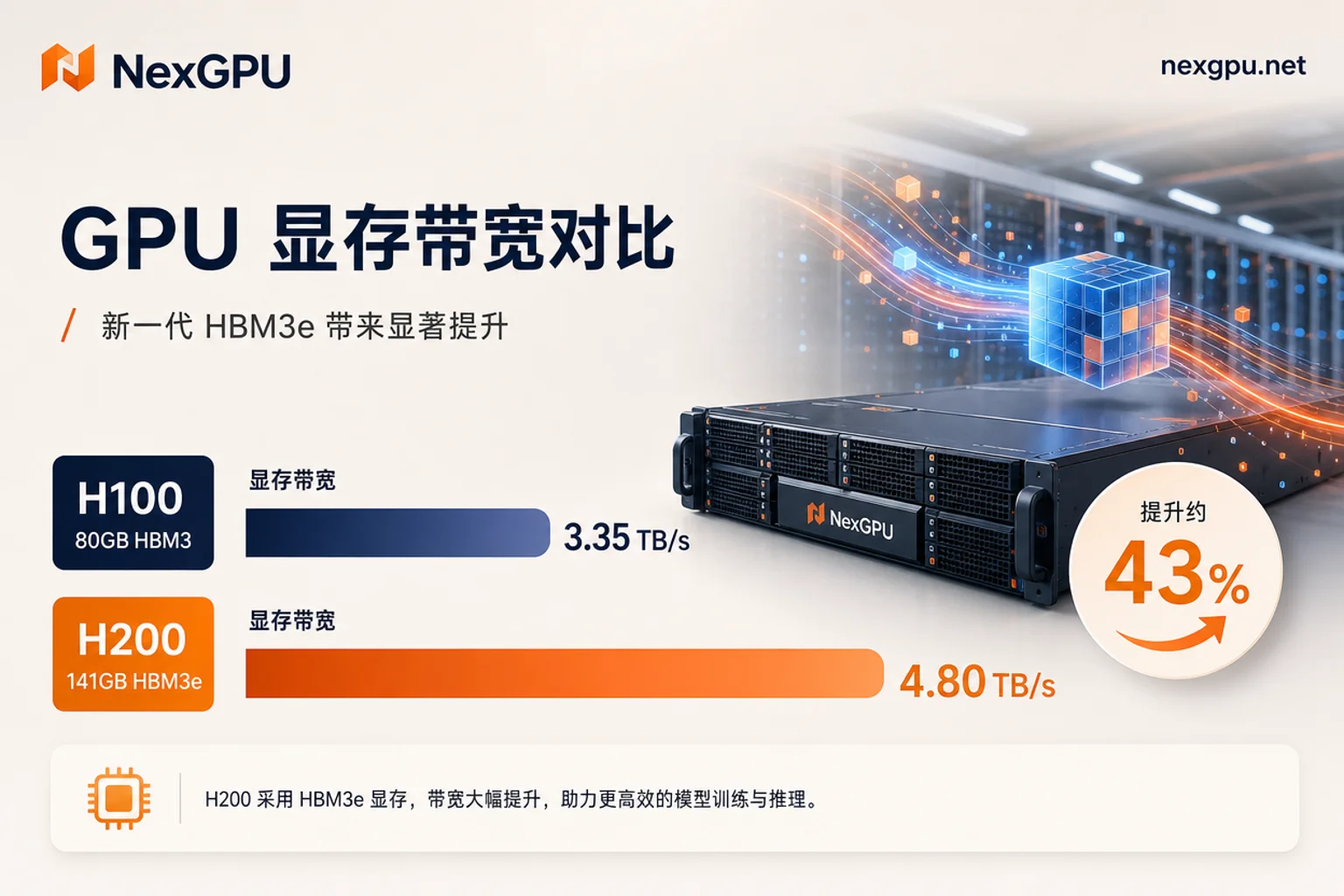
The Real Variables: 141GB vs 80GB, 4.8 TB/s vs 3.35 TB/s—Which Workloads Do They Change?
Since compute is identical, performance differences come entirely from the memory subsystem: memory capacity increases 76% (80GB→141GB), and bandwidth increases 43% (3.35 TB/s→4.8 TB/s). These two numbers affect different parts of the workload:
- Capacity determines whether model weights and KV Cache fit entirely on a single GPU. A 70B FP16 model needs about 140GB, so the H100's 80GB requires multi-GPU parallelism, while the H200's 141GB can handle it on a single card.
- Bandwidth determines how fast the full weights and KV Cache can be moved into the cores during the token-by-token generation phase (Decode).
So, the answer to "What's the use of 4.8TB/s bandwidth on H200?" is: it directly alleviates the memory-bound bottleneck in the Decode phase, improving per-token generation speed (TPOT).
Memory-bound vs Compute-bound: How to Tell Which One Your Inference Falls Into
To determine whether your inference is compute-bound or bandwidth-bound, you need to understand the two phases of LLM inference:
- Prefill (input processing): Parallel matrix multiplication, high arithmetic intensity, compute-bound. Here, H100 and H200 have nearly identical time-to-first-token (TTFT).
- Decode (token-by-token generation): Each generated token requires loading all weights and KV Cache into the cores, with very low arithmetic intensity, making it memory-bound. Here, the H200's advantages come into play.
In practice, workloads are usually a mix of both. You can self-check in the following order:
- Measure average input and output lengths: if output length is much larger than input, Decode dominates, and bandwidth is likely the bottleneck.
- Observe the concurrent batch size: large batches amplify bandwidth demand, making it more likely to be memory-bound.
- Monitor peak KV Cache usage: when close to the memory limit, capacity becomes crucial.
- Measure TTFT and TPOT: if TTFT is slow but TPOT is fast, it's compute-bound; the reverse indicates bandwidth-bound.
How Much Faster Is H200 than H100: 30%~90% Improvement Under What Conditions?
Regarding the quantified H100 vs H200 inference performance comparison: the often-cited claim that H200 is 30%~90% faster than H100 only holds under specific conditions. In memory-bound scenarios like 70B+ large models, high concurrency, and long-context output (high KV Cache usage), the H200 can achieve 30%~90% throughput gains (MLPerf throughput can be 1.4x~1.9x).
But with small models (e.g., 7B/8B), small batch sizes, or prefill-bound scenarios with very long prompts, the H200's throughput gain approaches zero, and given its higher rental cost, it may not be cost-effective.
| Workload Characteristics | Expected Improvement | Bottleneck Type |
|---|---|---|
| 70B+ model, large batch, long context | 30%~90% | Memory-bound (bandwidth) |
| 7B/8B model, small batch, short context | ~0% | Compute-bound (compute) |
| Very long prompt, short output | ~0% | Compute-bound (Prefill) |
The Hidden Benefit of Simplified Topology: Eliminating TP Communication Overhead by Fitting 70B FP16 on a Single GPU
A 70B FP16 model requires about 140GB of VRAM. The H100's 80GB cannot load it on a single GPU; it must be deployed with tensor parallelism (TP=2/4) across multiple GPUs. In contrast, the H200's 141GB HBM3e allows single-GPU deployment, completely eliminating the network overhead and topology complexity of cross-GPU communication (All-Reduce). For tuning details in multi-GPU scenarios, refer to multi-GPU inference optimization. This means the answer to "Is dual H100 or single H200 better for running 70B?" is clear: if it fits on one GPU, the single-GPU solution is usually better because it avoids communication latency and operational complexity.
Is H200 Worth the Extra Cost Compared to H100? The Break-Even Condition for Cost per Million Tokens
To decide if "H200 is worth paying more than H100," don't just look at the unit price; look at the cost per token. The method: under the same workload, measure the throughput multiplier of H200 relative to H100, then divide by the rental cost multiplier of H200—if the quotient is greater than 1, the H200 can amortize the cost per million tokens; if it's near 1 or less, the premium is unlikely to pay off. Specific rental rates should be based on cloud providers' public pricing pages; this article doesn't cite any numbers, but the criterion (throughput multiplier ÷ rental cost multiplier) is universal.
When to Stick with H100, When to Switch to H200, and When Neither Is Necessary
Based on your workload profile, decisions can be divided into three categories:
- Stay with H100: If you mainly run 7B/8B small models with low concurrency and short contexts, the H100 is more than sufficient; you won't notice a difference with H200.
- Switch to H200: If you need to deploy 70B+ models with high concurrency and long contexts (e.g., Q&A, summarization, Agents), the H200's capacity and bandwidth advantages significantly improve TPOT and throughput.
- Choose neither: If your workload is purely offline batch processing or prefill-intensive, compute is the bottleneck; you should focus on price per FLOP rather than generational GPU upgrades.
These decisions should be based on real measurements. Platforms like NexGPU, which offer per-second billing and flexible GPU choices, allow you to run hour-long validation tests first.
Using On-Demand Resources for a Same-Workload Comparative Test: What Metrics to Record
Armchair reasoning is no substitute for real testing. Before committing to a long-term setup, we recommend running a comparative test using on-demand cloud GPU resources. For example, rent both H100 and H200 on NexGPU and run the same model, request distribution, and inference framework (like vLLM) on both. Record the following metrics:
- TTFT (time to first token)
- TPOT (time per output token)
- Concurrent throughput (requests or tokens processed per second)
- Peak KV Cache usage
- Memory bandwidth utilization
By comparing these data points, you can clearly see whether the H200's improvements are real. If you need a multi-GPU setup, you can also refer to the vLLM multi-GPU tensor parallelism configuration guide to ensure correct setup. For more details on selection, How to choose GPU memory provides practical criteria.
Selection Checklist and Three Common Misjudgments
Before making your final decision on the H100 vs H200 inference performance comparison, check your workload against this checklist:
- Is the model parameter count over 70B?
- Is the average output length much larger than the input?
- Does the concurrent request volume exceed the current GPU's capacity?
- Is KV Cache usage close to the memory limit?
- Have you already measured TTFT and TPOT?
Also, avoid three common misjudgments:
- Treating H200 as a compute upgrade: Their compute power is identical; H200 improves bandwidth and capacity, not peak compute.
- Concluding H200 is worthless based on small-batch, short-context tests: If the test workload isn't in the bandwidth-bound range, you naturally won't see a difference.
- Ignoring multi-GPU TP communication overhead: Although dual H100s have higher paper compute, communication overhead may negate the advantage, making a single H200 often superior.
FAQ
Are H100 and H200 compute the same?
Yes, the H200 and H100 SXM use the exact same GH100 core, with identical FP8 peak compute of 3,958 TFLOPS and the same 900 GB/s NVLink bandwidth. There's no compute difference; the difference lies entirely in memory capacity and bandwidth.
How much faster is H200 than H100?
In memory-bound scenarios (e.g., 70B models, long contexts, high concurrency), H200 throughput can be 30%~90% higher, with MLPerf up to 1.4x~1.9x. But in compute-bound scenarios (small models, short contexts), the improvement is almost zero.
Can the H200's 141GB memory run a 70B model on a single GPU?
Yes. A 70B FP16 model requires about 140GB, so the H200's 141GB memory can just fit it, enabling single-GPU deployment without multi-GPU communication overhead. The H100's 80GB requires two or four GPUs.
How do I know if my inference is compute-bound or bandwidth-bound?
Check whether average output length is much larger than input, and consider batch size and KV Cache usage. Long output, large batch, and high KV Cache typically indicate a bandwidth bottleneck; otherwise, compute may be the bottleneck. More reliably, measure TTFT and TPOT.
Is H200 worth the extra cost compared to H100?
Only if your workload falls into the memory-bound range does the H200's throughput gain amortize the cost per million tokens. If your workload is prefill-heavy or uses small models, the H200's premium may not pay off. We recommend testing first before deciding.



Comments(0)