 NexGPU-算力租赁,GPU服务器,GPU云算力,AI服务器租用-新闻博客
In the AI field, the iteration speed of DeepSeek models constantly refreshes developers' understanding. However, as projects move from local validation to production delivery, many teams find that the biggest bottleneck is not model capability, but how to balance high compute costs and service stability.
The "Second Half" of Deployment: From "Getting It Running" to "Making It Affordable"
If the early hot topic of DeepSeek deployment was "how to quickly spin up a service," the core issue now is "how to precisely control ROI while ensuring high concurrency." When your business scales, fixed hardware investment often means huge resource waste. At this point, the "hourly billing, second-level metering" model advocated by NexGPU's GPU marketplace is becoming a new favorite among developers.
Choosing the Right Card is the First Step to Cost Reduction
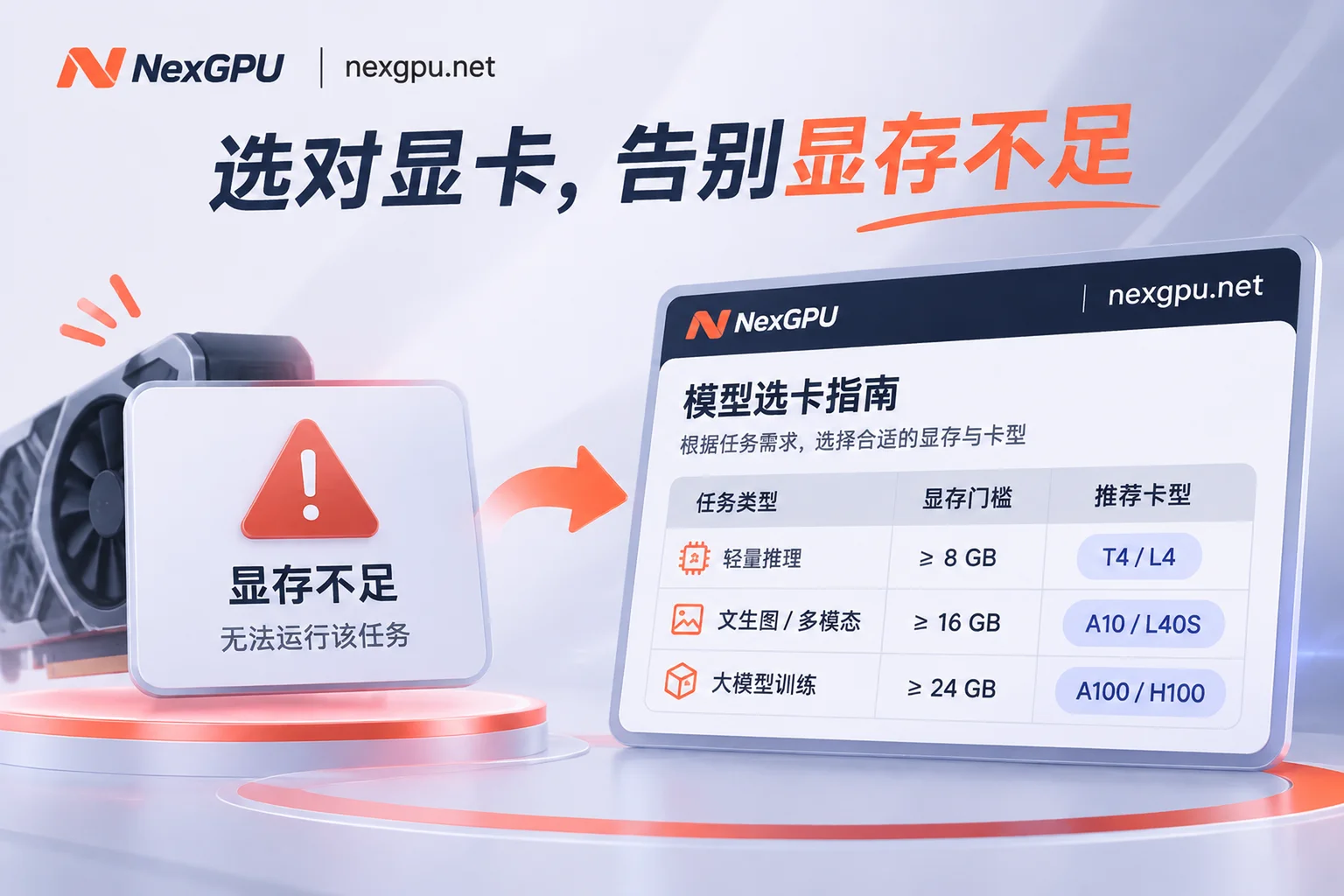
Facing different versions of DeepSeek models, the VRAM threshold is often the first hurdle. Blindly pursuing top-tier H200 may cause serious resource waste, while insufficient VRAM leads to inference errors.
NexGPU provides a highly valuable model selection guide, which directly gives quantized VRAM thresholds and recommended card types for various mainstream open-source models. By comparing the unit price and performance of consumer-grade (e.g., RTX 4090/5090) and data center-grade (e.g., A100/H100) GPUs, you can create the most streamlined hardware configuration for inference tasks.
Say Goodbye to Hassles, Images Are Ready to Use
Many developers spend a lot of time on CUDA environment configuration and driver compatibility troubleshooting during deployment. NexGPU's image templates feature completely abstracts these tedious engineering actions. Whether you want to quickly launch vLLM or Ollama with OpenAI-compatible interfaces, or perform deep fine-tuning with LLaMA Factory, you can load pre-configured environments with one click and use them immediately.
In addition, for developers with special CUDA version dependencies, NexGPU also supports importing custom Docker images, ensuring high controllability of the production environment.
Elasticity and Control: Your Compute, Your Rules
In a recent analysis article, we mentioned the breakdown of compute bills. In NexGPU's instance management, this transparency is taken to the extreme:
- Cost transparency: Compute, storage, and traffic are clearly separated. When an instance is stopped, compute billing stops, truly achieving "pay for what you use."
- Persistent environment: Stopping an instance retains the disk, so data is not lost, and you can restart anytime.
- Minimal O&M: Built-in web terminal, direct SSH access, and one-click installable visual panels make remote management as smooth as local operations.
For teams that need to build large-scale inference clusters or handle high-concurrency businesses, NexGPU also offers multi-GPU nodes and enterprise solutions. By supporting architectures like DeepSpeed and FSDP, it helps you smoothly transition from single-machine inference to clusters with tens of thousands of GPUs.
Conclusion
DeepSeek deployment should not be a burden for creators and beginners. With the flexibility and cost-effective compute provided by the NexGPU official website, you can focus more on tuning the model's performance rather than underlying hardware maintenance.
Start evaluating your compute needs now, refer to the scenario practices page to find a solution that suits you, and embark on an efficient AI productivity journey.



