 NexGPU-算力租赁,GPU服务器,GPU云算力,AI服务器租用-新闻博客
Many teams are still running inference on H100, thinking the hourly rate is sufficient. But when calculating token costs, the new generation Blackwell has quietly widened the gap. It's not just about swapping cards; it's about combining native FP4 throughput in hardware with continuous iteration of the inference software stack, allowing the same budget to produce more tokens. Cloud elastic rental is ideal for small and medium teams to test the waters without a hefty upfront investment in full machines.
Let's first look at hardware-level changes. Blackwell GPUs like the B200 bring 192GB-class memory and higher bandwidth, significantly boosting throughput for large models at FP4 precision. Industry data comparisons show that for 70B-class models, FP4 mode yields far more tokens per unit time than H100's FP8, and even if the hourly rate per card is slightly higher, the cost per million tokens can drop to a third or even lower. The advantage is even more pronounced for large batches, long contexts, and MoE architectures—with ample memory, a single card can hold models that previously required multi-card splitting, reducing communication overhead. Recently, some inference cloud data centers have deployed thousands of B300s specifically for production-grade inference, indicating that supply is increasing and availability is no longer a bottleneck.
But what truly drives costs down continuously is software. Hardware deployment is just the starting point. The inference software stack continues to optimize after deployment: runtimes, kernels, routing, and cache management iterate together. Official data shows that within just one month of Blackwell's launch, software optimizations for specific models boosted performance by up to 5x, compressing token costs to about one-fifth. The entire software stack can even deliver a 20x throughput improvement. Several leading teams are already using this stack to run DeepSeek series, long-context inference, and coding assistants: some have pushed tokens/sec up by 50%, others achieved a 30% throughput increase while maintaining sub-second time-to-first-token, and some use specialized frameworks to manage the lifecycle of reinforcement learning inference engines. These aren't lab numbers; they're production deployments.
Breaking it down, the key optimizations are highly practical. Prefill and decode phases have completely different resource requirements; splitting them onto separate GPU pools for independent scheduling avoids resource contention. Smart KV cache routing lets multi-turn conversations hit cached GPUs directly, avoiding recomputation. Caching can also be offloaded to CPU or disk, freeing up precious GPU memory. A planner dynamically adjusts GPU pools based on actual traffic patterns. These optimizations are effective even on clusters as small as 2 GPUs and even more so on larger ones. Open-source inference engines can integrate with them, so teams don't need to start from scratch.
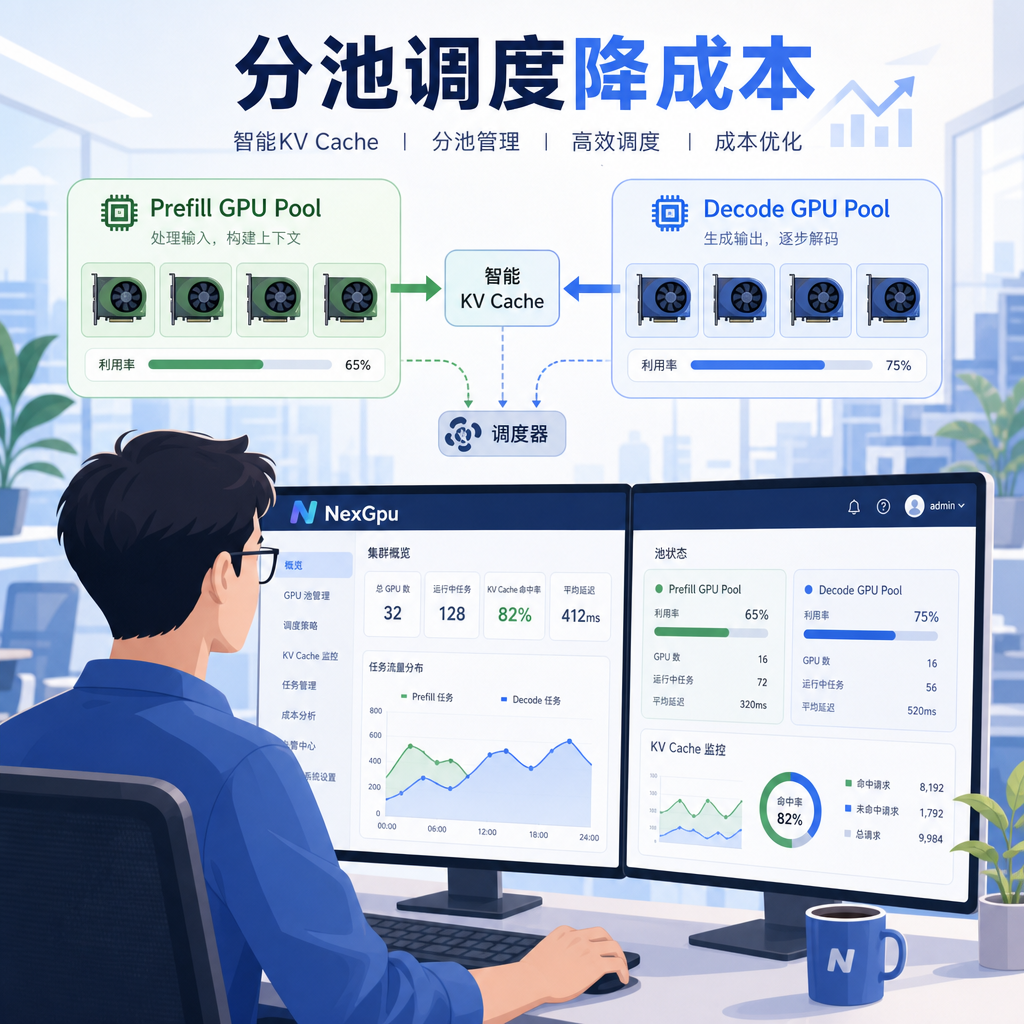
How do you get started in the cloud? Don't lock into a long-term commitment right away. Use on-demand elastic instances to test your own models: with the same code, first measure baseline tokens/sec and cost on H100, then switch to Blackwell to compare FP4/FP8. Focus on long-context and multi-turn agent scenarios—these are most sensitive to KV and scheduling, offering the biggest gains. Monitor utilization not just GPU occupancy, but token throughput, time-to-first-token, and P99 tail latency. If traffic has clear peaks and valleys, elastic scaling can save significant costs; if it's near 7x24 full load, consider a hybrid on-prem solution.
Common pitfalls abound. First, focusing only on hourly rate and ignoring throughput differences can result in higher token costs. Second, lack of framework updates—still using old serving versions without disaggregated and KV-aware routing—wastes half the hardware potential. Third, rigid memory planning—Blackwell's large memory could handle it on a single card, but teams stick to old multi-card splitting, adding unnecessary latency. Fourth, neglecting continuous optimization—deploying and then forgetting, missing out on free speedups from subsequent software updates.
For small and medium teams, cloud rental flexibility matches this stage perfectly. You can spin up instances with the latest Blackwell whenever needed, shut down after testing or when traffic drops, without bearing idle risk. Platforms like NexGpu offer on-demand cloud GPU rental, making it easy to switch between different GPU generations, run A/B comparisons, and scale elastically—ideal for validating FP4 benefits and software stack efficiency. Once business stabilizes and utilization consistently rises, consider supplementing with local desktop supercomputers—new desktop systems can run trillion-parameter models, suitable for persistent agents or dev iteration, while the cloud handles spikes and large-scale inference.
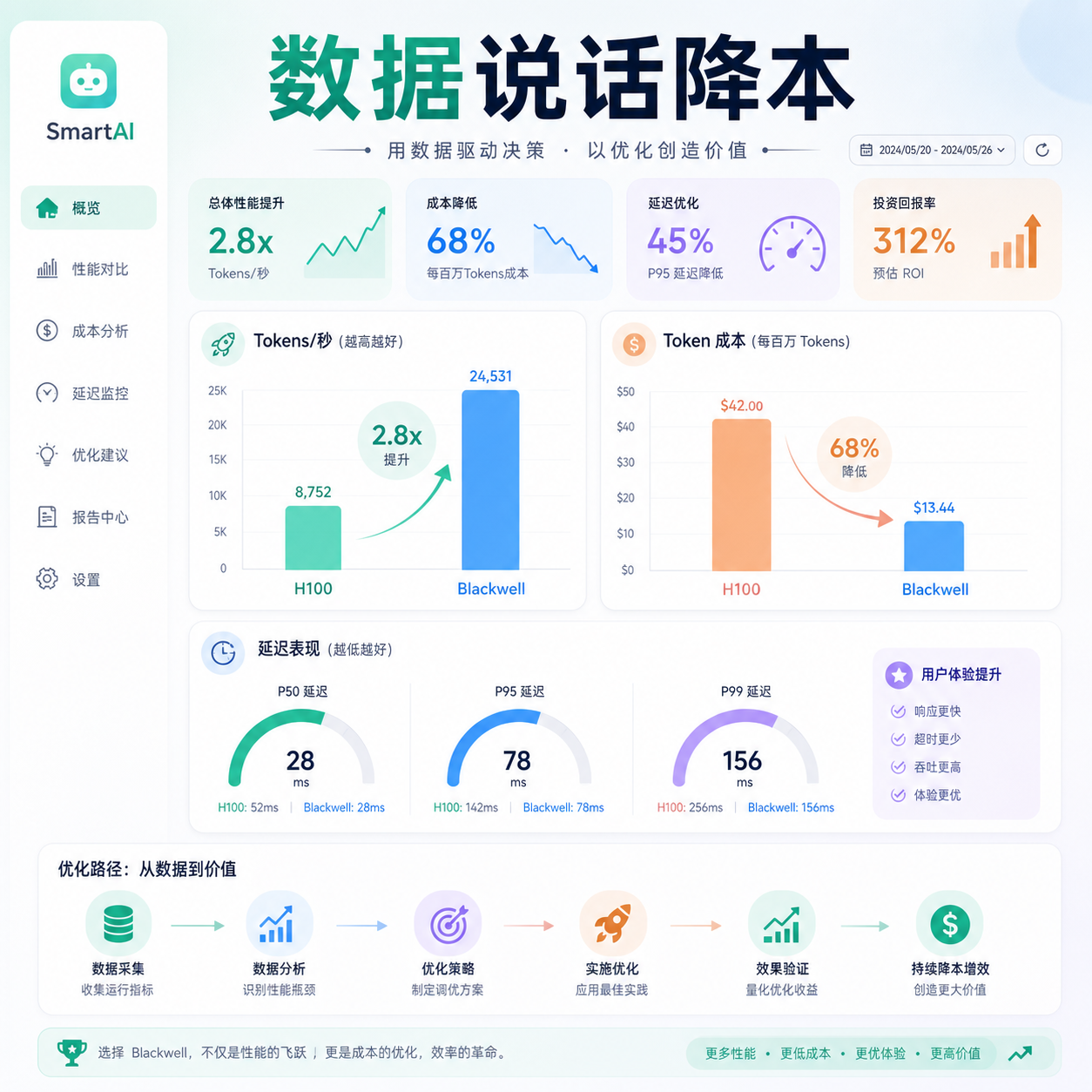
When choosing, remember the core question: is your GPU working or waiting? If you have many spikes and fast iteration, prioritize cloud elasticity; stable high loads then justify self-hosting. The Blackwell + software stack combo turns "continue to reduce costs after deployment" into reality. Start with small cloud instances to run your own model path, calculate real token costs, then decide on scaling. Let data speak, don't be fooled by hourly rates.
Practical steps: First, pick a core inference workload and record your current H100 tokens/sec, cost, and latency baselines. Second, switch to a Blackwell instance, enable the latest inference software stack and FP4 (if quality is acceptable), and compare output speed and total cost under the same inputs. Third, integrate disaggregated scheduling and KV routing, and observe improvements in multi-turn agent scenarios. The whole process is done via cloud elasticity, keeping costs controlled. After validation, plan production traffic migration.
Market supply is improving, price ranges are widening, and software continues to iterate. Acting now is more cost-effective than waiting for the "perfect timing." Truly lowering token costs allows teams to spend budgets on models and business rather than pure hardware consumption.


Comments(0)