 NexGPU-算力租赁,GPU服务器,GPU云算力,AI服务器租用-新闻博客
AI video generation has been making waves recently, but many people get a headache when they crunch the numbers. Closed-source models cost millions of dollars to train, and the GPU hours for generating a short video clip remain high. For small and medium teams and entrepreneurs aiming for commercial-grade quality, hardware barriers and operational costs can stall progress. The good news: the open-source route has proven that with fine-grained data filtering, staged training, and high-compression autoencoders, total training costs can be squeezed down to around $200K while still matching top-tier closed-source products in performance.
Open-Sora 2.0 is a prime example. The team completed training using roughly 4,160 GPU hours (estimated at ~$2/hour for H200), keeping total costs just above $200K. In terms of visual quality, prompt adherence, and motion consistency, human preference evaluations show it can match or even surpass some commercial models, and VBench scores have significantly narrowed the gap with leading systems. The key isn't throwing more GPUs at the problem; it's using every bit of compute efficiently.
Let's start with data. They didn't hoard massive amounts of raw video; instead, they built a hierarchical pyramid. Raw footage was first cut into 2-8 second continuous segments, filtering out garbage that was too short, low bitrate, abnormal frame rate, or odd aspect ratio. Then they applied aesthetic scores, motion scores, blur detection, OCR, and jitter detection to progressively refine from ~70M low-quality samples down to 5M high-purity, high-scoring samples. For low-resolution stages, they used a large volume of medium-quality data to build a foundation, while high-resolution stages only used curated data. Captions were also tiered: lower-tier used open-source vision-language models, high-tier upgraded to stronger models, with additional motion scores to control dynamics later. Data preprocessing alone consumed a significant portion of compute, but it boosted training efficiency so much that the overall cost-benefit was positive.
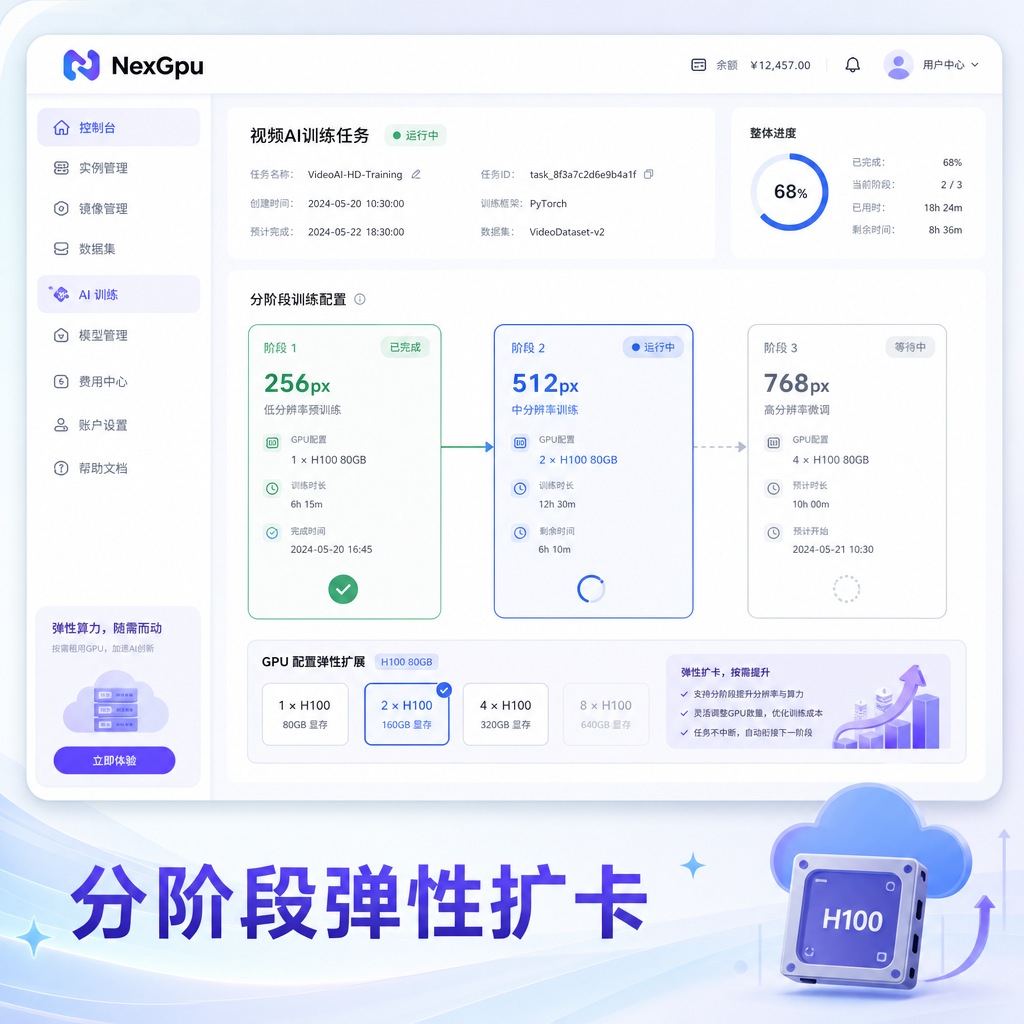
The model architecture is equally detail-oriented. They started with a powerful text-to-image model as a base, then expanded it into a multimodal diffusion Transformer that handles text and visual streams separately, with cross-attention blocks for bidirectional information exchange. The autoencoder was upgraded from the standard 4x8x8 compression to a deeper 4x32x32 Video DC-AE, cutting spatial tokens by more than half. This multiplied training and inference throughput by several times to over tenfold, while reducing memory pressure. Training progresses in three stages: Stage 1 at 256px text-to-video to build foundational capabilities (~2,240 GPU days); Stage 2 switches to image-to-video, focusing on learning motion (~384 GPU days); Stage 3 scales up to 768px, using compressed autoencoders and dynamic guidance strategies for fine-tuning (~1,536 GPU days). Each stage matches data volume and resolution, avoiding hard training on high-res full-scale from the start.
These techniques are especially effective on cloud GPUs. You don't need to buy a bunch of latest cards upfront or set up your own cluster. For experimentation, use mid-range GPUs for small batches, validate data pipelines and low-res prototypes; once direction is confirmed, elastically scale to high-memory GPUs for high-res stages. The current rental market fits this rhythm perfectly.
Recent two-week market data shows H100 on-demand generally around $1.5/hour, with some platforms offering lower spot prices, and prices have been relatively stable. B200 is noticeably more expensive, with the cheapest quotes around $4.5/hour, mainstream range at $4-7, with hyperscalers even higher. Blackwell demand remains tight overall, new cluster delivery times are long, and on-demand often sells out or requires waiting. Older-gen GPU prices have softened, but the scarcity of new cards combined with multimodal loads like agents and video keeps compute tight overall. Price volatility is high, with significant differences by region and billing model—some charge per minute, others per hour, and some force full-node reservations. For small teams, buying GPUs outright leads to losses when utilization drops; elastic cloud allows switching GPU types by stage and turning instances on/off per task.
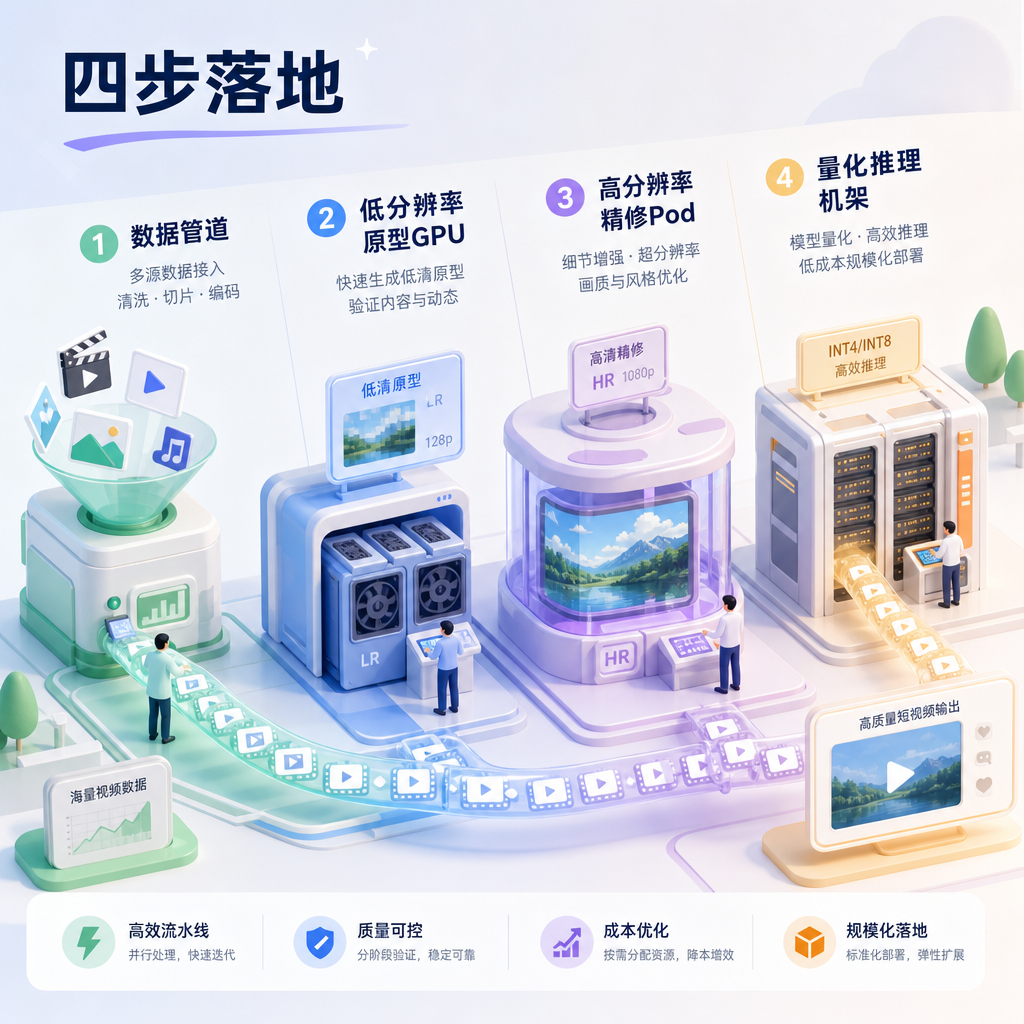
How to implement it practically? First, define target resolution and duration. For the 256px prototype phase, a single or a few A100/H100 GPUs suffice, focusing on validating data filtering pipeline and motion consistency. Don't skimp on data prep: use FFmpeg for scene segmentation, write or use existing tools for scoring and filtering, and batch-generate captions with manual spot-checking for hallucinations. For training frameworks, prioritize support for mixed precision, gradient checkpointing, and efficient data loading to avoid I/O bottlenecks. If training your own autoencoder, prioritize high compression ratio schemes; fewer tokens make the DiT stage much easier.
At the high-resolution stage, memory and interconnect are critical. A B200 192GB can handle larger batches or longer sequences, and FP4/FP8 throughput is a clear advantage, often yielding lower cost per token. But don't jump straight to B200—first get the pipeline working with H100/H200, then migrate. For multi-GPU setups, pay attention to NVLink/InfiniBand configuration and data/model parallelism partitioning; poor NUMA alignment can drop throughput by 30%. Checkpoint frequently and use network drives or object storage for persistence to avoid losing progress if instances are reclaimed. For inference deployment, quantization, PagedAttention, and continuous batching remain effective, with video models additionally requiring attention to temporal dimension caching and dynamic guidance scale adjustments.
Common pitfalls? First, forcing compute on poor data quality leads to models learning noise and artifacts. Second, jumping straight to high-resolution full-scale data blows the budget. Third, ignoring compressed autoencoders causes token explosion that wrecks training speed and memory. Fourth, over-indexing on buying GPUs: early experiments are frequent and direction changes often; cloud rental by hour/minute is more flexible; only consider building your own if you're running at full capacity over 90+ days. Fifth, neglecting billing details like egress traffic, storage, and idle instances, which can quietly inflate your bill.
For teams looking to test the waters quickly, cloud compute platforms like NexGpu fill the elasticity gap. On-demand instances, multi-spec GPU switching, support for training and inference co-location, and validation with cheap GPUs before scaling to high-performance ones—no need to worry about data centers and ops. Data upload, pre-built images, and storage mounting are straightforward, suitable for staged pipelines like Open-Sora. Using NexGpu's elastic scheduling for peak phases and minimizing configuration at other times can squeeze costs further.
Practical recommendations are concrete. Step one: build a data pipeline with 100,000-200,000 high-quality short videos, run filtering and captioning, with preprocessing compute being the main cost. Step two: low-res prototype—rent a few mid-range GPUs, run stages one and two, evaluate motion and prompt alignment. Step three: high-res fine-tuning—switch to high-memory GPUs, use compressed AE and dynamic guidance, focusing on visual consistency and artifacts. Step four: inference optimization—quantization plus serving frameworks, test latency and throughput at different resolutions, then decide whether to upgrade to B200. Throughout, use spot or preemptible instances for non-critical paths and reserved instances for stable training to keep bills controlled.
Video generation compute demand is still rising, but open source plus the cloud has lowered the barrier. $200K isn't small, but compared to million-dollar closed-source training, it's an order-of-magnitude advantage. The key is to integrate data, architecture, training strategy, and cloud resource scheduling rather than simply stacking GPUs. Small teams can start with prototypes, use elastic cloud GPUs to validate business value, and then decide whether to scale. NexGpu provides stable on-demand compute support in such scenarios, helping you spend every dollar on effective iterations. Run small-scale first, then talk about large-scale; with the right pace, the opportunity in video AI is right before you.


Comments(0)