 NexGPU-算力租赁,GPU服务器,GPU云算力,AI服务器租用-新闻博客
The gap isn't a fixed number—it depends on which bottleneck your workload hits
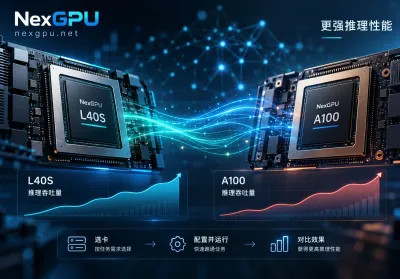
There's no single answer to the L40S vs. A100 inference throughput gap, because large model inference has two phases: Prompt encoding (Prefill) is compute-bound, while Token generation (Decode) is bandwidth-bound. L40S has far lower bandwidth than A100, but higher compute and native FP8 support; it lags by 50–60% in low-concurrency generation tasks, but can catch up or even lead in high-concurrency or long-prompt tasks.
The core contradiction in hardware specs
- Memory bandwidth: A100 80GB (SXM4) offers 2,039 GB/s of HBM2e bandwidth, while L40S 48GB has only 864 GB/s of GDDR6—A100 is about 2.36× L40S.
- Compute: L40S features Ada Lovelace 4th-gen Tensor Cores with 733 TFLOPS FP8 dense compute, while A100's native BF16/FP16 compute is about 312 TFLOPS. L40S is 2.35× A100 (A100 hardware doesn't support FP8).
These two opposing differences determine which is faster in different scenarios.
Low-concurrency token generation: A100 is 2.2–2.4× faster
Autoregressive generation produces one token at a time, requiring the full weights and KV cache to be read from memory to the compute units. In single-user chat, batch size = 1, or very low concurrency, GPU compute sits largely idle and throughput is entirely determined by memory bandwidth.
In this case, A100's decode throughput is about 2.2–2.4× that of L40S, meaning L40S is roughly 50–60% lower than A100 in low-concurrency decode. If your service is a single-user chatbot or low-concurrency API, A100 has a clear advantage in this phase.
High concurrency and continuous batching: L40S catches up or even overtakes
When using inference frameworks like vLLM or SGLang with dynamic batching, and concurrency rises to batch ≥ 8, compute becomes a larger share and the bottleneck shifts from bandwidth to compute. If model weights and KV cache use FP8 quantization, memory transfer pressure is halved, and L40S's high compute advantage begins to show.
In this case, L40S's total throughput can match or even exceed A100. If your service is a high-concurrency API, batch inference, or multi-tenant deployment, and the model supports FP8 (e.g., Llama 3, Mistral series), L40S offers better price-performance.
Prefill phase: L40S is often faster
Prompt encoding is compute-bound, as the model processes the entire input sequence at once. In long-prompt tasks (e.g., document understanding, RAG retrieval, code completion) or short-output scenarios, L40S relies on its FP8 compute advantage, and time-to-first-token (TTFT) and prefill throughput often outperform A100.
If your task is long-context inference, semantic ranking, or document classification, L40S performs better in the prefill phase.
Multi-GPU tensor parallelism: A100 has NVLink, L40S uses PCIe
Running 70B+ models requires multiple GPUs to split weights (tensor parallelism) due to insufficient memory per card. A100 SXM supports NVLink (600 GB/s bidirectional bandwidth), while L40S can only use PCIe Gen4 (about 64 GB/s), resulting in huge inter-GPU communication overhead.
In multi-GPU inference, L40S throughput will be significantly weaker than an A100 SXM cluster. If you need to run 70B+ models with multiple GPUs on a single node, A100 is the safer choice. For whether two L40S cards can replace one A100, see this analysis classified by task bottleneck.
How to choose: answer three questions first
- Concurrency: For single-user low concurrency, choose A100; for high-concurrency batch processing, choose L40S (with FP8).
- Task type: Long-output chat favors A100; long-prompt short-output favors L40S.
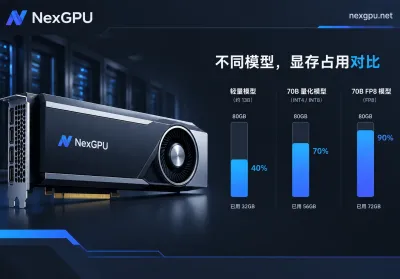
- Model size: Models that fit on a single card (7B–34B) can use L40S; for 70B+ multi-GPU scenarios, prefer A100.
If you're still unsure about the memory requirements for a specific model or which card to choose, check out NexGPU's model selection guide, or go directly to the pricing page to see currently available nodes and real-time unit prices. Billing is hourly and metered by the second, with no minimum spend or contract lock-in. Bills cover only compute, storage, and traffic; storage fees continue when stopped, and only destruction stops all charges.
For a more detailed cost comparison of L40S vs. A100 under different concurrency, context lengths, and precisions, see this analysis breaking down cost per token.


Comments(0)