 NexGPU-算力租赁,GPU服务器,GPU云算力,AI服务器租用-新闻博客
Have you ever hit a situation during inference where the model weights fit just fine, but as soon as you enable long context or high concurrency, you get OOM errors, or token generation speed just won't climb? Don't rush to add more GPUs. Increasingly, feedback from the field points to a common culprit—especially during the decode phase, the real bottleneck isn't FLOPS, but VRAM capacity and bandwidth.
During training, GPUs run near full load computing gradients, and compute is the star. Inference is the opposite. To generate a single token, the entire model weights must be moved from HBM into the compute units, and GPU cores often end up waiting for data. KV cache is an even bigger consumer; it stores the key-value states of the conversation context and grows linearly with sequence length and concurrency. With long documents, multi-turn agents, and deep reasoning chains, the KV cache can squeeze out the weights and even take up the majority of VRAM. When memory is constrained, the model isn't just slow—it might truncate context, forget early information, and hallucinate more. The industry now generally views inference economics—per-token cost, latency, and number of users served—as primarily a memory problem, with compute taking a backseat.
On the hardware front, the upgrades are straightforward. The H100 typically comes with 80GB of HBM3, offering about 3.35 TB/s of bandwidth. The H200 jumps to 141GB of HBM3e, with bandwidth around 4.8 TB/s—over 70% more capacity and over 40% more bandwidth. The Blackwell series B200 reaches the 192GB class, with bandwidth further pushed to around 8 TB/s. The higher-tier GB300 even goes up to 288GB of HBM3e. A 72-GPU rack's total memory is so large it's changing supplier behavior—AI servers are willing to pay a premium for capacity and bandwidth, which in turn affects the entire memory supply chain. For agentic workloads, on the new 150-200GB-class cards, the KV cache share often hits 90%, making the model weights less of a concern.
Cloud rental has made these new cards accessible. Blackwell supply remains tight, spot prices have fluctuated recently, with a median around $6 per GPU hour; some spot prices are higher, and hyperscaler reserved pricing is even more expensive. The H200 median sits around $4, while the H100 is broader, typically in the $2-3+ range. The new cards carry a significant premium, but the bandwidth and capacity gains translate directly to higher token throughput, especially in small-batch, low-latency scenarios. For memory-bound decode, the H200 is almost a "same-compute, upgraded bandwidth" version, and many teams use it for 70B+ long-context or high-concurrency workloads. The B200 goes further, suitable for larger KV or agent pipelines needing higher throughput. AWS already offers Blackwell instances, with reports of several-fold inference performance improvements over the previous generation.
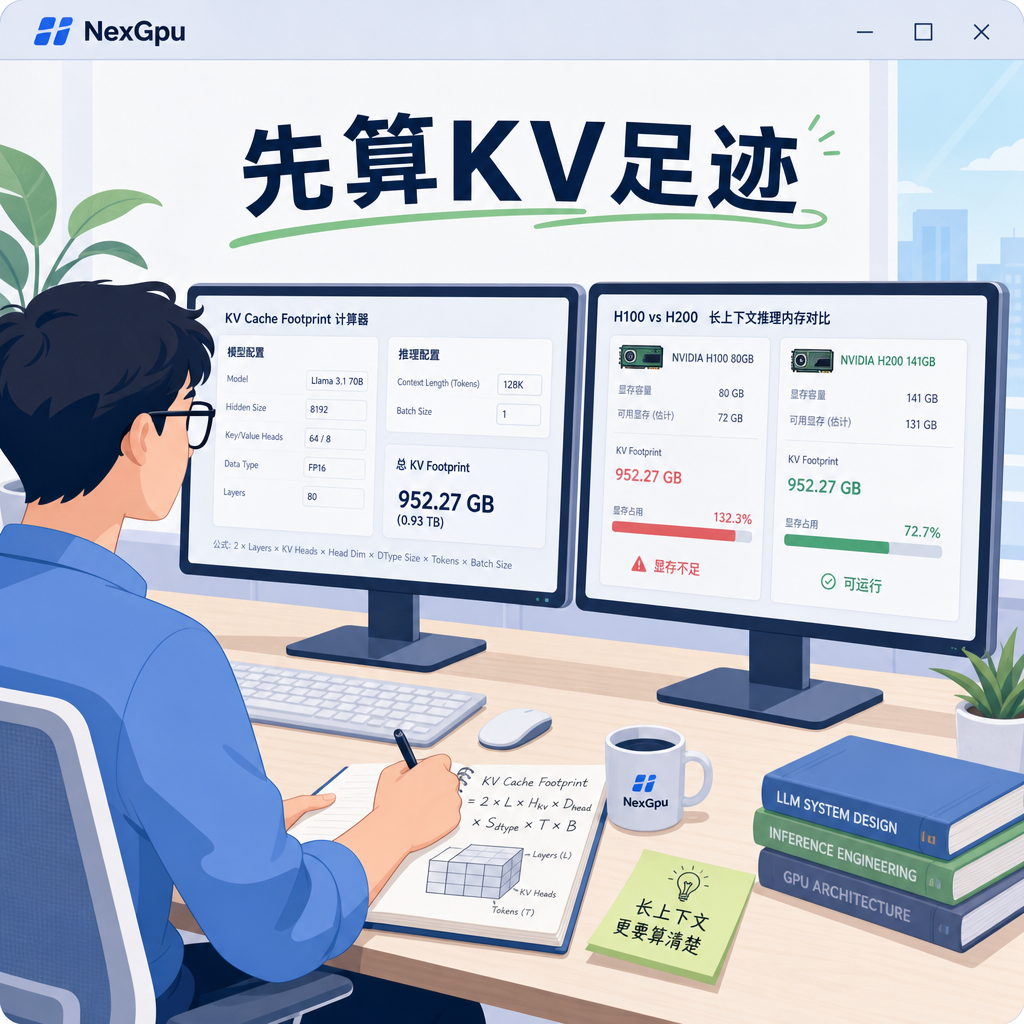
How to choose and use them? First, calculate your own KV footprint. The formula is roughly: layers × KV heads × head dimension × sequence length × batch × bytes per precision × 2 (for K and V). For a 70B FP16 model with 8K context and a batch of 8, that's already over 20GB of KV; at 32K, it easily exceeds 80GB. On an H100, running 70B with high concurrency or long context can hit the ceiling quickly. In that case, going straight to H200 or B200 is more straightforward and requires less sharding. There's also room in precision: FP8 KV cache can halve bandwidth pressure, and precision loss is usually manageable; Blackwell has better support for lower precision. The software layer is equally critical—disaggregated serving splits prefill and decode, large expert parallelism, multi-token prediction, and other optimizations can stack up to significantly boost effective throughput. Simply adding more cards won't solve bandwidth bottlenecks; interconnect might become the new shortcoming.
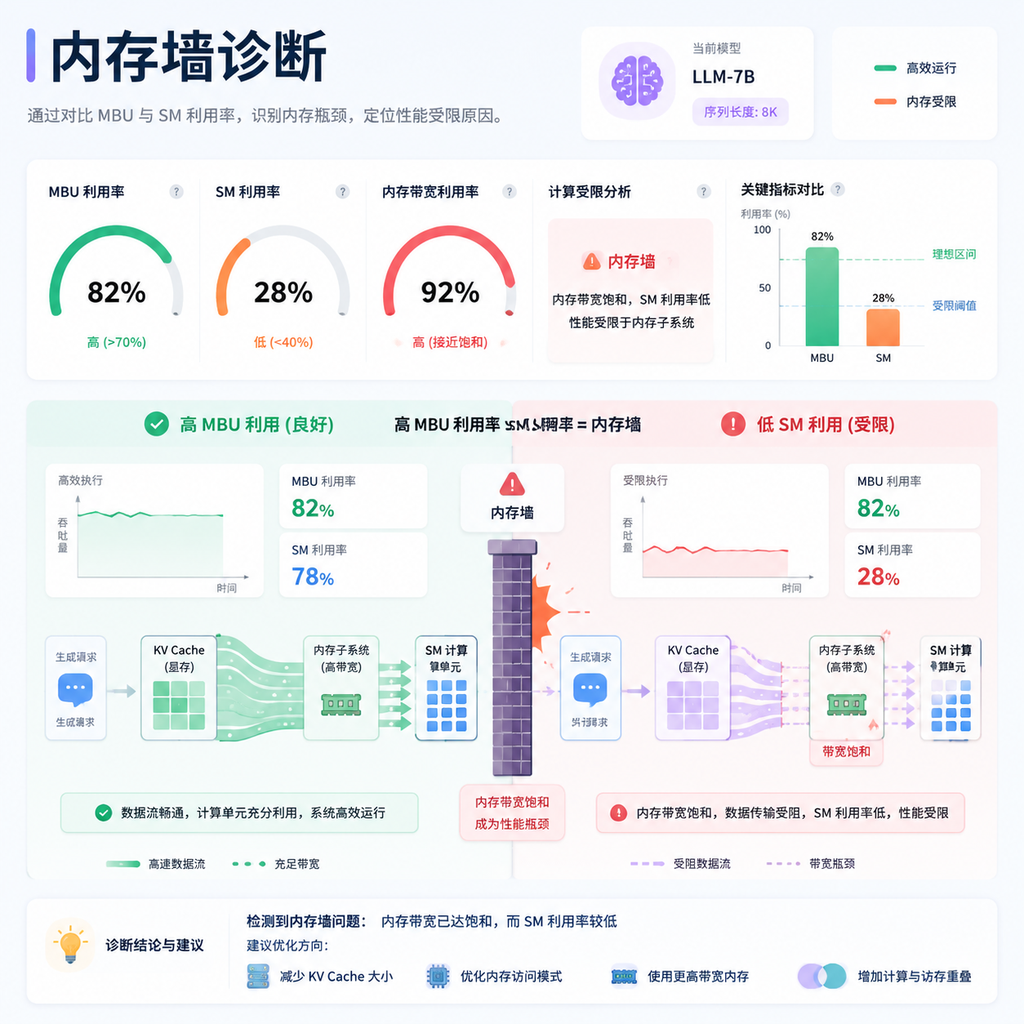
In practice, there are some common pitfalls. One is choosing a card based only on peak FLOPS, ignoring that small batch sizes are almost entirely memory-bound. Two is underestimating concurrency and context growth, leading to a sudden KV explosion and last-minute scaling. Three is ignoring checkpointing or interruption tolerance; when you could use spot instances, going all-in on on-demand wastes money. Four is neglecting diagnostics: use nvidia-smi or DCGM to check memory bandwidth utilization (MBU) and SM utilization; high MBU with low SM indicates a memory wall; then use Nsight to inspect specific kernels. The resolution path sorted by cost: first quantize KV, tune batch and paged attention, then consider NVMe offloading for cold KV, and only finally upgrade to larger VRAM cards or add nodes.
As for scenarios, long-context document analysis, code agents reading multiple files, multi-step reasoning chains, and high-concurrency API services are all prime candidates for large VRAM. For short prompts and small models, you don't need the latest cards; A100 or even consumer-grade GPUs suffice. Platforms like NexGpu, which focus on GPU compute rental, are well-suited for this elastic demand—rent by the hour, switch specs anytime, without having to stockpile hardware to weather supply fluctuations. After training, switch to inference; for traffic spikes, temporarily add H200 or Blackwell instances, then release them when done, keeping costs controllable. Teams can first validate the pipeline on smaller cards, confirm memory pressure, and then upgrade, avoiding being locked into long-term large orders from the start.
On the supply side, Blackwell is still ramping up; CoWoS and HBM remain bottlenecks, and when spot supply is tight, reserving or mixing with H200 is a practical choice. Prices will fluctuate with new capacity and software optimizations, but the memory wall won't disappear in the short term. Agents and long contexts will only drive KV demand higher. Instead of obsessing over local procurement cycles, consider cloud rental as an "on-demand memory pool": when you need large VRAM, rent big cards; when bandwidth is insufficient, upgrade to a new generation, and keep software optimizations in sync.
Before your next deployment, make a table: model weights + worst-case KV + activations, match them against the target card's capacity and bandwidth, then calculate per-token cost and latency. Get memory right, and many "compute insufficiency" illusions vanish. Flexible rental lets small and mid-sized teams keep up with this round of VRAM upgrades without waiting for the supply chain to loosen up.


Comments(0)