 NexGPU-算力租赁,GPU服务器,GPU云算力,AI服务器租用-新闻博客
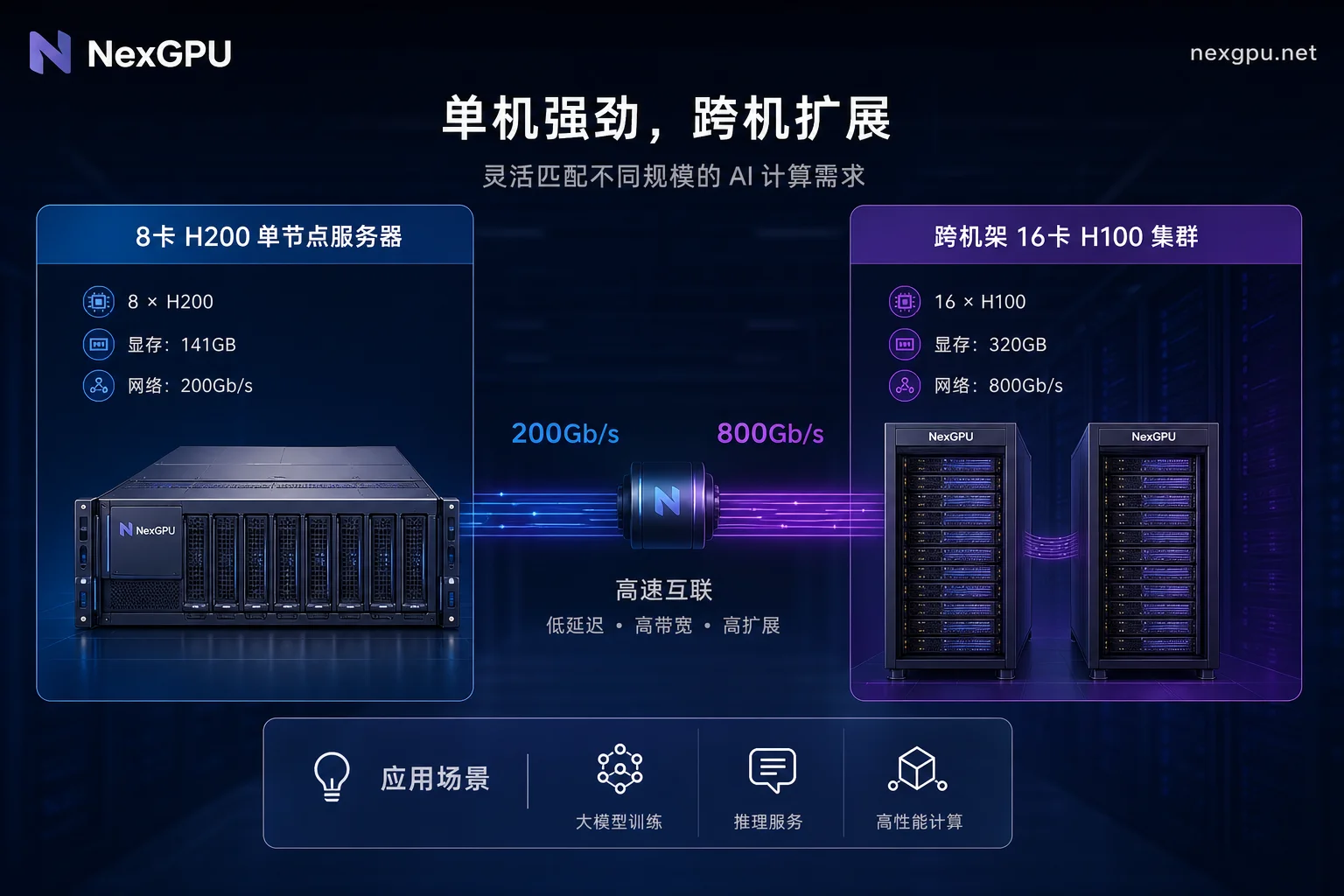
In August 2026, the on-demand GPU market witnessed a notable shift: the rental price for H200 with 141GB HBM3e dropped to $3.82 - $4.50/GPU-hour (e.g., $3.99/hr on Jarvislabs, $4.39/hr on RunPod) [fact_1]. This price level transforms "H200 rental" from a premium high-end option into a cost-effective choice that directly competes with H100. More importantly, the H200's memory capacity fundamentally changes deployment topology – models in the 400B class that previously required multi-node setups can now be consolidated into a single node. So the question is: Which is more cost-effective: an 8×H200 single node or a 16×H100 multi-node? This article will explore this decision.
1. H200 Rental Price per Hour: August 2026 Snapshot
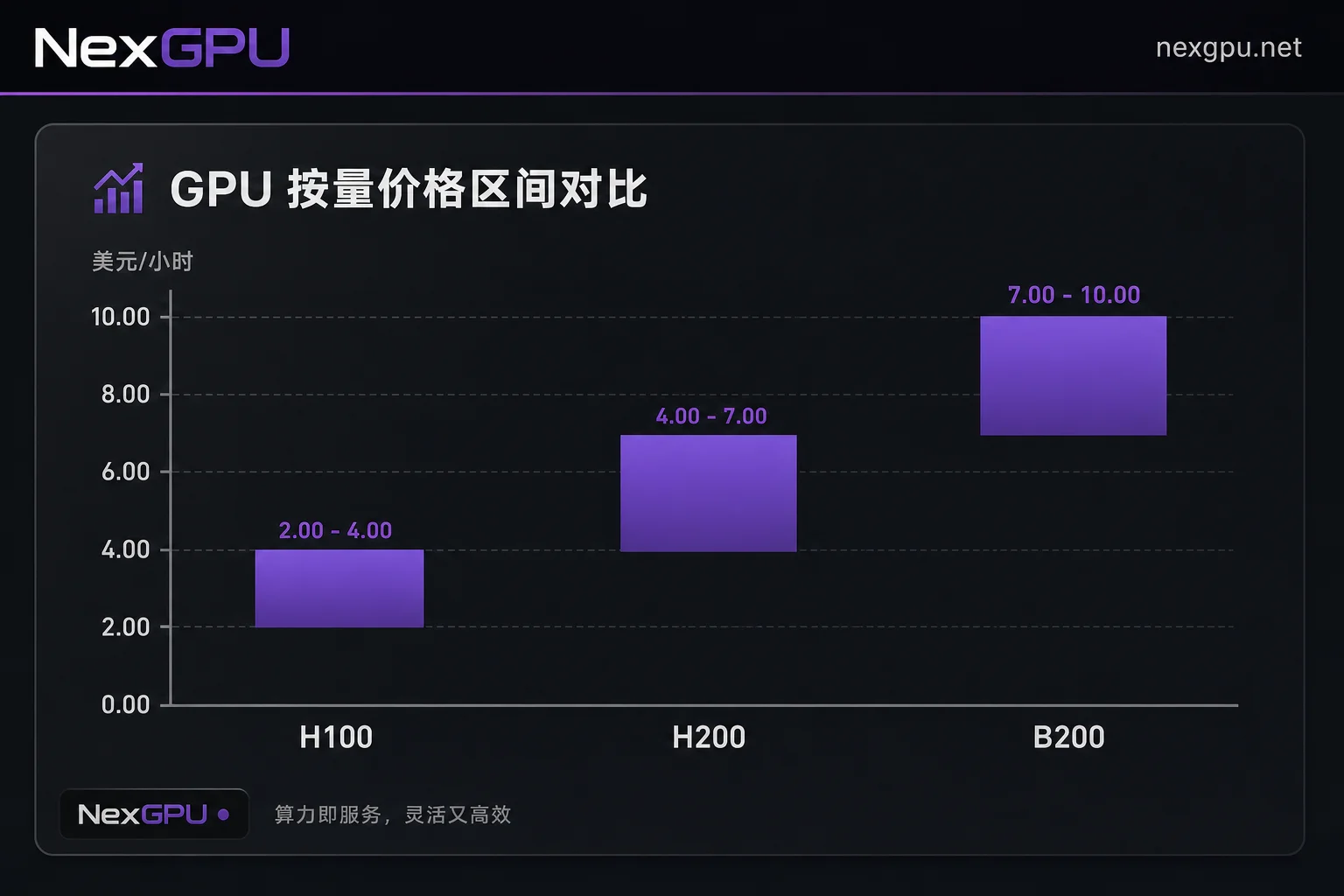
First, let's answer the most direct question: How much does it cost to rent an H200 per hour? According to on-demand pricing monitoring from July to August 2026, the H200 hourly rate ranges from $3.82 - $4.50/GPU-hour, with specific quotes like Jarvislabs at $3.99/hr, RunPod at $4.39/hr, and Nebius at $4.50/hr [fact_1]. Note that these are on-demand rates and may fluctuate based on time, region, and supply.
Meanwhile, H100 SXM rental prices have dropped to $1.80 - $2.50/GPU-hour (median ~$2.27/hr), while Blackwell B200 remains in the premium range of **$5.50 - $7.13/GPU-hour** [fact_4]. This price ladder across three generations forms the basis for today's decisions.
However, unit price is just the first layer. For teams deploying 100B+ models, the real question is: For the same memory requirement, what is the total bill difference between using a single H200 node versus multi-node H100? This requires understanding how the H200's memory advantage changes the topology.
2. 141GB HBM3e: Not Just On-Paper Speed, But a Change in Deployment Topology
The biggest difference between H200 and H100 is not TFLOPS but per-GPU memory: each H200 has 141GB HBM3e, while H100 has 80GB. This means an 8×H200 single node can provide up to 1,128GB of aggregate memory, enough to load a 400B-class open-source model along with its long-context KV Cache entirely into a single node [fact_2]. In contrast, with H100, the same requirement would need to span across 2 8-GPU nodes (16 GPUs) using a combination of Tensor Parallelism (TP) and Pipeline Parallelism (PP) [fact_2].
This difference has a decisive impact on deployment topology: a single node means GPUs are fully interconnected via NVSwitch/NVLink, providing 900GB/s bidirectional bandwidth, while inter-node network bandwidth is much lower than NVLink, leading to significantly higher communication overhead, which directly impacts Decode phase latency and concurrency stability [fact_3].
3. Converting Memory Requirements to Node Count: Two Ways to Fit a 400B Model
To determine which option is more cost-effective, you first need to calculate how much memory your model requires. Here's a reusable estimation method:
- Weight Memory: Parameters × bytes per parameter. For example, a 400B model in FP16 (2 bytes) requires about 800GB; in INT8 (1 byte) about 400GB.
- KV Cache: Grows with concurrency and context length. For instance, with concurrency 32, context length 4096, 80 layers, and 64 heads, the KV Cache can reach tens of GB.
- Runtime Overhead: Generally reserve 10-20% extra.
Summing these gives the required memory pool. For a 400B-level model (FP16), the total requirement is about 900-1000GB. At this point, there are two ways to configure it:
- 8×H200 single node: 1,128GB aggregate memory, fits in a single node.
- 16×H100 multi-node: 16×80GB = 1,280GB memory, but requires multi-node.
It's worth clarifying: the maximum model size that fits on an H200's 141GB is not fixed; it depends on quantization precision and context length. The above is a general estimate; plug in your own parameters for actual numbers.
4. Unit Price vs. Total Cost: The Hidden Communication Tax and Stability Cost of Multi-Node
Now let's compare costs. Based on August 2026 on-demand rates fact_1:
| Option | #GPUs | Per-GPU Rate Range | Total Hourly Cost Range |
|---|---|---|---|
| 8×H200 single node | 8 | $3.82-4.50/hr | $30.56-36.00/hr |
| 16×H100 multi-node | 16 | $1.80-2.50/hr | $28.80-40.00/hr |
As can be seen, the 16×H100 option has a lower total hourly cost floor, but its ceiling exceeds that of H200. When considering median prices, 16×H100 comes to about $36.32/hr, which is close to the 8×H200's $33.28/hr. However, beyond the hourly bill, there is a hidden cost: the communication tax for multi-node. In a 16×H100 multi-node setup, Tensor Parallelism (TP) requires data transfer across the network, which has much lower bandwidth than NVLink [fact_3]. This leads to significantly increased Decode phase latency and reduced concurrency stability [fact_3]. If your application is latency-sensitive, this cost might even outweigh the unit price difference.
5. Why "Multi-Node Only Affects Large Batches" Is a Common Misconception
Some developers believe that multi-node only impacts throughput when the batch size is large. However, in the autoregressive Decode phase of large language models, every generated token requires an All-Reduce operation. Even with a batch size of 1, network latency directly hits Time Per Output Token (TPOT) [fact_3]. This is a point of contention in industry discussions: throughput intuition from training doesn't apply to inference latency. Therefore, evaluation should be based on TPOT under actual workloads.
6. When Should You Still Choose H100, and When Is It Worth Paying the Premium for H200?
Scenarios where H100 still has an advantage:
- The model fits within a single node's 8×80GB memory (e.g., 70B-class models).
- Workloads are predominantly offline batch processing and insensitive to TPOT.
- Budget is strictly limited, and you can accept multi-node complexity.
Scenarios where paying the H200 premium is worth it:
- You need to run 400B-class models and want to avoid multi-node communication overhead.
- You have SLA requirements for time-to-first-token or per-token latency.
- You need long contexts and large KV caches, where per-GPU memory capacity becomes the bottleneck.
- You prefer simpler deployment and reduced operational complexity.
Note that H100 is not obsolete; it remains a cost-effective choice [fact_4].
7. Where Does H200 Fit Between H100 and B200 at $5.50-7.13/hr?
Putting the three generations on the same price ladder (all on-demand, August 2026) fact_1:
| GPU Model | On-Demand Price Range |
|---|---|
| H100 SXM | $1.80 - $2.50/hr |
| H200 | $3.82 - $4.50/hr |
| B200 | $5.50 - $7.13/hr |
B200 maintains a premium and is primarily available for top-tier custom scenarios. Claims that "B200 is fully mainstream and H100/H200 are obsolete" lack public data support [fact_4]. In the public on-demand market, H100 and H200 remain the primary inference choices.
8. Running a Same-Workload A/B Test with On-Demand Resources: Steps and Decision Checklist
To make the final decision, it's recommended to run a same-workload A/B test using on-demand resources:
Steps:
- Fix the model and quantization precision (e.g., 400B model, FP16).
- Fix context length and concurrency levels (e.g., 16, 32, 64 concurrency).
- Keep sampling parameters (temperature, top-p, etc.) consistent.
- Run the same request set on both 8×H200 single node and 16×H100 multi-node.
- Record TTFT, TPOT, concurrency limits, and failure rates.
- Divide the results by each option's hourly rate to get cost per unit.
Decision Checklist:
- Is there a memory step that is crossed (i.e., do you need >800GB in a single node)?
- Is there cross-node Tensor Parallelism (TP)? If so, is the communication overhead acceptable?
- Is latency SLA sensitive (are TTFT/TPOT critical)?
- Is the long-term spec being hostage to short-term unit pricing (consider future model scale)?
Common Misjudgments:
- Comparing only unit price, ignoring total cost and communication tax.
- Using training throughput intuition for inference latency.
- Assuming B200 has become mainstream and ignoring the spot advantages of H100/H200.
After working through the above, you might consider quickly setting up environments on platforms like NexGPU. NexGPU offers a variety of GPU server configurations, pay-as-you-go usage, and pre-built model/application templates, allowing you to run an A/B test on H100 vs. H200 with the same workload before committing to a long-term spec, rather than picking based on unit price alone.
It's recommended that you first plug your own model parameters, precision, and target concurrency into the memory estimation table above, then run a same-workload comparison on H100 and H200 with on-demand resources, and make the final choice based on your own TTFT/TPOT and unit cost data.
Appendix: Glossary of Terms
- Tensor Parallelism (TP): Splitting model layers across multiple GPUs for parallel computation.
- Pipeline Parallelism (PP): Splitting model layers in sequence across multiple GPUs.
- TTFT (Time To First Token): Time to generate the first token.
- TPOT (Time Per Output Token): Average generation time per output token.
- KV Cache: Key-value cache used to accelerate inference.



Comments(0)