 NexGPU-算力租赁,GPU服务器,GPU云算力,AI服务器租用-新闻博客
Many AI R&D teams reviewing their mid-year bills have noticed a troubling trend: as inference traffic grows, GPU rental costs are eroding profits faster than expected. Meanwhile, the capital market is aggressively betting on the infrastructure layer of this field, profoundly reshaping the supply-demand dynamics of the cloud computing market.
As of early July this year, the global cloud computing market has absorbed a total of $4.55 billion in funding. In the same period last year, this figure was only $1.02 billion. The average funding per deal has also doubled from $170 million to $325 million. This indicates that while the actual cost of computing power fluctuates, the capital intensity of the industry's foundation is rising sharply.
Market Polarization Due to High Capital Concentration
According to tracking data from the analysis firm New Market Pitch, among this massive total funding, the top three large deals accounted for 74% of the overall capital, while the top ten consumed nearly 97% of the share. For instance, Nscale alone secured a Series C round of $2 billion, representing 44% of this year's total funding.
This extreme capital concentration shows that cloud computing is evolving into a heavy-asset competition dominated by a few super giants. The influx of capital has not rapidly lowered end-user prices in the short term; instead, it has objectively raised the monopoly threshold for computing resources.
For small teams that need to rent computing power for model training and inference, this market structure has direct knock-on effects. Large funds are flowing to top platforms, meaning large-scale, standardized AI computing centers are rapidly expanding, but their pricing and contract terms typically favor institutional clients with substantial budgets.
Facing this divergence, NexGpu is committed to helping R&D teams lock in more cost-effective heterogeneous computing power through fine-grained resource scheduling. For startups without hundreds of millions in funding, leveraging fragmented computing resources as an alternative is becoming crucial to their survival.
Hybrid Architecture and Elastic Cloud Computing Become Safe Havens
This trend toward computing concentration is also prompting many companies to reassess their cloud architectures. A report released by the research firm ISG on July 16 points out that due to surging AI computing demand, compliance requirements, and persistently high bandwidth costs, more enterprises are returning to the hybrid cloud route.
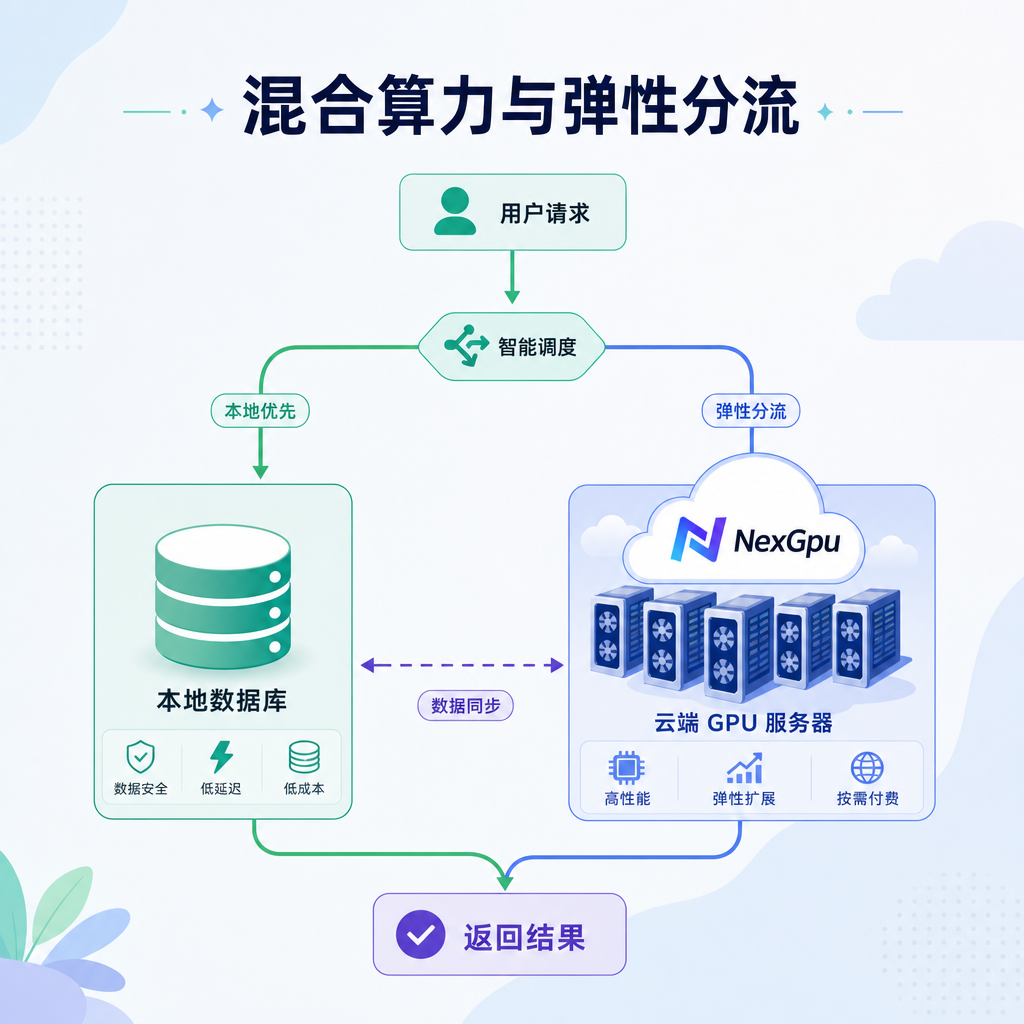
In practice, locking all computing loads into a single large public cloud is no longer the best option. Enterprises tend to keep core assets and highly sensitive data on-premises, while offloading elastic computing tasks and large-scale inference needs to dynamic distribution via elastic cloud computing.
This architecture not only avoids the high premiums of big vendors but also enables rapid disaster recovery and scaling through multi-vendor computing networks during sudden user traffic spikes. For teams developing AI applications, flexibility has become the top priority for reducing computing expenses.
In the long run, hybrid deployment allows enterprises to maintain control over underlying data while flexibly calling upon cloud GPU resources, thereby mitigating technical and financial risks from single-vendor price adjustments.
Multiple Challenges from Hardware and Capital Barriers
In the current market environment, small teams face more stringent barriers to maintaining efficient business operations. Not only are there financial pressures, but supply chain fluctuations directly impact terminal prices.
According to the GPU rental price index released by Silicon Data, as of July 15, the average spot rental price for high-spec GPUs rose by 3.3% in one week, reaching $2.50 per hour. This short-term price volatility places significant budget pressure on developers lacking risk-hedging capabilities:
- Supply mismatch: High-end GPU rental prices remain high, and spot availability in some regions is increasingly difficult;
- Payment cycle pressure: Traditional large vendors tend to lock in long-term contracts of over one year, exacerbating cash flow burdens for startups;
- Network overhead: Cross-provider distributed training is susceptible to bandwidth limitations, reducing overall computing efficiency;
- Downtime risk: Renting computing power on low-cost community platforms without service-level agreements (SLAs) can lead to task interruptions.
These obstacles make it difficult for many startups to deploy AI applications smoothly. If the computing supply chain breaks or budgets are exhausted prematurely, projects risk stalling. Therefore, establishing a resilient computing procurement strategy is crucial.
Engineering Path to Optimize Cost per Million Tokens
To address these challenges, technical teams cannot simply rely on hardware price drops; they must seek solutions in software stacks and rental strategies. For example, in inference scenarios, introducing key-value cache (KV Cache) sharding management and quantization techniques can reduce memory usage during inference.
Additionally, choosing the appropriate rental model based on business needs is equally critical. By integrating on-demand computing resources provided by NexGpu, technical teams can reduce cold-start costs and avoid expensive long-term contract constraints, achieving instant access and dynamic scaling of computing resources.
Through dual optimization of algorithm tuning and computing scheduling, the cost per million tokens can potentially be reduced by over 30%. This refined operation not only tests the technical expertise of engineering teams but also the sensitivity of business leaders to the underlying computing market.
A reasonable approach is to schedule non-urgent tasks to idle periods or use multi-region computing pools to distribute sudden traffic, thereby maintaining financial health and technical agility amid this wave of computing demand.




Comments(0)