 NexGPU-算力租赁,GPU服务器,GPU云算力,AI服务器租用-新闻博客
Many teams rent cloud GPUs for large model inference and watch their utilization stay low. Monitoring shows SM utilization often at 20-30% or even lower, yet costs remain the same. The issue isn't that the GPUs are weak—it's the nature of inference itself.
Inference is split into two phases: prefill, which processes the long prompt or context at once and generates the KV cache, and decode, which generates tokens one by one. Prefill is compute-intensive, while decode is memory-bandwidth-bound. When both share the same GPU, a long prompt can starve decode; with high concurrency, the KV cache in VRAM explodes. For a single request of Llama 3 70B at 128K context, the KV cache alone eats over 40GB, and with model weights, there's almost no room for concurrency. When multiple users come in, they either queue or hit OOM.
Over the years, we've gradually found solutions. Let's start with the KV cache.
PagedAttention treats KV as virtual memory, allocating small blocks on demand and releasing them immediately after a request. Previously, we reserved maximum length, wasting half the space; now utilization doubles or even quadruples. vLLM enables this by default, and with appropriate max-model-len and gpu-memory-utilization settings, you're good to go.
Next, quantization. KV doesn't need high precision; FP8 cuts it in half, and NVFP4 on new architectures can cut it further. For a 70B model with 32K context and 8 concurrent requests, it's common to drop from 80+GB to around 20GB. Quality loss is often acceptable in production, especially for non-critical tasks. CPU or NVMe offload can act as a secondary cache, swapping out cold blocks during peaks, so low-priority requests aren't outright rejected.
These are single-node optimizations. The real difference maker is service disaggregation.
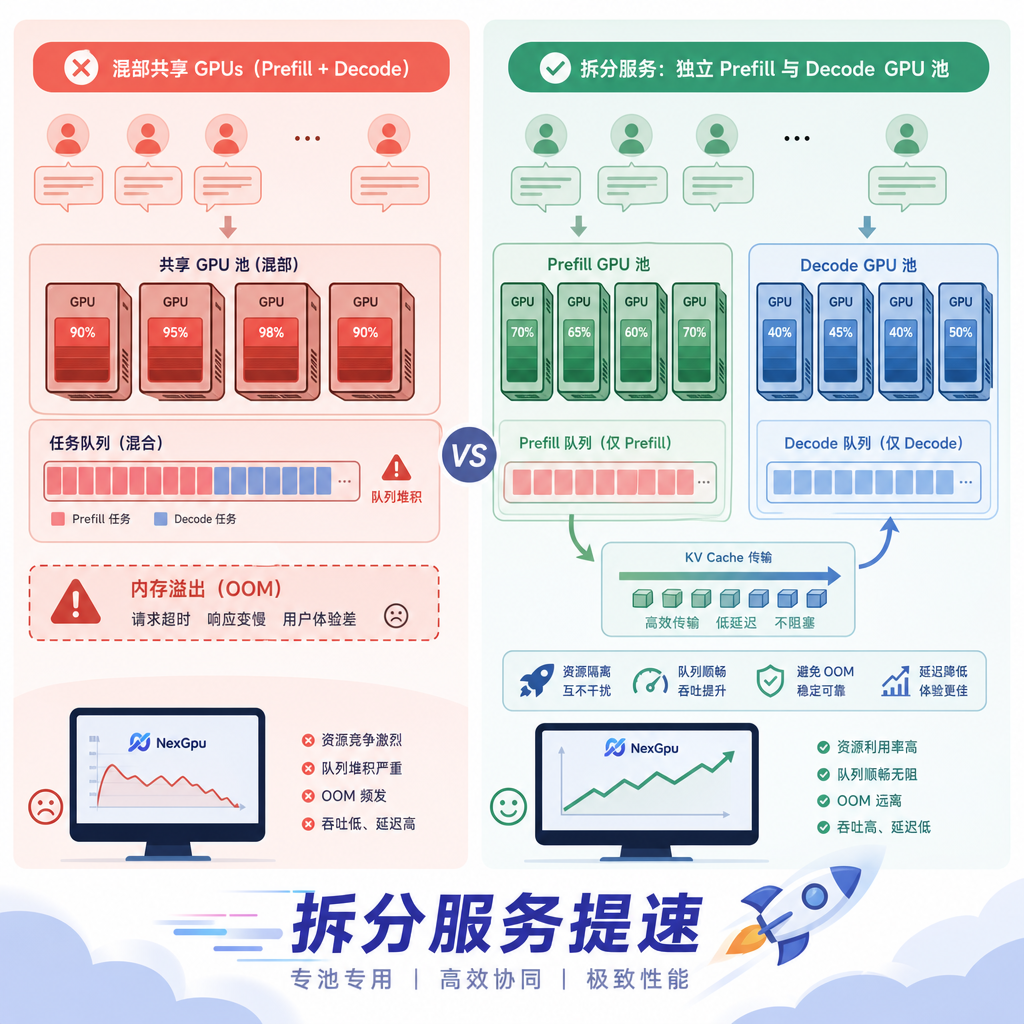
By putting prefill and decode on separate GPU pools, the prefill pool focuses on long contexts, and after computing, it transfers the KV to the decode pool for continued generation. Both can scale independently without interfering. Long prompts no longer drag down users who are already generating tokens, and the decode pool can be optimized specifically for memory bandwidth. Add KV-aware routing: new requests are preferentially sent to GPUs that have cached the same prefix or history, reducing recomputation. For shared parts like system prompts, RAG documents, and multi-turn dialogue history, TTFT can drop from over ten seconds to one or two.
Practitioners report that even just splitting into two cards, combined with cache routing and offload, can improve overall throughput and first-token latency by about 30%. When traffic patterns change, the planner can dynamically adjust the prefill/decode ratio without manual tuning.
Cloud is especially suited for this. With on-prem hardware, you buy a fixed ratio, and when traffic changes, some GPUs sit idle. In the cloud, you can spin up instances of different specs as needed: compute-heavy for prefill, memory- or bandwidth-heavy for decode, and release them when done. Elastic scheduling can push utilization from 20-30% to 50-60% or higher. For clusters saturating training but leaving inference half-idle, using autoscaling to zero and time-sharing can also help.
When choosing a platform, look at network. Disaggregated services rely on fast KV transfer; InfiniBand or high-bandwidth RoCE is a must, as high latency negates the benefits. Storage also matters for multi-level caching. There are GPU-focused cloud services that update hardware quickly, offer simple configuration, and charge per use, which matches this dynamic topology. NexGpu provides flexible GPU rental and elastic scaling, allowing you to quickly validate prefill/decode pools and adjust scale based on actual traffic without committing to a fixed set of GPUs upfront.
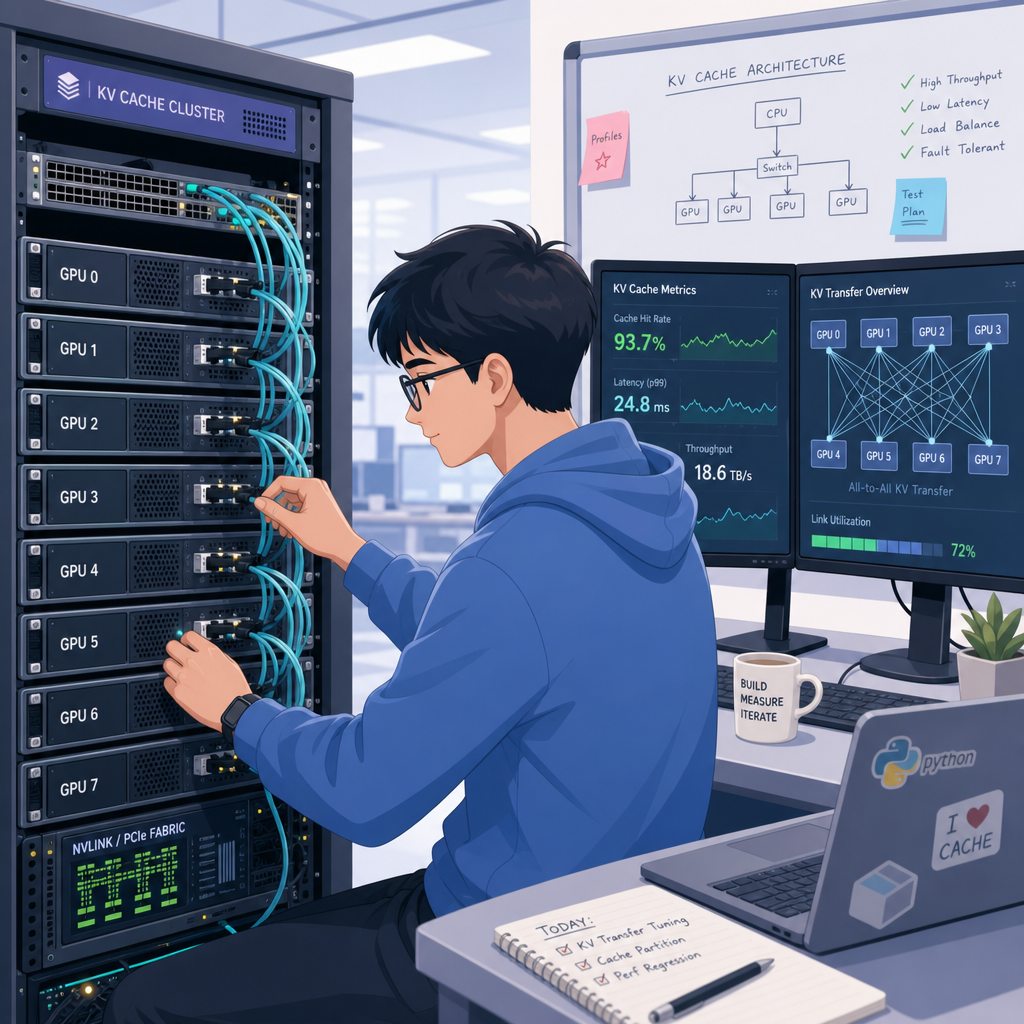
Practical steps you can take: First, run vLLM on a single GPU with PagedAttention, FP8 KV, and prefix caching enabled; measure baseline throughput and latency. Monitor memory bandwidth and SM utilization to confirm if you're memory-bound. Then move to multi-GPU, using frameworks to separate prefill and decode, and configure KV transfer and routing. Start with low traffic to verify cache hit rates, then gradually increase load. The biggest gains come in multi-turn agent or long-context RAG scenarios; once system prompts get long, cache hits save a lot.
Common pitfalls: First, splitting everything from the start adds complexity with low traffic; first test with aggregated patterns. Second, ignoring transfer overhead—if the network isn't fast enough, disaggregation may be worse. Third, focusing only on peaks while ignoring daily fluctuations; without proper elastic policy, you still waste resources. Fourth, quantizing without validating the task; some inference chains are sensitive to precision, so A/B test first.
Price fluctuations also need consideration. GPU rental prices swing like oil with supply and demand, with short-term volatility. With disaggregation and caching, you squeeze more tokens from the same compute, stabilizing unit costs. Elastic scaling when demand rises and scaling down when idle is more cost-effective than a fixed cluster. NexGpu supports on-demand and flexible scheduling, helping small and medium teams navigate volatility and bring optimizations to production, not just on paper.
When implementing, don't overreach. Start with two or four GPUs to validate end-to-end latency and cache hits, then expand based on data. The toolchain is mature; vLLM and orchestration frameworks are ready, and cloud images can be pulled with environments preconfigured. When monitoring, don't just look at GPU utilization—track TTFT, ITL, cache hit rate, and cost per token, as these are the metrics that truly matter.
Inference now accounts for the majority of compute consumption, and optimizing service architecture is more effective than simply adding more GPUs. By splitting prefill and decode, and managing KV well, the same cloud GPUs can serve more users, longer contexts, and more complex multi-turn tasks. Those who've tried it know that once you get it running, the bills and user experience both improve. Now it's up to you to fine-tune these details in your own traffic.



Comments(0)