 NexGPU-算力租赁,GPU服务器,GPU云算力,AI服务器租用-新闻博客
The compute circle has been buzzing lately. Many small and medium teams are still struggling to get the latest GPUs: either they wait months in queue, or the prices are too high to even try. NVIDIA's newly introduced revenue-sharing and credit support model directly lowers this barrier. AI cloud providers can now obtain large-scale clusters like Grace Blackwell without paying the full hardware cost upfront, deploying multi-tenant AI factories. The cloud side sells services, while NVIDIA earns both standard product revenue and a share of the revenue generated from cloud usage. This structure allows factories to go online faster and achieve higher utilization, enabling startups and model builders to access production-grade compute through these clouds more quickly, without having to handle the lengthy processes of site selection, power, and construction.
Initial partners are already in motion. One is deploying up to 40,000 Grace Blackwell GB300 units, and another is building a 360-megawatt campus in Indonesia with a target scale of 170,000 GPUs. The overall potential capacity easily exceeds 200,000 units. For early-stage AI product teams, this means the emergence of a class of clouds with more flexible capital structures, offering more accessible and elastic Blackwell-level resources. Previously, even long-term reservations struggled to unlock financing; now the barrier is lower. Analysts point out that this resembles ARM's ecosystem play: chips + software stack + now cloud revenue slicing, forming a cycle. Small teams don't have to wait to raise enough money to build their own factories; they can directly connect to these multi-tenant factories for training, post-training, fine-tuning, and large-scale agent inference.
The market side is also changing. The median price for mainstream H100 on-demand is around $2.99 per GPU hour, with a range from just over $2 to over $10, and neocloud endpoints are lower. For the latest generation B200, pricing spans widely, from around $3.5 on the low end to over $20 on the high end. Supply is still tight, but neoclouds are gradually increasing capacity. A100 is still in the $1-plus cost-performance range. Overall, H100 has fallen significantly from its peak and has become the mainstay for training; the latest cards carry a premium, but continuous software optimization is helping everyone save costs. On the Blackwell platform, the inference software stack has improved DeepSeek V4 performance by up to 5x within a month, reducing token cost to about one-fifth of the original. With full-stack coordination from runtime, kernels to networking, throughput on the same GPU can achieve up to a 20x improvement. After hardware goes online, software continues to unlock potential, which is crucial for long-term inference costs.
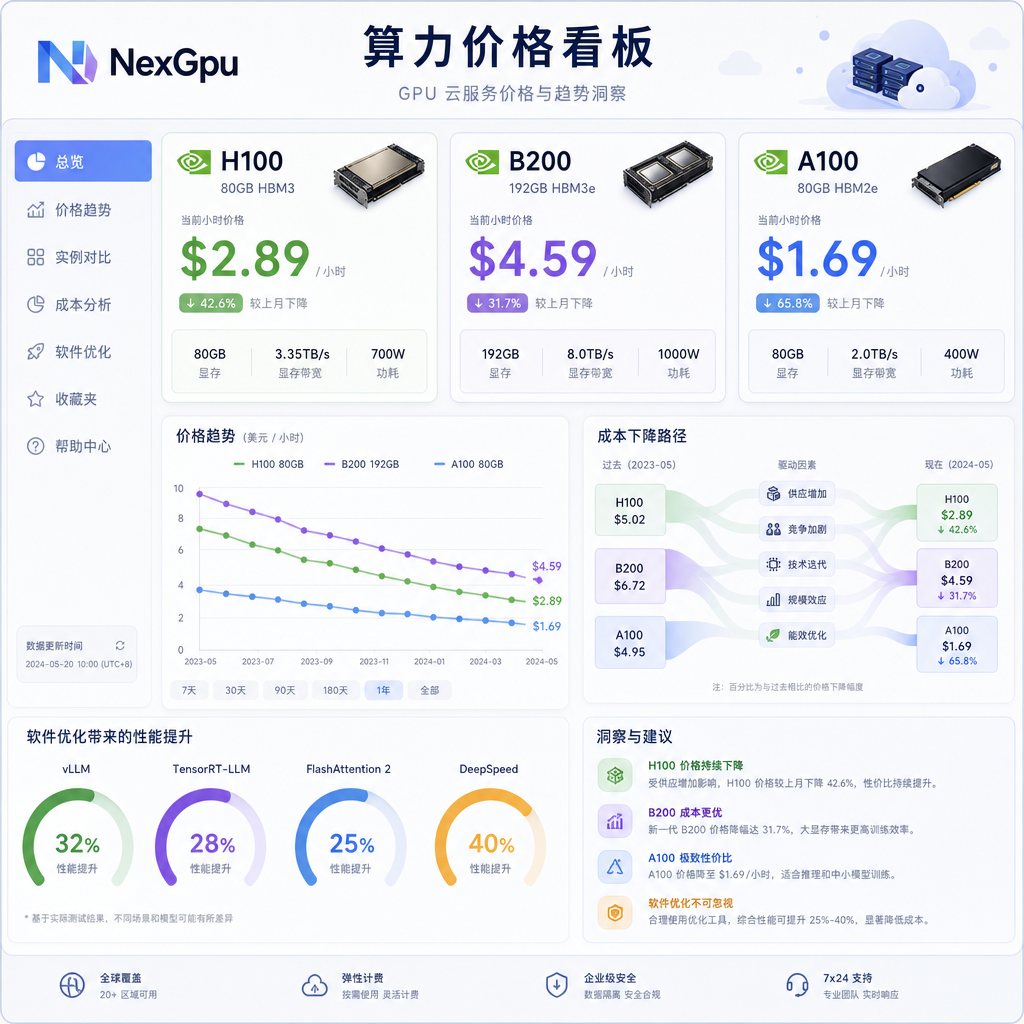
How to practically get started? First, look at your workload type. For burst experiments and rapid validation, use on-demand or spot instances to save about half; for stable production, consider reservations, which typically offer 15-39% discounts, but don't lock into a year-long commitment right away. Don't blindly chase the latest: for 7-70B fine-tuning or medium inference, A100/H100 are often sufficient and cost-effective; for large models with long context or obvious memory walls, step up to H200 or B200 for bandwidth and HBM. For multi-node setups, check interconnect bandwidth and latency; tech like NVLink can pool memory, which is critical for large model training. After starting, don't forget to use the latest inference frameworks and optimization libraries; software gains often outpace hardware upgrades.
There are several common pitfalls. First, thinking that just getting the latest card is enough, ignoring software stacks and checkpoint strategies, resulting in wasted spend and poor throughput. Second, signing long-term contracts despite workload volatility, where idle costs eat into the budget. Third, only looking at single-card hourly prices, ignoring data transfer, storage persistence, and multi-card communication overhead, leading to a higher real TCO. Fourth, not aligning compliance or regional requirements in advance, making later migration troublesome.
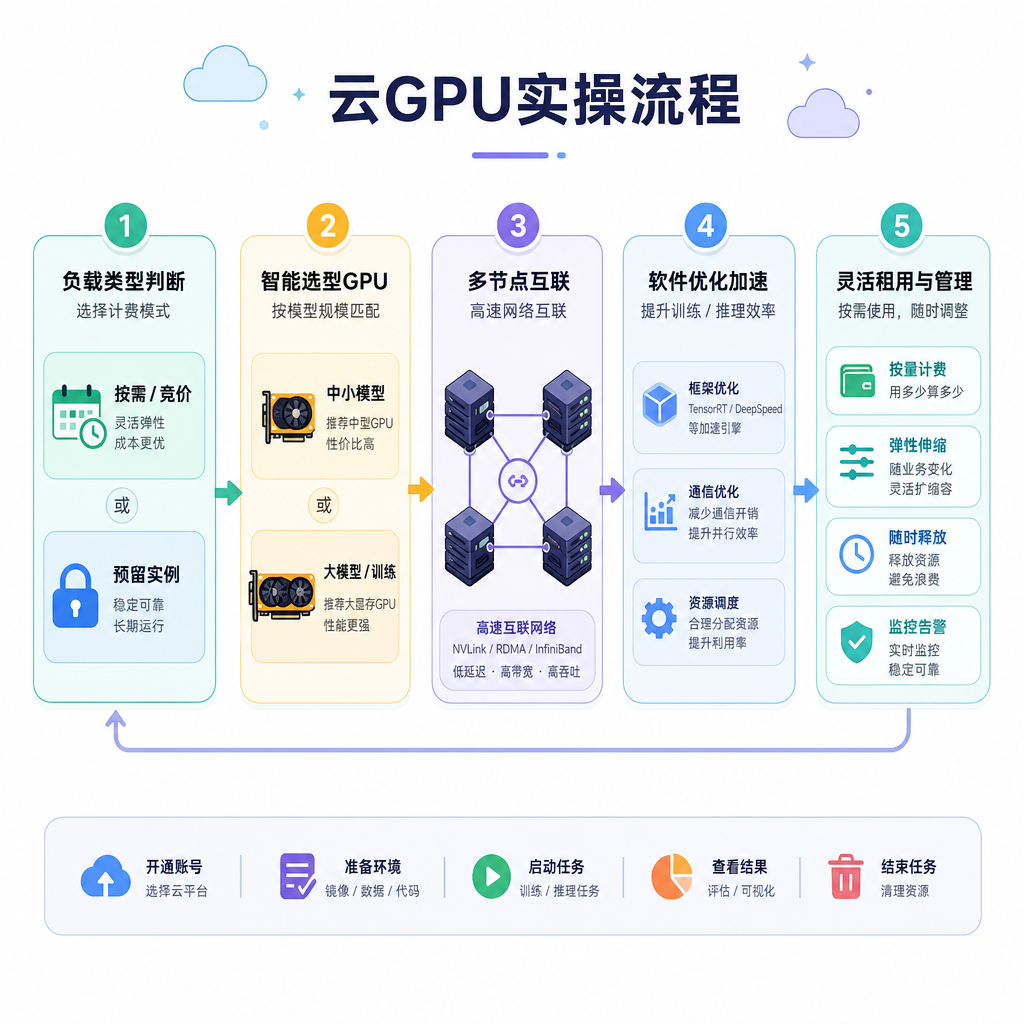
Small and medium teams now have a better path: use flexible cloud GPU leasing, spin up multi-GPU instances on demand, and shut them down when done, avoiding the maintenance and depreciation of owning hardware. Platforms like NexGpu are well-suited for such elastic scenarios, providing quick access to cloud compute resources and supporting transitions from experimentation to small-scale production without heavy upfront payments or waiting. Combined with the factory capacity expansion from the new model, it's easier to get Blackwell-related resources for prototyping and iteration. In actual deployment, it's recommended to start with small-scale stress tests of software optimization effects, then gradually scale up; also maintain monitoring to adjust card types and numbers based on token output and latency.
Compute demand is shifting from training peaks to continuous inference factories, and multi-tenant models with revenue alignment are making resources more accessible. Teams don't have to insist on building their own or waiting for big vendor quotas; they can directly use cloud elasticity to connect to these new capacities. NexGpu helps you navigate startup and scaling smoothly, allowing you to focus back on the model itself. Try it a few times to see that flexible leasing combined with continuous software optimization is much more cost-effective than struggling with hardware cycles. Over the next few months, capacity will continue to be released, so early movers will have a better chance to secure their positions.


Comments(0)