 NexGPU-算力租赁,GPU服务器,GPU云算力,AI服务器租用-新闻博客
Over the past two weeks, the compute sector has seen significant activity. On one hand, Meta plans to build a cloud business, selling excess AI compute and model access to external customers. On the other, NVIDIA is promoting a multi-tenant AI factory model, working with cloud partners to rapidly expand capacity using revenue sharing and credit support. The initial market reaction was somewhat panicked—some worried about a sudden surge in supply and plummeting rental prices. But looking at actual rental curves and hardware deployment, the story is not that simple.
The on-demand capacity for mainstream cards like the H100 remains tight in many places, even sold out or with long delivery times. The Blackwell series B200 is even scarcer, with spot prices significantly higher than the H100, and truly ready-to-use cloud instances are still limited. Some analysts point out that Meta locked in large capacity early last year, and now releasing some older-generation resources looks more like internal optimization: shifting resources from less matching scenarios to newer clusters while continuing to invest heavily in cutting-edge infrastructure. The forward rental curve is actually flattening and strengthening, with 1-year prices still being marked up. This indicates that demand—especially for inference and agentic workloads—has not loosened but is tightening.
For small and mid-sized teams, this is not bad news. Big tech releasing idle capacity and multi-tenant factories accelerating deployment means more options for cloud rentals and better elasticity. The key is how to use it with the right rhythm, not being led astray by "cheap" or "latest."
Cloud GPUs vs. Dedicated Servers: Ask About Utilization First
Many people get stuck on whether to rent or buy, on-demand or long-term contract. But the core question is simple: Are your GPUs working most of the time, or are they idle?
If workloads fluctuate—today 8 cards, tomorrow zero—cloud GPUs are more suitable. They offer flexible start/stop and pay-as-you-go, so you don't pay for idle time. For workloads that run 24/7, inference services constantly online, or training tasks fully packed, dedicated or long-term rentals are often more cost-effective. Over time, hourly rates add up and become more expensive than fixed capacity.
A common mistake in practice is "rent first, think later." During development, GPU utilization might be only 20%-30%, but the bill is still based on full capacity. Conversely, if production inference demand suddenly spikes and on-demand instances are unavailable, the service could go down. The right approach is to first understand your peak, valley, and average utilization. Use monitoring tools to track real workloads for a week, then decide the ratio. Many teams end up with a hybrid approach: stable base load on reserved capacity, bursts supplemented with on-demand cloud instances.
Platforms like NexGpu are well-suited for this, supporting quick start/stop and flexible scaling, fitting a rhythm of validate first, then scale, without betting on long-term contracts from the start.
Choosing Cards: Don't Just Look at Specs, Match to Scenario
In 2026, cloud GPU options are well-stratified. Hopper architecture H100 and H200 remain the workhorses for training and medium-to-large fine-tuning, with a wide price range, on-demand from around $2+ per hour and up. The A100 still offers good value, sufficient for many fine-tuning and medium-scale inference tasks. Blackwell's B200 has more memory and stronger performance, but supply is extremely tight, with significant price premium; currently, mostly top-tier customers or specific high-throughput scenarios compete for it. AMD's MI300X is also competitive in large-memory scenarios.
Common pitfalls:
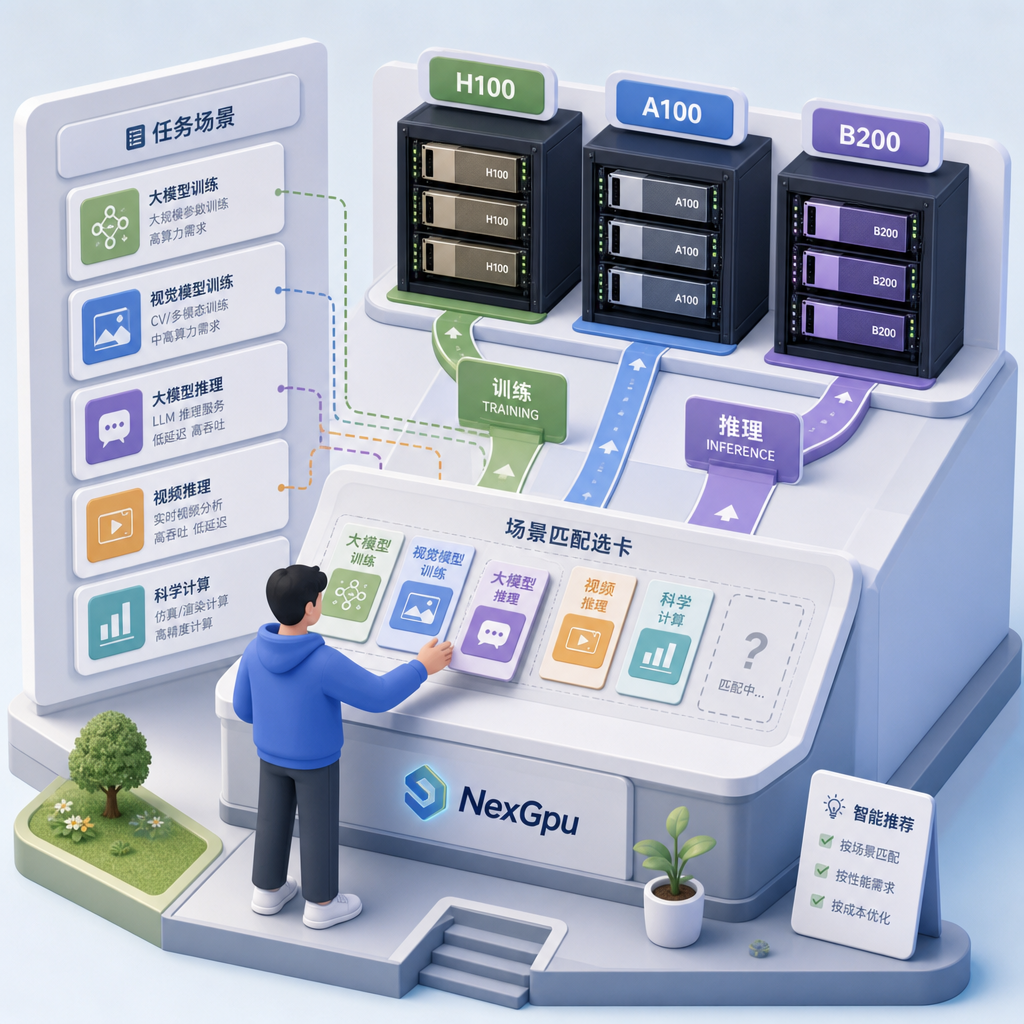
- Forcing B200 for the sake of "newest," resulting in queues or premiums, while the actual task could be handled by H100 with better cost-effectiveness.
- Ignoring network and storage. In multi-card training, insufficient interconnect bandwidth between GPUs can drastically cut effective compute due to communication overhead. Also, don't underestimate the time to pull data from object storage.
- Mixing inference and training configurations. Inference values throughput and latency more; sometimes mid-range cards + optimized frameworks (quantization, batching) save more than stacking high-end cards.
- Comparing unit price only, not total cost of ownership. Instance startup time, persistent storage, data transfer, technical support—these hidden costs can add up to more than the GPU itself.
It's recommended to break down by task: use cheap cards or small instances for development and debugging; choose configurations matching memory and interconnect for formal training; for online inference, prioritize stability and cold start speed. Do quantization, distillation, and speculative decoding where possible to reduce token costs and compute needs.
Changes from Multi-Tenant AI Factories
NVIDIA's new model focuses on helping AI cloud partners quickly build large-scale multi-tenant factories. Revenue sharing and credit support allow partners to build clusters like Grace Blackwell without bearing all upfront capital pressure. Already, some partners are deploying tens of thousands or larger scales. For tenants, this means:
- Faster time to availability, without waiting to build your own data center and power infrastructure.
- Higher utilization under multi-tenant sharing, theoretically reducing unit costs.
- But isolation, security, and performance consistency become more important. In production, ensure tenant isolation is solid and watch for noisy neighbor effects.
Meta's move is similar, potentially offering raw compute or a combination of hosted models and compute. For developers, this adds an entry point to "big tech excess capacity." However, details are still being finalized; actual usable capacity and pricing need verification after deployment.
These changes make "flexibly responding to demand fluctuations" more realistic. Previously, you worried about not getting cards; now there are more options, but competition is also fiercer. Teams need to actively compare multiple sources: different regions, billing models, hardware generations—prices and availability vary greatly. Some on-demand is stable; some spot is cheap but has interruption risk. Long-term contracts offer discounts, but if demand changes during the lock-in period, you're stuck.
Practical Rhythm Suggestions
- Discovery phase (1-2 weeks): Run your pipeline on small on-demand instances, record actual GPU hours, memory peaks, network bottlenecks. Don't jump to large clusters immediately.
- Selection comparison: Test throughput and cost for the same task on different card types. Pay attention to cold start time, ease of persistent volume mounting, and support for your framework (vLLM, TensorRT-LLM, etc.).
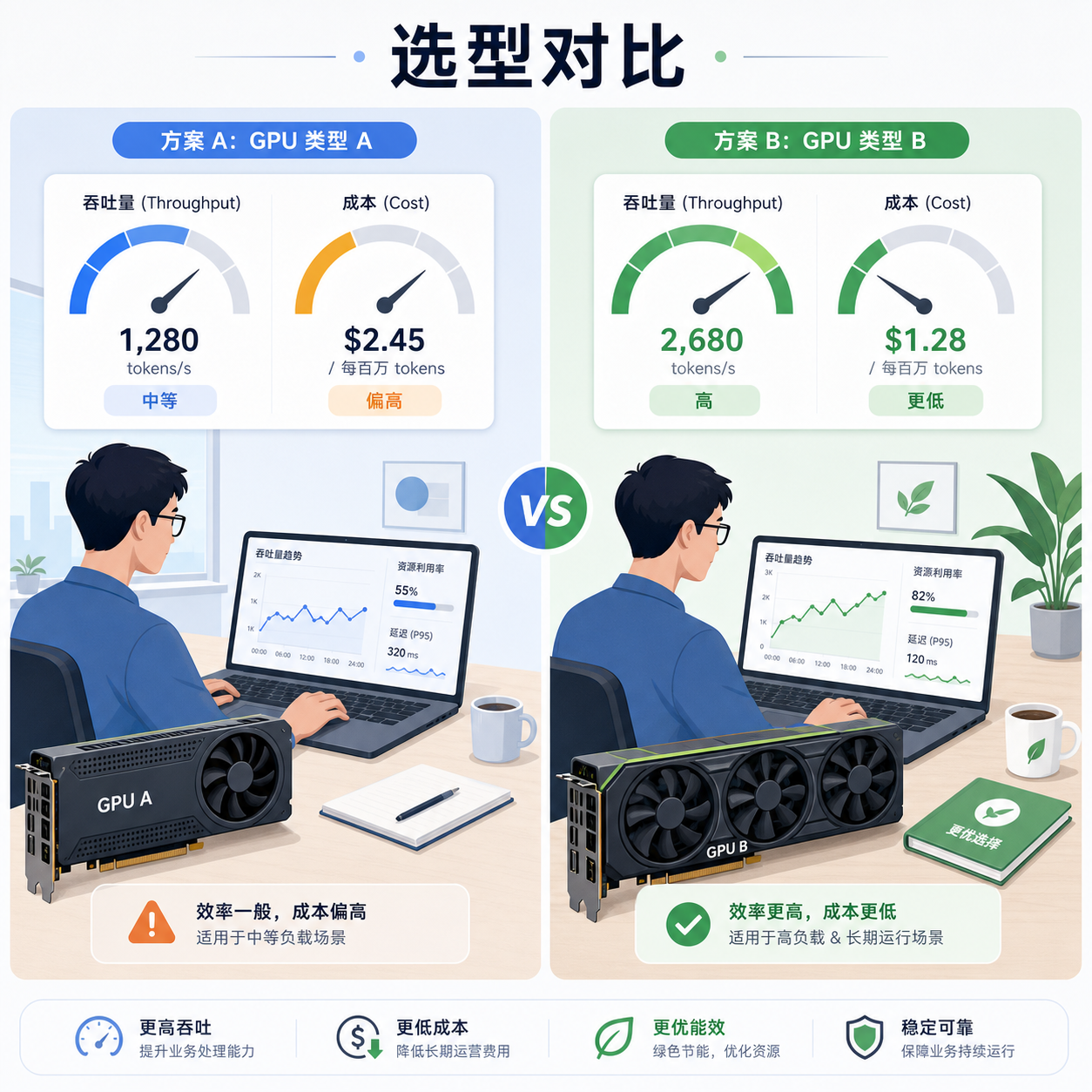
- Hybrid deployment: Use reserved or dedicated for stable parts, on-demand for fluctuations. Set up auto-scaling policies and shut down idle instances automatically.
- Continuous monitoring: Set alerts for utilization below thresholds, promptly scale down or switch to more suitable instances. Regularly review bills for "zombie" instances.
- Risk hedging: Don't rely on a single provider or hardware generation for critical tasks. Have backup plans and ensure data backups.
The biggest mistake small and mid-sized teams make is following big tech's rhythm—going all in on Blackwell because it's hot, or betting on long-term contracts when prices dip. Your own business rhythm should be the priority. After training, immediately evaluate whether to switch to inference optimization or continue iterating. As agentic applications grow, inference often takes a larger share, and scenarios with sustained high utilization increase, making hybrid strategies more critical.
Services like NexGpu excel at reducing trial-and-error costs. You don't need to sign a large contract first; you can quickly get suitable configurations to validate ideas, then decide whether to scale or transition to longer-term arrangements. In terms of general capabilities, they support elastic scheduling for mainstream AI workloads and on-demand start/stop, fitting the current phase of dynamic supply-demand adjustments.
Don't Be Misled by Short-Term Noise
Meta releasing idle capacity and NVIDIA pushing multi-tenant factories will cause short-term price and availability fluctuations. Some analysts see this as rebalancing in a mature market: moving resources from low-matching scenarios to high-value ones while new capacity continues to come online. The H100 forward price strengthening and B200 scarcity indicate overall compute demand remains. For users, the opportunity is more choices, but decisions become harder.
When it comes to actual deployment, focus on your utilization, task matching, and total cost. Don't just look at hourly price; calculate how many effective results you get per month. Idle cards are a waste even if cheap; busy cards, even at a higher unit price, may yield better cost per output.
Now is a good time to streamline your workflow. Start with small-scale validation, then adjust flexibly based on actual load. Cloud GPU rental is no longer just "renting cards to run models" but a schedulable resource in the overall AI workflow. Shift this mindset, and small teams can be more agile than big tech in seizing opportunities.
Cross-referencing multiple sources, supply and demand remain in tight balance, and flexibility and utilization management are core competitiveness. Running a test round is more useful than reading more analyses.


Comments(0)