 NexGPU-算力租赁,GPU服务器,GPU云算力,AI服务器租用-新闻博客
1. After vLLM v0.26.0, Has the Value Proposition of SGLang Deployment Changed?
On July 28, 2026, vLLM released v0.26.0 with three major updates: NVFP4 model quantization support, a dedicated routing operator for DeepSeek-V4 (officially reducing E2E TPOT by 2.94%), and object storage-based hierarchical KV Cache offloading (fact_1). A week later, on August 5, DeepInfra's H100 benchmark showed SGLang leading with 16,215 tokens/s versus vLLM's 12,553 tokens/s in shared-prefix scenarios, a 29% advantage (fact_2).
These two pieces of news naturally raise doubts among engineers planning SGLang deployment: with vLLM updating this fast, is SGLang still worth betting on? This article does not take sides in a "who's stronger" debate; instead, it places both facts in the same coordinate system: vLLM v0.26.0 targets memory and compute on the single-request path, while SGLang's RadixAttention targets redundant prefix computation across requests. They operate on different cost segments, so the key to selection is not the version number but the shape of your own request distribution.
2. Dissecting the 29%: What Computation Does RadixAttention Actually Save?
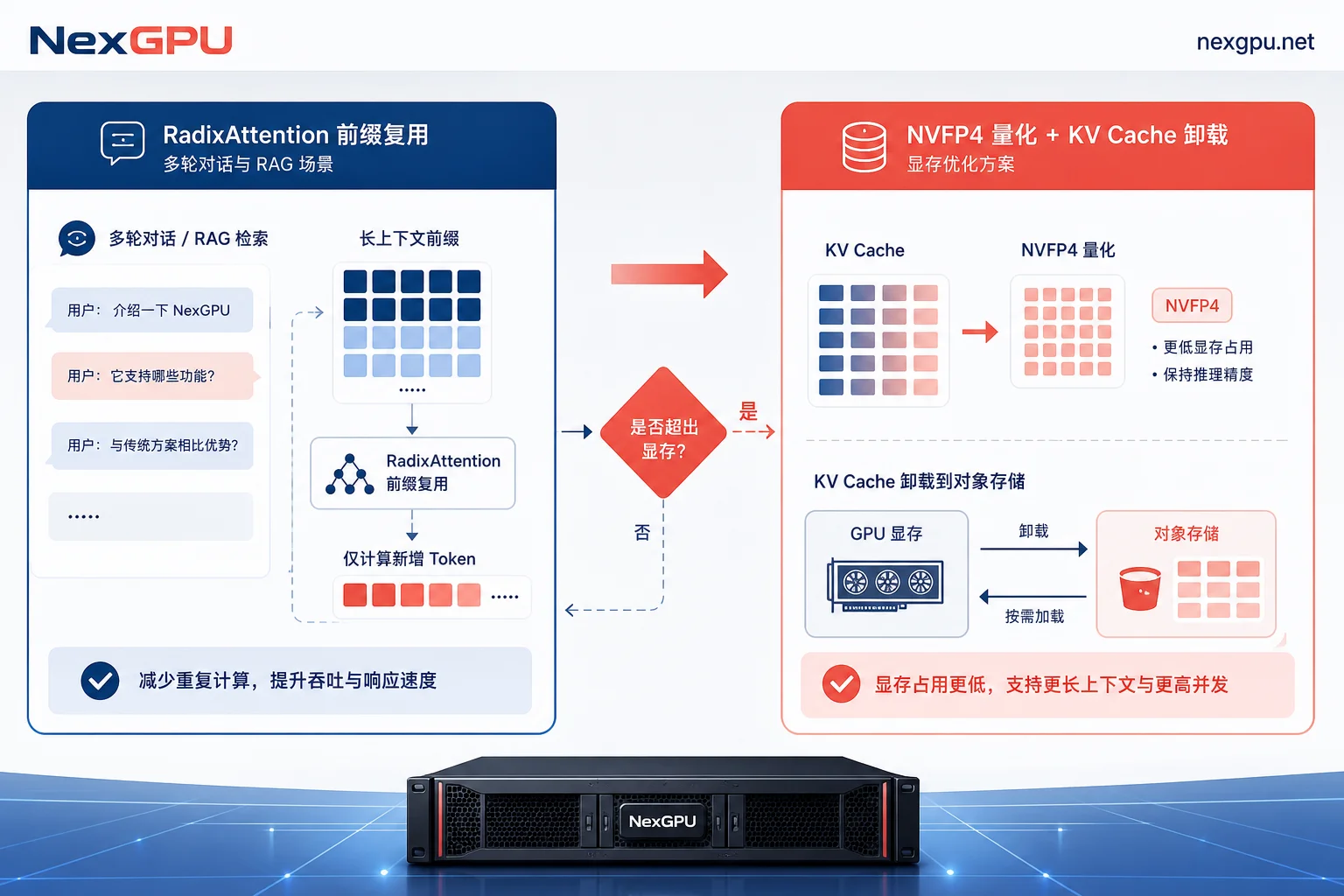
First, let's look at how the 29% lead came about. DeepInfra's benchmark ran on H100 GPUs with shared prefixes—many requests carrying the same system prompt, context, or retrieval prefix. In such workloads, SGLang's RadixAttention reuses the KV cache for prefixes, skipping the already-computed prefill for new requests, saving cross-request repeated prefix computation. Multi-turn conversation history, fixed retrieval templates in RAG, and long system prompts are typical high-prefix-repetition scenarios.
But 29% is not a universal gain. It depends on two conditions: the prefix must constitute a large portion of total input, and prefix repetition across requests must be high. If your requests are independent with short prefixes, or generation length far exceeds input length, prefill is not the dominant factor in single-request latency, so RadixAttention's savings are limited, and the 29% advantage shrinks significantly. So, don't rush to migrate upon seeing "29%"; quantify your workload first. To verify, record prefix repetition rates in your service and compute the common prefix length proportion across the first 1000 requests from logs—this gives a rough idea of the metric's relevance in your environment.
3. Which Cost Segment Does Each vLLM v0.26.0 Feature Target?
The three new capabilities in vLLM v0.26.0 each affect different cost components. NVFP4 quantization compresses weights to 4-bit floating point, directly reducing weight memory usage and memory bandwidth pressure, allowing larger models or batches in the same memory—this is memory optimization on the single-request path. The DeepSeek-V4 routing operator optimizes sparse routing in MoE architectures, making token-to-expert assignment more efficient; officially, E2E TPOT drops by 2.94%. TPOT is the generation time per output token, targeting single-request decode latency. Finally, object storage KV Cache offloading: when KV Cache exceeds VRAM, part is offloaded to object storage, shifting memory pressure to external storage I/O and extra network latency—a strategy trading memory for throughput, but offloading itself introduces latency costs.
These three features all target the "single-request path" and "memory usage," not overlapping with RadixAttention's "cross-request prefix reuse." Therefore, they are not mutually exclusive: you can use RadixAttention for prefix benefits on SGLang, or NVFP4 and KV offloading on vLLM to free memory. The essence of selection is confirming where your bottleneck lies.
4. Selection by Request Distribution: A Decision Table
Place both optimization types in the same decision table—don't pick sides by engine, but match your workload characteristics:
| Workload Characteristics | Prefer SGLang (RadixAttention) | Prefer vLLM v0.26.0 (Quantization/KV Offload) | Decision Basis |
|---|---|---|---|
| Multi-turn conversations (long history) | High prefix repetition, large cache hit benefit | Less advantage when prefixes are rare | Record common prefix proportion per turn |
| RAG scenarios (fixed retrieval templates) | High-frequency shared prompts/system prompts | Limited benefit if templates vary | Stat retrieval prefix repetition probability |
| Single-turn long generation (output >> input) | 29% will be flattened | Decode optimization and memory freeing more practical | Compare input/output token length ratio |
| Offline batch (independent requests) | Low prefix reuse probability | Quantization and KV offload stable and controllable | Analyze prefix similarity between requests |
| Memory-constrained large models | Requires extra memory for cache pool | NVFP4 and KV offload directly reduce memory | Check current memory headroom and peak |
This table doesn't decide for you; it tells you what to measure. The "decision basis" column indicates the metrics to collect in your environment.
5. SGLang Deployment Practical Path: From Startup to Prefix Cache and Concurrency Tuning Order
If the decision table points you toward SGLang, here's a reusable tutorial sequence for SGLang deployment. The core methodology is "run first, tune later; change one variable at a time" to avoid messing up parameters.
- Environment and weights preparation: Pull the official image, prepare weights and tokenizer for the target model, confirm precision and quantization format (e.g., NVFP4 support differences per official docs).
- Single-card run: Start with one GPU, run a simple request to confirm service responds; don't chase performance yet.
- Enable RadixAttention prefix caching: Check if it's on by default, record cache hit rate as requests increase; allocate cache pool size based on available memory (specific params per official docs; example values like
--max-prefill-tokensare illustrative). - Multi-card and parallel scaling: After single-card is stable, consider tensor parallelism or multi-card deployment; add one dimension at a time, avoid changing parallel and cache parameters simultaneously.
- Concurrency and batching convergence: Gradually increase concurrency, observe throughput, TTFT, TPOT, and memory peaks; adjust one concurrency or batch size parameter per round.
- Structured output integration: If business needs JSON or other constrained decoding, integrate SGLang's structured output capability and run end-to-end tests.
Record metrics at each step to trace where gains or regressions come from.
6. Migration Cost Evaluation: API Compatibility, Quantized Weight Formats, and Observability
When migrating from vLLM to SGLang (or vice versa), friction often lies in engineering details rather than performance. First, the OpenAI-compatible API layer usually changes little, but your wrappers, error handling, and streaming logic need regression testing. Second, whether quantized weight formats and precision schemes can be reused is critical: new formats like NVFP4 have inconsistent support across engines, so check official docs for the current version to see if your weights load directly; otherwise, conversion or re-quantization adds significant cost. Finally, observability: SGLang and vLLM expose different metrics and labels, so your monitoring, alerting, logging, and cost accounting pipelines may need rebuilding. Thus, migration decisions should compare one-time costs with expected throughput gains in the same time window: if the gain is only 5% but migration takes two weeks, it may not be worth it; if the gain is 29% and matches your workload, it's worth serious consideration.
7. A Side-by-Side Benchmark on Pay-as-You-Go GPUs with the Same Model and Load
Public benchmark numbers are references, not gospel. To reach your own conclusion, run a side-by-side test with the same model, load, and precision on pay-as-you-go GPUs. Here's the flow:
- Fix model and weight precision: Use the same weights and precision for both engines to eliminate variables.
- Replay real requests: Sample actual requests from logs, including system templates, user prompts, context length distribution, and compute prefix repetition.
- Uniform concurrency gradient: Run both engines under the same concurrency levels (e.g., 8/16/32/64) to ensure equal pressure.
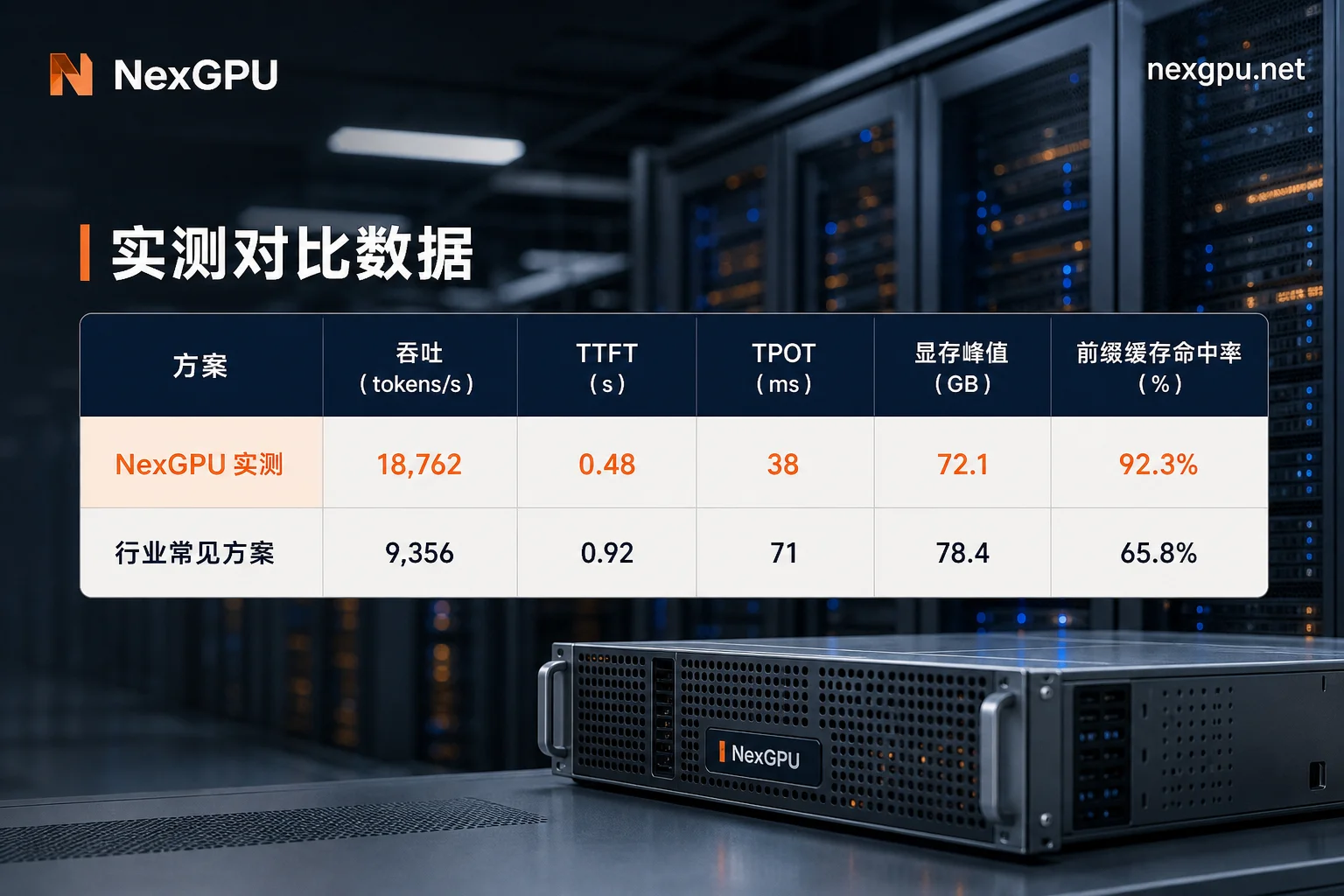
- Record key metrics: Throughput (tokens/s), TTFT, TPOT, peak memory, prefix cache hit rate; take median of at least three runs.
- Normalize by unit cost: Divide throughput by hourly rent of pay-as-you-go GPU to get cost per token, not just peak throughput.
If your prefix repetition is high, you may reproduce the ~29% gap; if low, the gap may narrow or even reverse. If you lack suitable local GPUs, platforms like NexGPU offer pay-as-you-go GPU rental and prebuilt templates, allowing you to run both engines on the same model and load and decide based on measured results. This is just an implementation means; there's no official relationship between the platform and the frameworks—the choice is yours.
8. SGLang Deployment Decision Checklist and Four Common Misjudgments
Finally, tick these boxes before deciding:
- [ ] Quantified your prefix repetition rate and input/output length ratio, not based on intuition.
- [ ] Confirmed memory headroom, whether it's tight enough to require quantization or KV offload.
- [ ] Confirmed whether structured output is needed and its support on both engines.
- [ ] Prepared a rollback plan to switch back to the original engine within an hour.
- [ ] Confirmed that observability metrics coverage from the new engine meets alerting requirements.
Also, avoid four common misjudgments:
- Treating the 29% shared-prefix gain as universal—confirm your workload is high-prefix-repetition.
- Assuming a new release invalidates old choices—vLLM v0.26.0 features address memory and single-request issues, not affecting SGLang's prefix reuse advantage.
- Ignoring the latency cost of KV offloading—offloading to object storage frees memory but worsens latency; test tail latency.
- Looking only at throughput, not cost per token—include pay-as-you-go GPU rent and total latency for true productivity.
Engines are tools, not beliefs. Spend a week logging your own prefix repetition and input/output ratios, run a side-by-side test on pay-as-you-go GPUs, and decide with data—not by version numbers or features.



Comments(0)