 NexGPU-算力租赁,GPU服务器,GPU云算力,AI服务器租用-新闻博客
In November 2026, the AI industry is undergoing a profound "revaluation of the compute ledger."
On one hand, "delivery certainty" at the macro infrastructure level has become a global focus. Affected by tighter power loads and data center approvals in many regions such as North America, the expansion cycles of traditional centralized data centers and some cloud providers have been lengthened, and long-term contracts for high-end compute are frequently delayed. On the other hand, as multimodal understanding, ComputerUse (computer operation capability), and complex AI Agents enter deep waters, enterprises are generally falling into a double anxiety over ROI (return on investment) when pushing large models from "demo" to "core production pipelines."
In this industry reshuffle from "extensive card stacking" to "cash flow and deterministic pricing," how should R&D teams and compute procurement adjust their AI compute rental strategies to secure deterministic spot compute while safeguarding the financial budget底线?
I. Enterprise AI Trapped in the Financial Ledger: Heavy Asset Sunk Costs and "Token Assassins"
In industry research and reports in Q4 2026, more and more technical leaders find that what hinders the large-scale implementation of "AI + business" is often not model capability, but disconnected compute delivery and billing models:
- "Heavy asset sunk costs" of long-term exclusive contracts and failed schedules
To cope with possible business peaks or post-training needs, many teams used to sign long-term whole-rack or annual compute packages. However, in the current environment, not only do new long-term contracts for high-end cards face long power-on and delivery schedules, but even if machines are obtained, idle machines during business troughs will continue to eat profits, causing serious waste of idle compute. - "Black-box costs" of public APIs and "Token Assassins"
If relying entirely on third-party public APIs billed by usage, once the business enters long-context reasoning, multimodal image/video generation, or AI Agent workflows requiring high-frequency iterative reflection, token consumption will jump exponentially. When business scales, the originally seemingly low call fees often turn into uncontrollable "Token Assassins," accompanied by hidden risks of data export compliance and concurrency throttling. - Budget distortion caused by price increases upon renewal
The structural differentiation of compute supply and demand puts some popular card models under pressure of unit price increases after contract expiration. Without a price lock mechanism, the marginal inference cost estimated at project initiation can easily be overturned half a year later.
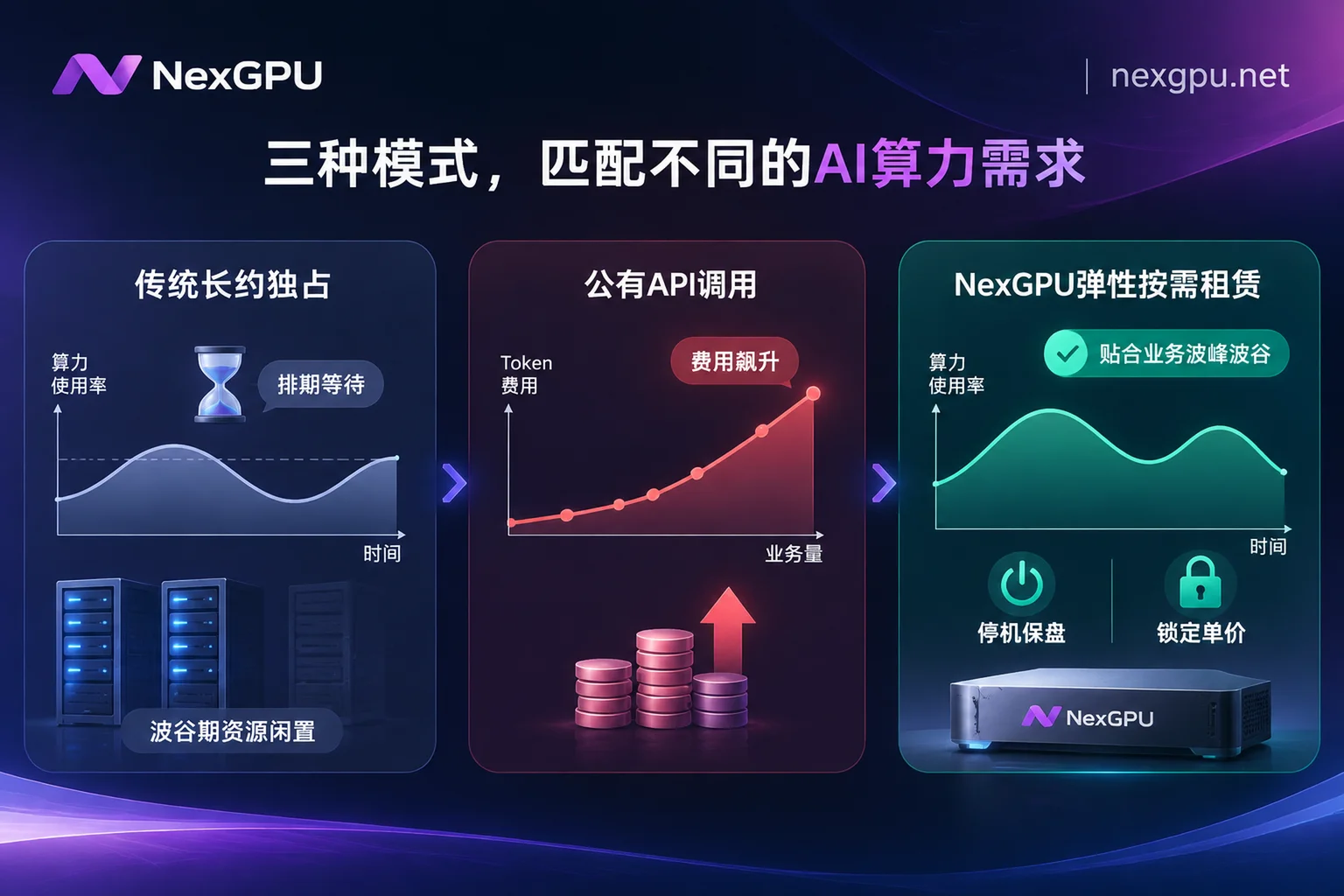
To break the deadlock of "afraid of idle when buying cards, afraid of explosion when calling APIs, afraid of delays when signing long-term contracts," the most pragmatic solution is to break down compute procurement from a "heavy asset bet" into a flexible GPU rental pipeline that can be started and stopped at any time, with locked unit prices, and autonomous control. For the macro card selection logic in the inference era, you can also refer to the previous analysis "AI Compute Rental Enters the "Inference Over Half" Era: How Small Teams and Developers Can Rent Cards on Demand and Calculate Costs Accurately."
II. Breakthrough Idea 1: Hedge Single Data Center Delivery Bottlenecks with a "Global Distributed Spot Market"
When centralized data centers in a single region are constrained by grid approvals or rack schedules, compute markets that aggregate global distributed GPU supply demonstrate high delivery resilience.
In the NexGPU Compute Market, compute delivery does not rely on lengthy business schedules; instead, it presents real rentable machines worldwide directly in a list:
- What you see is what you get spot filtering: Each row represents a real rentable physical machine. Whether it is consumer-grade GPUs for lightweight inference, image generation, and 3D rendering (RTX 3090, 4090, 5090, etc.) or data center-grade GPUs for large-scale fine-tuning and high-concurrency services (A100, H100, H200, B200, etc.), prices are clearly listed separately.
- Multi-dimensional transparent comparison of hard metrics: Procurement and developers can directly filter by VRAM size, price, region, machine reliability, network bandwidth, and minimum number of cards (for detailed filtering logic, see How to Choose GPU Documentation).
- Select environment first, automatically avoid pitfalls: If unsure whether a machine can run the target task, you can select an environment template before choosing a machine; the system will automatically mark machines with insufficient VRAM and indicate the specific reason, avoiding trial-and-error costs of "renting the wrong card causing OOM (out of memory)" from the source.
- Zero access friction: Registration only requires an email, no cumbersome real-name verification or long quota application; after registration, you can view real-time prices across the network without pre-binding a payment method, support Alipay and USDT (TRC20) deposits, and the number of cards opened is not limited by quota (only constrained by account balance), truly achieving "instant power-on, ready to use."
III. Breakthrough Idea 2: Cage the "Token Assassin" and Build a Private Inference Pipeline with Fixed Hourly Rental
Facing high API bills after business scaling, more and more teams choose to migrate core business back to self-built private deployment pipelines of open-source models—replacing unlimited token throughput with fixed GPU hourly rental.
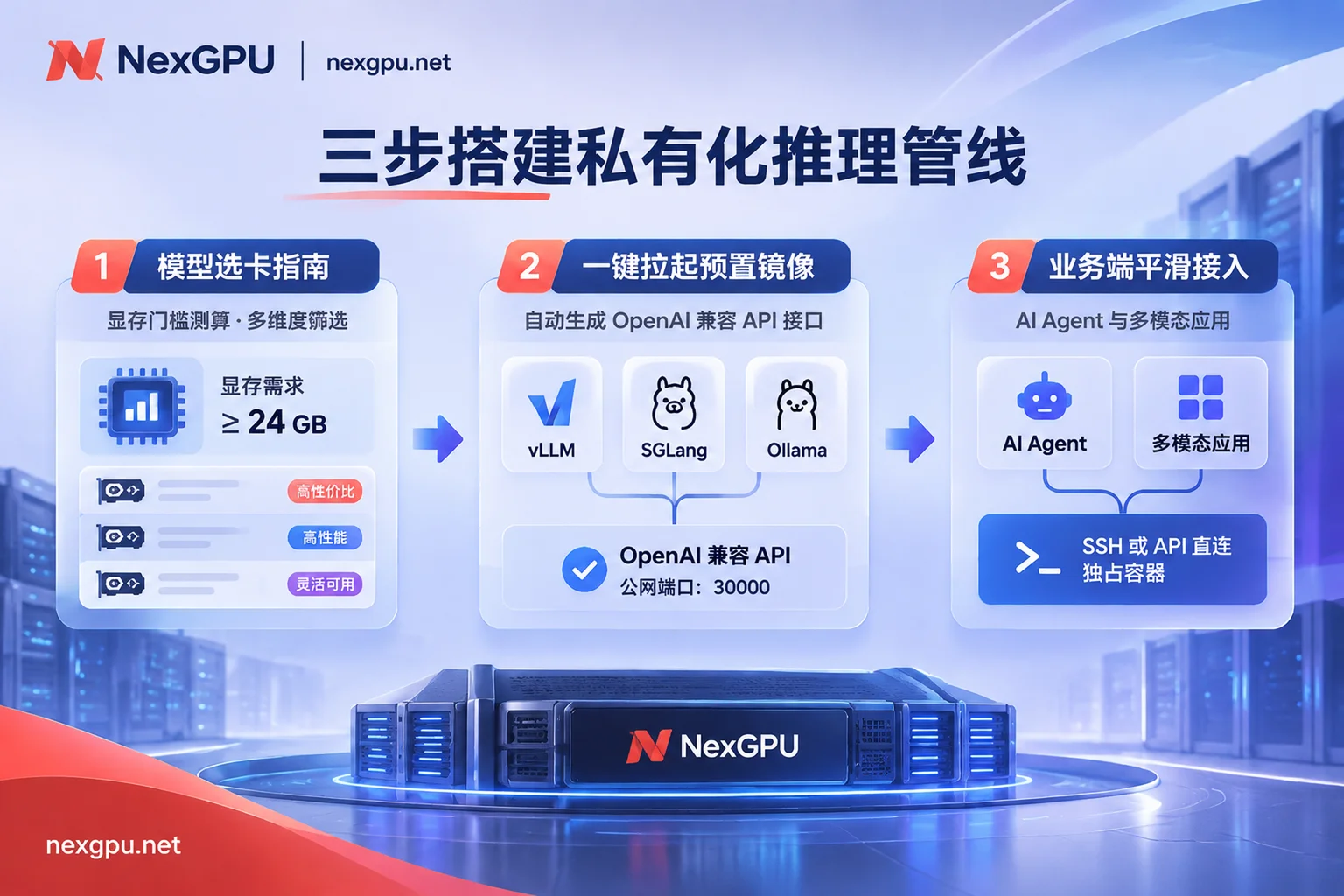
Through NexGPU's Scenario Practices Page and Model Card Selection Guide, teams can bypass cumbersome underlying environment tinkering and turn large model services into standardized "industrial assembly lines":
1. Tailor to needs, reject compute mismatch
In the Model Card Selection Guide, mainstream open-source models (covering text large models, multimodal vision, OCR, AI Agents, image/video generation, speech recognition and synthesis, etc.) all specify the current version, VRAM threshold after quantization, and recommended GPU models for rental. For example, when deploying Qwen series models, you can directly refer to the Qwen Exclusive Card Selection and Deployment Page or the in-site实战 guide "Qwen Deployment Practical Guide: From 7B/32B to 235B MoE, How to Select Cards, Configure Images, and Control Costs on Demand?" to match the minimum viable compute according to real concurrency needs.
2. One-click launch of OpenAI-compatible interfaces
No need to compile drivers and inference engines from scratch. In the Image Template Library, the large model inference category has pre-installed mainstream frameworks such as vLLM, TGI, Ollama, SGLang (including drivers, CUDA, and dependencies). Once an instance is launched, it can directly provide OpenAI-compatible interfaces. With the public IP and alternate service port mapping that come with each instance, the business side only needs to change one line of base_url to seamlessly switch traffic from expensive commercial APIs to private GPU instances (for specific migration details, refer to "vLLM Deployment Practical Guide: From Ollama to High-Concurrency Production Environment, How to Select Cards, Configure Images, and Open OpenAI-Compatible Interfaces"). In addition, if the team's code is locked to a specific CUDA version, the platform also supports custom Docker images from public or private repositories, with custom startup commands and environment variables.
3. Exclusive containers ensure data closed-loop
For overseas business or scenarios with high compliance requirements such as finance and government, each NexGPU instance is an exclusive container, and the platform does not read or back up disk contents. Developers can manage it through a browser web terminal, one-click Jupyter with token, or SSH direct connection via public IP + port without a jump server (see Instance Connection Guide for details), ensuring that core prompts and business data remain entirely within their own closed loop.
IV. Breakthrough Idea 3: Reconstruct the Compute ROI Ledger with "Price Lock Mechanism" and "Second-level Start/Stop"
To reassure the finance department about AI compute investment, bills must completely abandon "black boxes" and "hidden bundling." In "2026 GPU Cloud Server Bill Breakdown: How to Avoid Hidden Charges and Calculate Storage, Bandwidth, and Idle Compute Costs?," we detailed common traps in cloud bills. NexGPU's Billing Rules are designed around "high certainty":
| Cost Control Dimension | Traditional Extensive Rental / Complex Cloud Bill Pain Points | NexGPU Deterministic Billing Mechanism |
|---|---|---|
| Bill Composition | Hidden activation fees, port occupation fees, image licensing fees, minimum consumption thresholds | Only compute, storage, and traffic, listed transparently item by item on the instance details page; machine list separately indicates compute unit price and disk unit price |
| Price Fluctuation Risk | Unit price increases with market scarcity upon renewal, budget out of control | Price locked upon order: The unit price at the time of order is locked until the instance is destroyed, unaffected by subsequent market fluctuations |
| Idle Costs During Troughs | Monthly/yearly machines are billed and idle during off-hours or troughs | Billed per second, priced per hour: No minimum rental duration, compute fees only accrue when "running," compute fees stop immediately upon stop or destruction |
| Environment Preservation and Reuse | Releasing compute often means reinstalling environment and re-downloading hundreds of GB of weights | Stop and preserve disk: Retain disk and data in stopped state (only storage fee per GB/month), can restart and resume work at any time |
| Arrears Tolerance Mechanism | Balance depletion instantly forces release, causing loss of unsaved training results | Warning and buffer: Send email warning when balance is low; when depleted, automatically stop (not destroy) first, destroy only after timeout without recharge, can be restored by recharging in between |
Practical Tip: Since the platform does not read or back up user disk contents, and destroying an instance (requires entering instance ID for confirmation) immediately releases the disk and is irreversible, it is recommended to develop the habit of regularly syncing core fine-tuning weights and output results to external storage while using "stop and preserve disk" to control daily compute costs (see Instance Management Documentation for details).
V. From Single-Card Agile Validation to Multi-Card Clusters: A Smooth Evolution Path for Enterprises
In the market environment at the end of 2026, the healthiest AI evolution rhythm is "validate ROI in small steps, then scale out cards on demand after success":
- Validation Period (Single Card/On-Demand): Creators, beginners, or small R&D teams can directly refer to the Quick Start Guide, choose image templates pre-installed with PyTorch, LLaMA Factory, Unsloth, or ComfyUI, and rent a single RTX 4090/5090 or A100 by the hour to complete fine-tuning validation and workflow refinement.
- Scaling Period (Multi-Card Whole Machine Self-Service Ordering): When model parameters expand or distributed training and high-throughput inference with DeepSpeed, FSDP, Megatron are needed, you can filter multi-card nodes with high VRAM such as A100, H100, H200 by "minimum number of cards" in the GPU market. Multi-card nodes are rented as whole machines, with clear and transparent order amounts (unit price per card × number of cards), and can be launched self-service.
- Large-Scale Production Period (Enterprise Custom Solutions): For R&D teams and enterprise procurement that have achieved a commercial closed loop and need a long-term stable foundation, you can Contact Sales for enterprise-level solutions—supporting RDMA high-speed interconnect, data isolation, private networks, and dedicated compute clusters, and providing reserved instances, monthly/yearly packages, dedicated compute pools, as well as complete contract signing, corporate payment, invoicing, and PO procurement processes.
Regardless of fluctuations in external infrastructure cycles, taking compute initiative into your own hands and spending every penny on effectively running seconds is the hard truth for navigating the AI cycle. Now go to the NexGPU Official Website to check real-time spot market prices and start your journey of highly deterministic compute.



