 NexGPU-算力租赁,GPU服务器,GPU云算力,AI服务器租用-新闻博客
Against the backdrop of rapid advancements in generative AI and large models, AI server rental has become the preferred way for AI developers, algorithm engineers, and startup teams to access elastic compute power. With the surge in demand for fine-tuning large models and high-concurrency inference, the traditional approach of "directly purchasing hardware" faces challenges such as rapid depreciation, high initial investment, and steep operational costs.
Therefore, how to choose the right GPU cloud server based on specific business scenarios, while ensuring compute performance and minimizing costs, is a core issue that every compute procurement decision-maker must address.
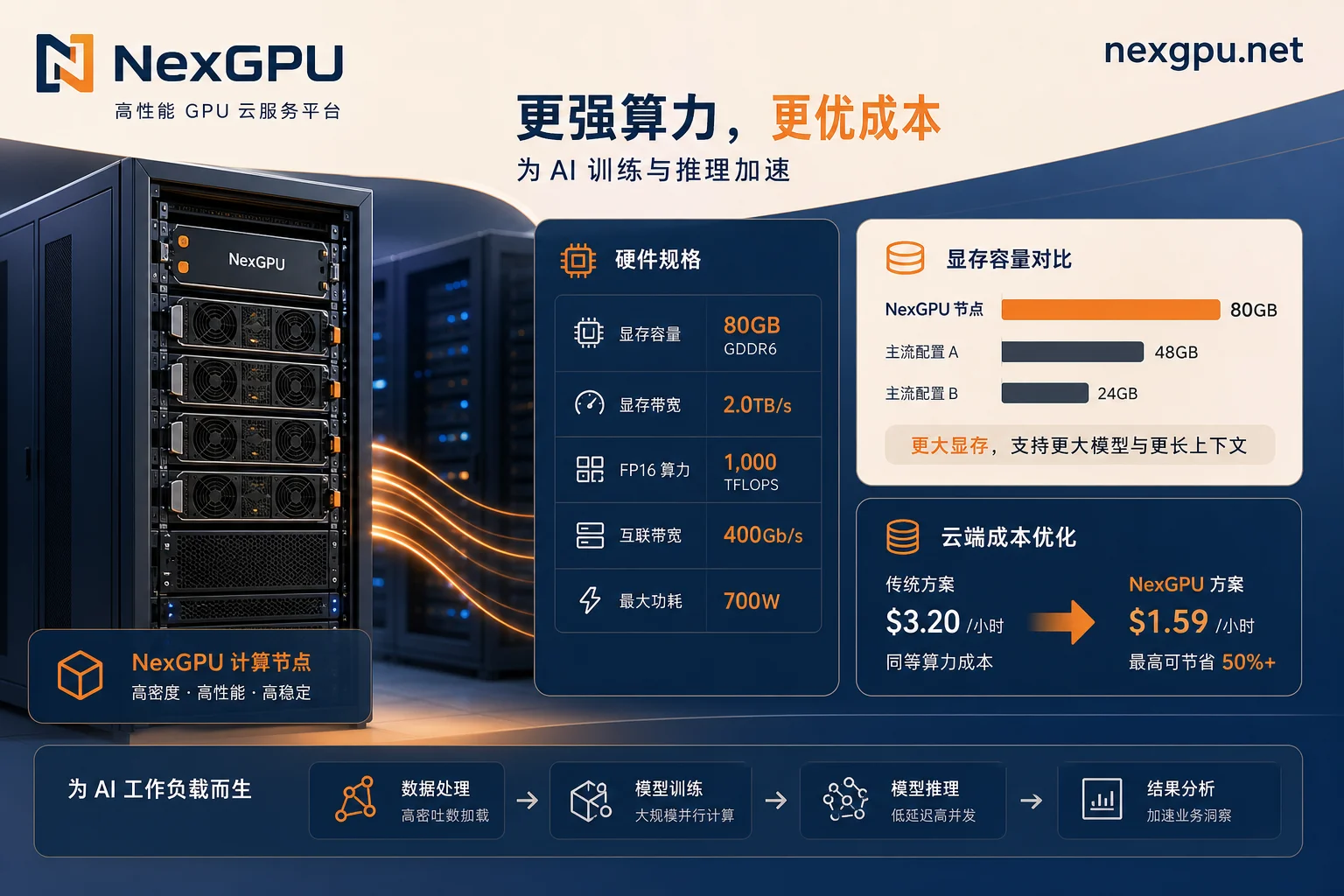
1. GPU Compute Market Dynamics and Rental Price Trends in 2026
According to the latest "Cloud GPU Rental Price Index" and market analysis released by GetDeploying and AIMultiple in July 2026, on-demand rental prices for cloud GPUs show clear stratification and divergence trends:
- Enterprise-grade high-performance training/inference cards (e.g., NVIDIA H100 / H200): On-demand rental prices on mainstream GPU cloud platforms range from $1.80 to $3.50 per GPU-hour. Meanwhile, H200 (141GB HBM3e) nodes with large memory are popular for long-context and large-parameter inference.
- Next-gen and consumer-grade high-value cards (e.g., RTX 4090 / RTX 5090): With excellent price-performance, these cards demonstrate high compute returns in lightweight fine-tuning, image generation, and small-to-medium API inference scenarios.
- Software ecosystem and deployment friction: Industry data shows that setting up development environments (e.g., version matching between CUDA drivers and frameworks such as PyTorch, FlashAttention, and vLLM) remains a major efficiency bottleneck. Out-of-the-box prebuilt images can effectively reduce hidden time costs.
2. How to Select: Matching AI Server Specifications to Your Scenarios
When choosing an AI server rental plan, three core dimensions should be considered: memory size, compute throughput, and network topology.
- Full fine-tuning of large language models and multi-node distributed training:
It is recommended to choose 8-GPU bare-metal or cloud container nodes (e.g., H100 / A100 80GB) with high-bandwidth NVLink interconnect. High-bandwidth interconnect significantly reduces distributed communication latency and boosts training throughput. - High-concurrency LLM inference and service deployment:
For open-source models in the 7B-70B range, quantization techniques (INT4/FP8) combined with inference engines like vLLM or SGLang can be flexibly deployed on GPU nodes with 24GB-48GB memory. - Experimental validation and POC development:
In the early stages, prioritize elastic pay-as-you-go models that can be started and stopped as needed, avoiding wasted compute on idle resources.
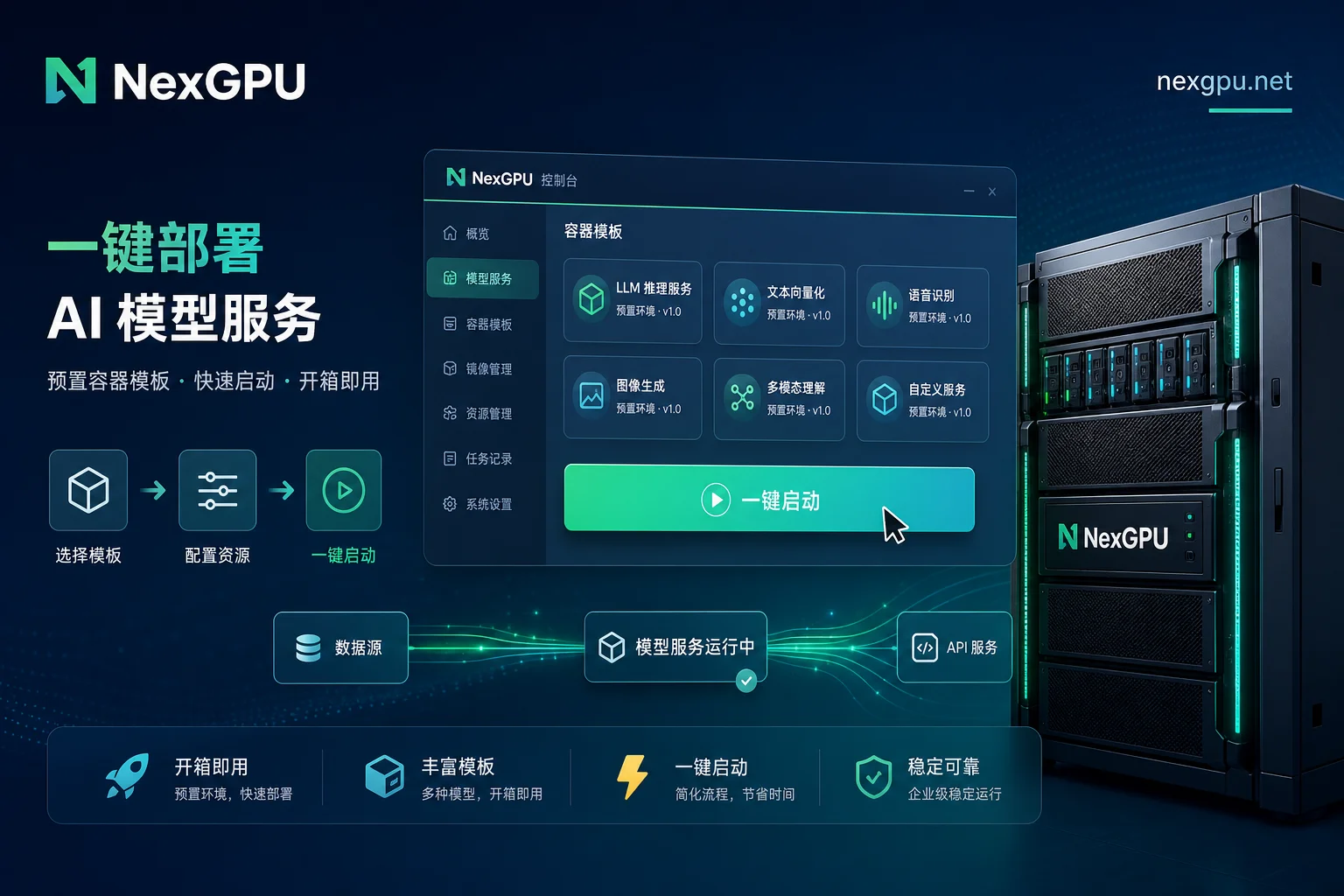
3. NexGPU Compute Platform: Flexible Pay-as-You-Go Rental and Rapid Deployment
Addressing developers' pain points in memory selection, environment configuration, and cost control, NexGPU offers GPU cloud compute and AI server rental services covering various business scenarios.
As a professional GPU compute platform, NexGPU provides the following capabilities and advantages:
- Rich hardware options: Featuring a variety of AI server models, from consumer-grade high-value cards to data-center-grade GPUs, to meet different compute needs from prototyping to large-scale production.
- Pay-as-you-go and instant start: Supports flexible pay-as-you-go pricing, eliminating high upfront costs. Instances can be created in seconds and shut down at any time.
- Prebuilt models and application templates: The platform includes mainstream open-source large models and deep learning framework images (e.g., PyTorch, vLLM, DeepSeek, and Stable Diffusion) for one-click deployment and rapid reproduction, reducing environment setup time to minutes.
Whether you need to quickly fine-tune a domain-specific model or build a high-availability inference API service, you can quickly find matching resource nodes and deployment templates on the NexGPU platform.
4. Practical Tips for Cost-Effective AI Server Rental
- Precisely evaluate memory budgets: Before deployment, calculate the memory required for model weights, context KV cache, and batch size to avoid unnecessarily upgrading to expensive cards due to out-of-memory (OOM) issues.
- Use application templates for rapid iteration: Leverage the platform's prebuilt images to skip complex dependency installation and accelerate project launch.
- Combine on-demand and reserved plans: Use pay-as-you-go during development and debugging, and switch to long-term reserved plans after the production service stabilizes, reducing overall costs by over 30%.
Reader Interaction and Discussion
In your current AI projects, what troubles your team the most: memory capacity bottlenecks, time spent on environment configuration, or compute rental costs? Feel free to share your selection practices and deployment insights in the comments!
Call to Action: If you are looking for cost-effective and instantly available GPU compute resources, visit NexGPU to explore a wide range of GPU server models and prebuilt application templates, and kick-start your AI deployment journey.


Comments(0)