 NexGPU-算力租赁,GPU服务器,GPU云算力,AI服务器租用-新闻博客
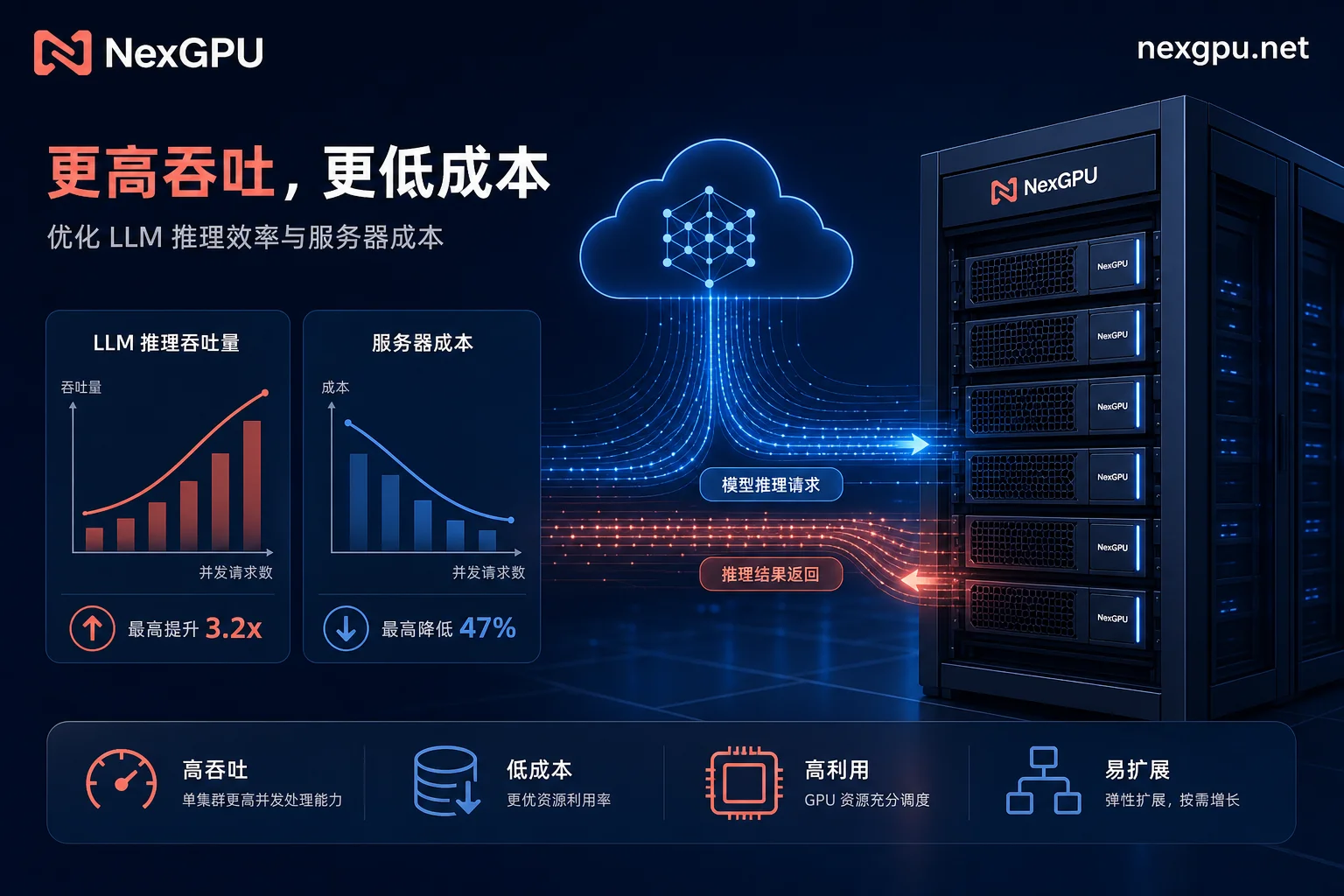
In the wave of large model deployment in 2026, the focus of AI teams' compute spending is undergoing a profound shift. With the prevalence of Agentic AI and complex multi-turn inference scenarios, inference compute consumption now runs 10 to 15 times that of the training phase. How to choose the right GPU compute platform and maximize compute output per unit while ensuring high concurrency and low latency has become a core challenge for algorithm engineers and compute procurement decision-makers.
I. Analysis of Two Key Trends in the 2026 GPU Compute Market
1. Soaring Inference Demand Strains Compute Costs
According to industry research from Sina Finance at the end of July 2026, as weekly token call volumes for large models hit new highs, the pricing for high-end GPUs and cloud compute leases remains elevated due to supply-demand dynamics. As many enterprises' AI applications shift from early "experimental training" to "round-the-clock high-frequency inference," fixed architectures and premium-priced compute place immense pressure on infrastructure budgets. Fine-grained management of GPU resources and reducing per-token inference costs (GPU FinOps) have become industry consensus [1] [2].
2. Heterogeneous Hardware Evolution and Architecture Specialization
Hardware vendors are undergoing intense architectural iteration targeting inference and agent scenarios. At the Advancing AI 2026 conference on July 23, 2026, AMD officially unveiled the Helios rack-scale system (integrating 72 Instinct MI455X GPUs and 18 6th-gen EPYC CPUs), emphasizing higher memory capacity and high-bandwidth connectivity to provide up to a 30% improvement in tokens-per-dollar for agentic inference [3]. Additionally, AIMultiple's latest evaluation data indicates that for mainstream open-source model inference, proper matching of memory bandwidth and compute architecture can directly yield several-fold cost-performance improvements [2].
II. Dimensions for Selecting a GPU Compute Platform for Developers and Enterprises
When choosing an efficient GPU compute platform, it is recommended to focus on the following three key metrics:
- Memory capacity and bandwidth match: For inference or long-context scenarios involving large models with 70B+ parameters, memory bottlenecks often outweigh compute bottlenecks. Choosing server architectures with high memory bandwidth and large memory capacity can significantly improve batching efficiency.
- Elastic pay-as-you-go and instant provisioning: Compute demands fluctuate widely across development testing, model fine-tuning, and business peaks. Platforms that support pay-as-you-go and instant provisioning can effectively avoid idle waste.
- Pre-configured images and template deployment: Environment configuration and dependency conflicts often consume days of engineering time. Platforms with pre-built model and application templates enable developers to achieve one-click startup within minutes.
III. Deployment and Migration Recommendations Based on NexGPU Scenarios
Facing diverse hardware models and evolving business needs, hardware selection should not only consider single-card specs but also the fit with your specific application scenarios:
- Lightweight model deployment and debugging: For small to medium-sized open-source models (7B-14B parameters) or development validation, there's no need to blindly chase top-tier flagship cards. Utilizing pay-as-you-go lightweight hardware nodes can meet development and testing needs.
- High-concurrency inference and large model fine-tuning: For high-concurrency throughput inference and LoRA fine-tuning, prioritize cluster configurations with large memory and high bandwidth, and use rapid startup templates to deploy optimized inference engines like vLLM or TGI.
NexGPU, as a platform focused on GPU cloud compute and AI server rental, offers a variety of GPU server models, supports pay-as-you-go and instant provisioning, and integrates pre-built models and application templates for deployment. With NexGPU's elastic resource scheduling and ready-to-use environments, development teams can complete the entire process from environment preparation to model service deployment in minutes, allowing them to focus on core business logic development and model performance tuning.
IV. Interaction and Actionable Recommendations
Compute Selection Mini-Survey: In your team, what is the main bottleneck in compute spending—insufficient memory, high unit prices, or tedious environment setup?
Action Recommendation: Before the next phase of large model deployment, first sort out your business's peak concurrency and response latency requirements. You can visit the NexGPU platform to view the pay-as-you-go rental configurations of multiple GPU server models, use pre-built model templates to set up a small-scale test node, and measure the per-token inference latency and cost performance before deciding on expansion plans.



Comments(0)