 NexGPU-算力租赁,GPU服务器,GPU云算力,AI服务器租用-新闻博客
On July 22, cloud service provider DigitalOcean released an official announcement stating that starting August 1, it will raise on-demand prices for its NVIDIA and AMD GPU instances by approximately 30%. The hourly rental for the NVIDIA H100 80GB will rise from $3.39 to $4.41, with similar increases for the H200 and AMD MI300X. The official reason cited is the rapid growth in demand for generative AI computing, leading to rising costs for data center expansion and power acquisition.
The overall increase in cloud hardware compute prices has directly disrupted the budget planning of many teams advancing model training and inference deployment. As cloud providers begin to raise base rates, the old approach of only looking at chip model and hourly price when searching for suitable GPU rental solutions is no longer sufficient to maintain cost balance. Evaluating the overall cost-effectiveness of a compute solution requires systematic comparison across four core dimensions: acquisition mode, supply channel, software-hardware synergy, and network topology.
GPU Rental Mode Comparison: Trade-offs Between On-Demand and Long-Term Dedicated
In the past, most small and medium-sized AI teams preferred pay-as-you-go on-demand models or spot instances that offer higher discounts but can be interrupted at any time. While on-demand lowers the barrier to entry, the financial pressure of frequent on-demand usage is rapidly amplified after a 30% increase in base unit prices.
In contrast, long-term dedicated compute is on the rise. On July 23, compute service provider QumulusAI announced a two-year agreement worth $32 million to supply NVIDIA Blackwell B300 compute power to a generative AI platform. This agreement indicates that as multimodal generation and real-time inference businesses move from the lab to large-scale production, enterprise demand for Service Level Agreements (SLAs) and continuous compute power is exploding.
In selection comparisons, on-demand and spot instances are suitable for early-stage code debugging, short-term model fine-tuning, and stateless offline batch tasks. In contrast, long-term reserved or dedicated clusters sacrifice short-term flexibility but offer lower unit hourly costs and stable hardware guarantees. When planning infrastructure, teams should separate baseline resident workloads from burst elastic workloads to avoid mounting all business on high-priced on-demand instances.
Evolution of Supply Channels: Standard Cloud Platforms vs. Secondary Markets
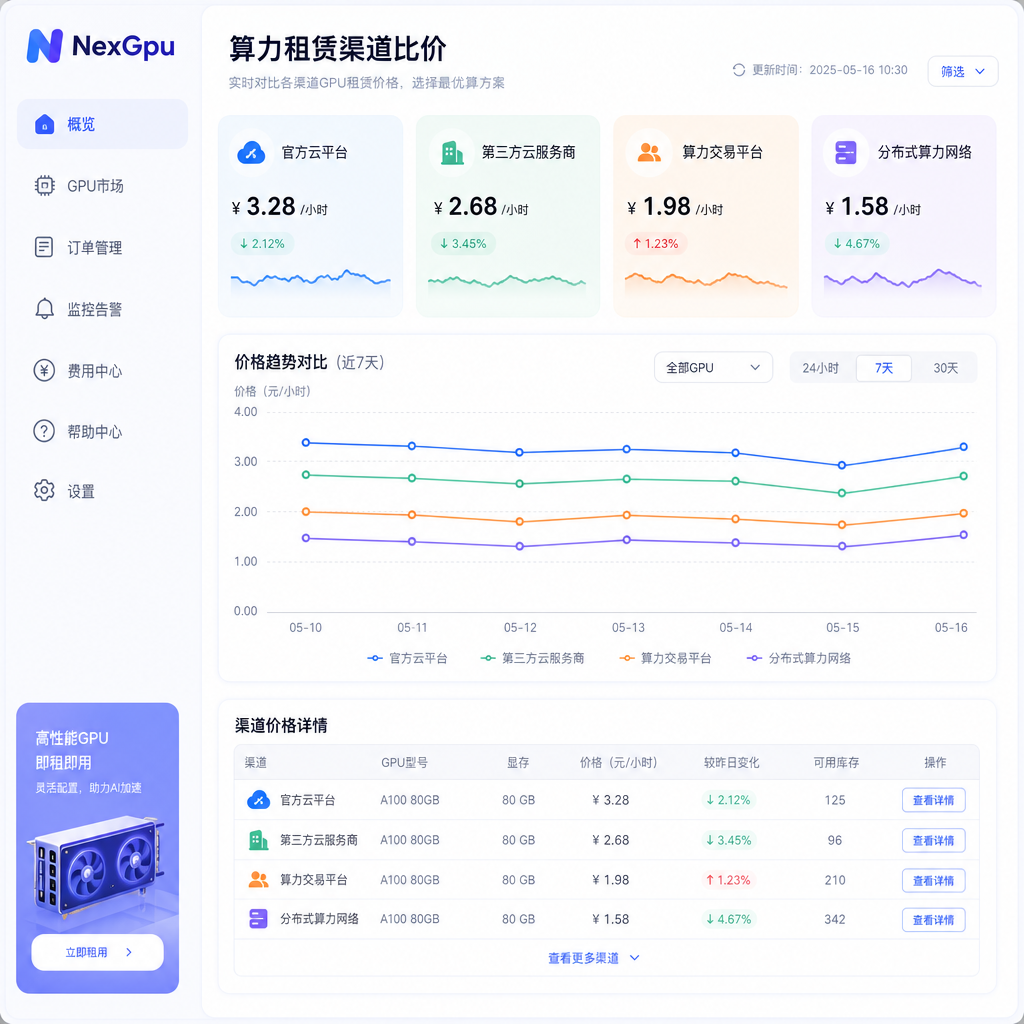
Beyond billing models, the diversification of supply channels adds a new comparison perspective to compute selection. In mid-July, Compute Exchange officially launched a secondary trading platform for used and refurbished NVIDIA H100 and A100 hardware. Meanwhile, the industry-released GPU Rental Price Index (GRPI) shows that quotes for the same hardware across different channels can vary by several times.
Standard cloud platforms offer a complete cloud-native toolchain, high-reliability hardware operations, and out-of-the-box convenience, but users must bear service premiums and pricing risks that adjust with market fluctuations.
In contrast, the emergence of secondary markets and refurbished hardware circulation platforms offers a more price-attractive alternative for compute procurement and medium-to-long-term rental. However, when evaluating such channels, teams must weigh hidden technical risks: whether hardware failure rate guarantee mechanisms are robust, whether cross-node interconnection bandwidth has been tested through real physical testing, and whether supporting cloud software stack support is available.
Software-Hardware Synergy: Software Optimization's Substitution Effect on Hardware Specifications
A common blind spot in the selection process is over-reliance on hardware specifications, assuming that only the latest flagship chips can meet deployment requirements. In fact, software evolution in inference frameworks is redefining actual hardware capacity.
In the vLLM v0.25.0 and LvLLM (v2.3.6) inference engine updates released on July 17, NVIDIA FP4 (NVFP4) low-precision quantization and dynamic speculative decoding technologies were fully introduced. These improvements enable graphics cards with 16GB to 24GB of VRAM to smoothly run models with 27B parameters, significantly lowering the hardware barrier for deploying medium-sized open-source models.
Simply stacking top-tier hardware, if model throughput and memory bandwidth bottlenecks are not resolved, often results in low memory utilization (MFU). Through deep software-hardware synergy, introducing advanced quantization and KV cache management mechanisms, teams can achieve excellent tokens per second on more cost-effective GPU architectures. In NexGpu's tests, a matched and optimized mid-range card cluster even outperformed an unoptimized top-tier cluster in terms of unit token operating cost in specific inference scenarios.
Network Topology and Scalability: Invisible Metrics Beyond VRAM
When building multi-card distributed training or tensor parallelism inference clusters, performance bottlenecks often depend not on the computing speed of individual GPUs but on communication efficiency between nodes.
Blindly comparing single-card prices can easily overlook differences in data center network architecture. When evaluating cluster options, teams should comprehensively calculate the following key metrics:
- VRAM capacity and memory bandwidth: Determines the upper limit for large model parameter loading and long context window processing capabilities;
- Inter-node interconnect bandwidth: Including NVLink topology domain size and RDMA network throughput, directly affecting communication latency in parallel computing;
- Framework and acceleration library compatibility: Whether native support for FlashAttention, CUDA Graph, and automated deployment tools exists;
- Fault tolerance and migration mechanisms: Whether the cluster provides rapid isolation of faulty nodes, snapshot recovery, and flexible expansion terms.
As large model deployment shifts from merely pursuing compute scale to focusing on investment return ratio, replacing single-dimensional hardware stacking with multi-dimensional evaluation allows teams to better control cost initiative in an environment of cloud provider price fluctuations.


Comments(0)