 NexGPU-算力租赁,GPU服务器,GPU云算力,AI服务器租用-新闻博客
If your AI team is preparing to deploy a multi-turn agent system to production, or handling high-concurrency knowledge base retrieval, you've likely felt the cost pressure recently. On July 21, DigitalOcean announced a price increase for some GPU instances effective August 1, reinforcing the reality of tight cloud hardware resources. Against the backdrop of budget constraints for compute rental, simply trimming prompt lengths or reducing concurrency is no longer sufficient to cope with real business growth.
In fact, the high cost of multi-turn conversations and long-context reasoning often stems not from the sheer size of model parameters, but from the inference engine's inefficient handling of repeated prefixes. In the pursuit of maximizing resource utilization, more and more engineering teams are shifting from traditional inference engines to SGLang, aiming to save real money at the architectural level.
Rising Cloud Hardware Costs: Why Are Multi-Turn Dialogues a Compute Black Hole?
In agent applications, systems typically need to input long contexts containing system prompts, historical conversation records, and external retrieved knowledge (RAG) to the LLM. With traditional inference frameworks, each time a user initiates a new query, the engine re-executes a prefill (prefix pre-filling) for previously computed content. This repetitive computation quickly consumes GPU compute TFLOPs and memory bandwidth as concurrency rises.
When evaluating specific compute rental costs, many developers find that out-of-memory (OOM) errors occur frequently. To prevent service crashes, teams must temporarily rent H100 or H200 nodes with higher memory. However, according to the latest compute evaluation data released in July, such repeated prefix computation accounts for nearly 40% of resource waste in the inference phase. Once you master prefix caching, the same memory configuration can handle double the concurrent requests.
Switching from vLLM to SGLang: Freeing Memory with RadixAttention
To solve the waste of prefix computation, the key is managing the KV cache (Key-Value Cache). In the past, developers commonly used vLLM, which relies on PagedAttention. While it addresses memory fragmentation through paging, cache reuse is limited when handling complex tree-like prefixes or branched dialogues.
SGLang introduces the RadixAttention mechanism. It builds the generated KV cache into a radix tree, dynamically matching and sharing at the token level. This design shows significant efficiency advantages in several high-frequency scenarios:
- Multi-turn agent interactions: The first few turns of dialogue in a long session are directly reused, and subsequent computations only need to process new tokens.
- Tree-like branch exploration: When agents perform self-consistency sampling or chain-of-thought searches, multiple branches share the same system prompt and context.
- Structured output extraction: When generating JSON or specific schemas, SGLang overlaps computation during the masked generation phase, reducing data transfer latency between CPU and GPU.
Real-world test data shows that for prefix-intensive tasks, SGLang can improve throughput by over 25% to 30% compared to traditional solutions. This means that with the same workload, teams can reduce the number of GPU nodes, thereby lowering compute rental costs.
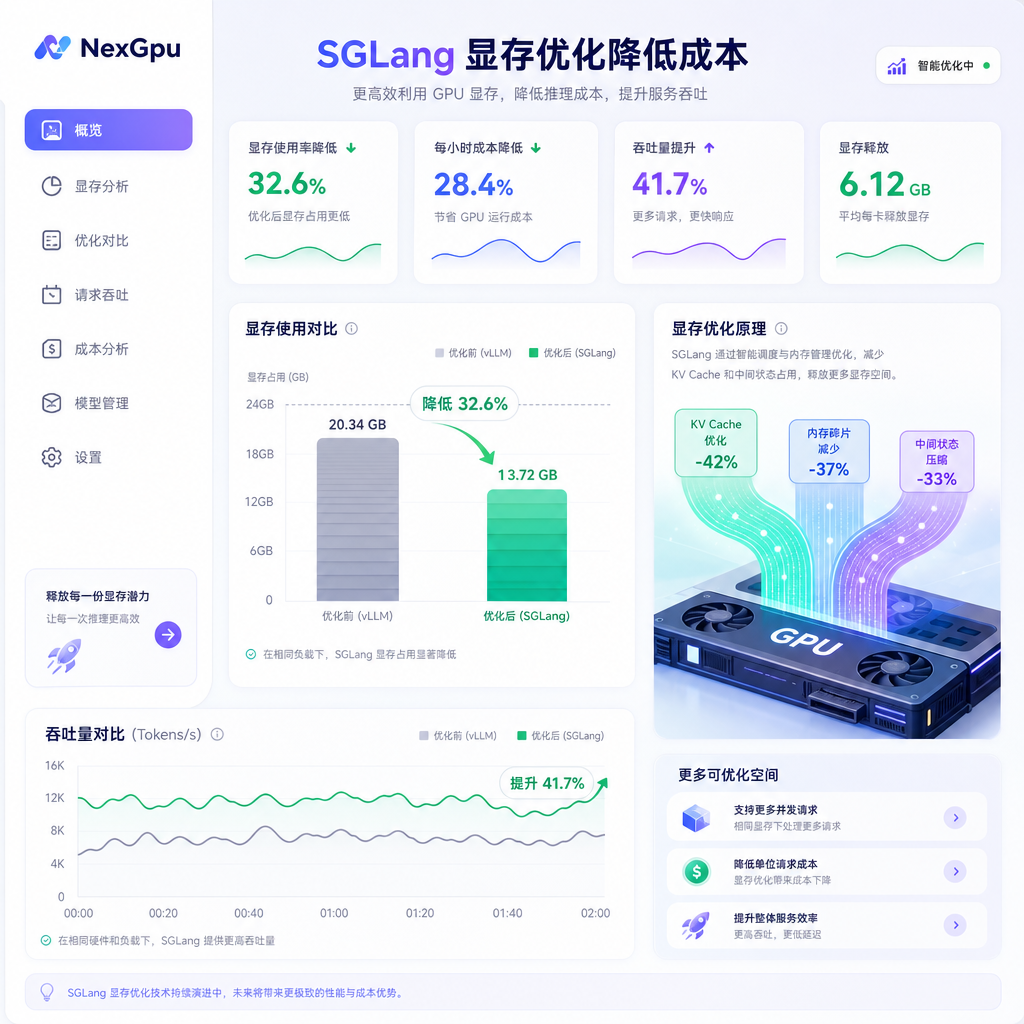
A Step-by-Step Plan to Deploy SGLang and Cut Compute Rental Costs
Migrating your existing LLM inference service to SGLang and achieving cost compression can be done in three steps:
Step 1: Prepare container environment and image. Configure a Docker environment with CUDA 12+ support on your compute nodes. Pull the latest official SGLang Docker image to set up the runtime, ensuring it includes Triton Kernel optimizations for NVIDIA Tensor Cores.
Step 2: Configure RadixAttention and memory pre-allocation parameters. When starting the service, specify the --enable-torch-compile and --mem-fraction-static parameters to lock the memory usage ratio. Setting it around 0.90 leaves sufficient buffer for the dynamic radix tree, avoiding memory jitter due to traffic spikes. If you rent pay-per-second compute nodes on the NexGpu platform, you can automate this configuration in the service initialization script.
Step 3: Integrate the OpenAI-compatible interface and enable structured constraints. SGLang natively supports the OpenAI API protocol, so your frontend doesn't need code changes—just update the base URL. For JSON output scenarios, introduce SGLang's dynamic regex constraints to block invalid tokens during generation, saving compute power wasted on invalid outputs.
Combining Elastic Scheduling to Use Every Bit of Compute Wisely
Solving the inference engine efficiency issue is only the first step; combining it with flexible cloud compute is key to controlling the overall bill. In real projects, traffic often has clear peaks and valleys. If you rent high-config nodes on a monthly basis to handle peak loads, the waste during idle periods can be staggering.
By deploying SGLang images on elastic compute nodes provided by NexGpu, teams can build a highly elastic inference cluster. Leveraging SGLang's efficient cold-start warm-up and dynamic prefix reuse, nodes can quickly reach full throughput after being spun up. During nights or off-peak periods, automated scripts can release unnecessary GPU instances, keeping only the baseline service nodes.
As AI models evolve toward deep agents and continuous post-training in the second half of 2026, and as NVIDIA emphasized in its latest technical seminar in July, the cost per token will become a core metric for measuring the viability of AI products. Optimizing inference architecture is not just a response to cloud provider price adjustments; it's also fundamental for technical teams to ensure long-term sustainable business operations.




Comments(0)