 NexGPU-算力租赁,GPU服务器,GPU云算力,AI服务器租用-新闻博客
SGLang's official release at the end of July 2026 provides Day-0 native inference support for the Kimi K3 2.8T LatentMoE model and the MiniMax-H3 audio-video model, introduces DCP (Decode Context Parallelism), DSpark speculative decoding, KDA-aware prefix caching, and FlashInfer optimizations, and has been validated on GB300 and B200 hardware clusters (information from the official SGLang release). For most engineers responsible for deploying large model inference, the real point of interest isn't 'the model can run on new architectures again,' but rather that these changes are redefining the planning parameters for GPU clusters: how node count is determined, how topology is chosen, and how the VRAM budget is calculated. This article will translate this update into actionable cluster decisions across these three dimensions.
1. What Layer of the GPU Cluster Does This SGLang Update Actually Change?
The Day-0 support in the latest SGLang release is often viewed as a 'compatibility update,' but the two types of models involved—trillion-parameter-scale LatentMoE and unified audio-video models—are precisely the workloads that place the highest demand on cluster resources in current production inference. A scale like Kimi K3 2.8T means the model weights alone far exceed the VRAM of a single GPU, while unified audio-video models generally tend to produce longer sequences and larger intermediate activations (this is a general inference; the official release does not specify sequence length or activation scale for that model).
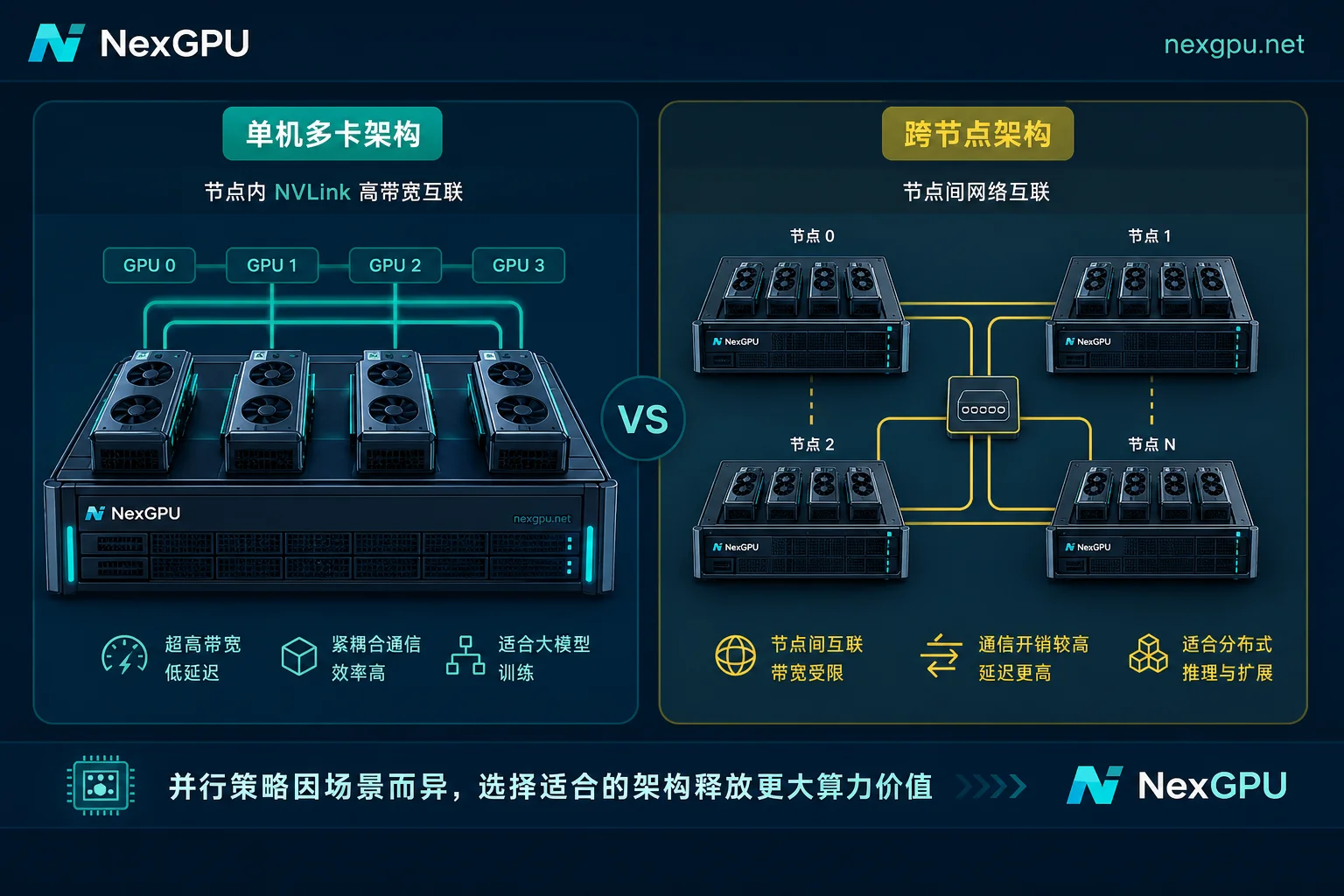
In the official deployment documentation, when introducing distributed parallelism and cluster deployment, the topology configuration principle is clear: prioritize using NVLink's high bandwidth for tensor parallelism (TP) within a single node, and when scaling across nodes, use DCP to shard the KV cache along the sequence dimension during the decoding phase, or combine pipeline parallelism (PP) with RadixAttention prefix caching to eliminate redundant cross-node AllReduce communication and reduce VRAM usage and time-to-first-token (TTFT).
In other words, this update isn't about 'can the model run' but 'how should the cluster be partitioned.' It directly impacts three decision points when planning your GPU cluster: what parallel strategy to use within a node, what communication pattern to use across nodes, and how to allocate the VRAM budget.
2. Translating DCP into Cluster Language: Sharding KV Along Sequence in Decoding Eliminates Which Cross-Node Communication
DCP's core mechanism is to shard the KV cache along the sequence dimension during the decoding phase. Traditionally, when a model is large enough to require cross-node deployment, tensor parallelism (TP) shards weights and activations across multiple GPUs within every Transformer layer, which requires cross-node synchronization of intermediate activation results at each step, generating high-frequency AllReduce communication. In contexts where inter-node bandwidth is far lower than NVLink, this communication often becomes the throughput bottleneck.
The official deployment documentation states that DCP shards the KV cache along the sequence dimension during the decoding phase to eliminate redundant cross-node AllReduce communication. Based on this mechanism, its communication pattern is fundamentally different from sharding along the tensor dimension, but the official documentation does not provide quantitative information on communication frequency or data volume.
Note: The official documentation does not provide acceleration ratios or TTFT numbers for DCP, and we should not speculate on specific benefits. However, the mechanistic difference is clear—sharding by sequence versus by tensor has a fundamental difference in communication patterns, with the former better suited to low-bandwidth cross-node cluster environments.
Actionable judgment: If your current model requires cross-node deployment and the primary bottleneck is cross-node communication wait, DCP is worth considering as the primary parallelism scheme; but benefits must be measured on your own workload.
3. Single-Node TP, Cross-Node PP/DCP: How to Understand the Official Topology Boundary
The official deployment guide gives a very clear topology principle: prioritize TP within a single node, and use PP/DCP for cross-node. Behind this principle is the reality of interconnect bandwidth constraints.
- TP consumes interconnect bandwidth: Tensor parallelism requires AllReduce of intermediate results at every layer, generating massive communication, and therefore must rely on the high bandwidth of NVLink within a node. Intra-node interconnect bandwidth is significantly higher than typical inter-node network bandwidth; specific values should refer to your own hardware specifications.
- PP/DCP has lower communication volume: Pipeline parallelism only passes activations at layer boundaries, with low communication frequency; DCP passes small amounts of KV information between decoding steps. Both have lower bandwidth requirements, making them suitable for cross-node deployment.
This boundary tells us that the first constraint for large model inference GPU cluster topology selection is not 'how many GPUs do you have' but 'what parallelism degree can the intra-node interconnect support.' If your model weights require 4 GPUs to fit and those 4 GPUs are in the same node, TP is the preferred option; once the number of GPUs exceeds the single-node limit (usually 8), you must consider cross-node, and then you should switch to PP/DCP rather than forcibly increasing the TP size.
Actionable judgment: When planning a GPU cluster, first calculate the TP size that a single node can accommodate, then decide whether cross-node is needed.
4. Three Types of Pressure on GPU Clusters from Ultra-Large MoE and Multimodal Models: VRAM, Interconnect Bandwidth, and Long-Context KV
The two types of models with Day-0 support in this SGLang release represent two typical load pressures. Abstractly, they place three types of pressure on GPU clusters:
- Weight VRAM pressure: Trillion-scale LatentMoE models have massive total weight, and even though MoE structure reduces activation parameters, weight storage still requires multi-GPU sharding. This directly determines the minimum number of GPUs in the cluster.
- Interconnect bandwidth pressure: Multimodal models (e.g., audio-video integration) process long sequences and require frequent exchange of intermediate states between compute nodes. If the parallelism strategy is inappropriate, cross-node communication extends the wait time at each step, reducing GPU utilization.
- Long-context KV pressure: KV cache grows linearly with context length. Ultra-long contexts (e.g., video sequences or long documents) cause a surge in KV VRAM usage, and the decoding phase has massive KV access, where the communication pattern directly impacts access efficiency. DCP's design of sharding KV along the sequence dimension targets exactly this pressure.
These three pressure sources act on the same cluster but with different emphases. The question of how many GPUs are needed to form a cluster for MoE models actually depends on whether the heaviest pressure is weight VRAM or KV VRAM: the former requires more GPUs to shard weights, while the latter is better suited to DCP or prefix caching optimization.
5. From Model Scale to Node Count: A Reusable Estimation Sequence for VRAM and Parallel Sharding
Below is a general estimation sequence applicable to most large model inference scenarios. Note: this section is an estimation framework, not an official conclusion; you must verify it yourself.
- Estimate weight VRAM: Divide total weight bytes (e.g., parameter count × bytes per parameter) by single-GPU VRAM to get the minimum GPU count lower bound. For MoE models, weight VRAM must be calculated based on the sum of all expert weights, not just activation parameters.
- Estimate KV cache VRAM: KV cache size = number of layers × number of KV heads × head dimension × 2 (K/V) × bytes per element × sequence length × concurrency. With GQA/MLA structures, the number of KV heads is much smaller than attention heads, so use actual configuration.
- Add activation and framework overhead: Activation size relates to batch size and sequence length; generally reserve 20-30% headroom.
- Divide by usable VRAM per GPU: Get the minimum number of GPUs.
- Determine node count: Divide the minimum GPU count by the GPUs per node limit (e.g., 8), round up to get node count. If greater than 1, cross-node is needed, and parallelism strategy must switch from TP to PP/DCP.
This sequence directly answers the questions of how to calculate VRAM for multi-node GPU clusters and how to plan node count for GPU clusters. For example, if the total VRAM of an 8-GPU node cannot hold your weights + KV, then the node count is not 1 but 2 or more.
6. Three Boundary Lines: Single GPU Suffices, Single Node Multi-GPU Suffices, Cross-Node Cluster Required
Based on the above estimation, we can draw three decision boundaries:
- Single GPU suffices: When total VRAM demand (weights + KV + activations) is less than the usable VRAM of a single GPU and concurrency is low, no parallelism is needed; a single GPU can serve.
- Single node multi-GPU suffices: Total VRAM demand exceeds a single GPU but remains within a single node (e.g., 8 GPUs); then TP is the preferred choice. Since all GPUs are in the same node, they benefit from NVLink high bandwidth, and communication overhead is acceptable.
- Cross-node required: When total VRAM demand exceeds the single-node limit, or long context makes KV the primary bottleneck, cross-node is needed. In this case, use PP or DCP, and be mindful of cross-node communication costs.
Note: Cross-node should not be the default option. Cross-node introduces communication latency, especially without optimizations like DCP, and TTFT may increase significantly. Therefore, the decision of single-node multi-GPU vs. cross-node GPU cluster should be based on VRAM accounting and measured communication overhead, not blindly going cross-node just because model parameters are large.
7. Cluster Parameter Configuration Order: Parallelism Strategy, Prefix Cache Hit, Speculative Decoding Activation Order
Once cluster size is determined, the order of SGLang configuration parameters has a logical sequence:
- Determine parallelism strategy first: Based on node count, choose TP degree, PP layers, or DCP degree. This is the foundation; get the service running first.
- Then evaluate prefix caching: RadixAttention prefix caching (including KDA-aware variants) is suitable for business scenarios with many repeated prefixes, such as multi-turn dialogues or document QA. In scenarios with high prefix repetition, it can reduce redundant computation and cache overhead. The official documentation does not provide specific magnitudes; you need to A/B test yourself.
- Finally consider speculative decoding: DSpark speculative decoding can accelerate token generation during the output phase, but the benefit depends on model architecture and output length; it is an incremental optimization.
This configuration order helps you avoid falling into the trap of 'optimizing for the sake of optimization'—ensure correctness first, then consider efficiency.
8. Using On-Demand Multi-GPU Resources for a Same-Load Comparison Test: Single Node vs. Cross Node
Before formally building a cluster, the safest approach is a small-scale controlled experiment using on-demand GPU resources. Specific steps:
- Fix the same model, same concurrency, and same context length.
- Run on a single-node multi-GPU configuration (e.g., 8 GPUs in one node), recording TTFT, per-request throughput, peak VRAM usage, and cache hit rate.
- Run the same load on a cross-node configuration (same total GPUs split into 2 nodes), recording the same metrics.
- Compare communication wait ratio and GPU utilization.
If you don't have an existing multi-node environment, consider using NexGPU's on-demand GPU resources. NexGPU provides various GPU server models with pre-built model/application templates for quick SGLang deployment. You can first launch single-node multi-GPU and cross-node instances under the same load, verify the above estimations with real data, and then determine long-term cluster specifications. After validating the estimation with small-scale real data, decide on the long-term cluster size.

9. GPU Cluster Planning Checklist and Four Common Misconceptions
Finally, here is a checkable planning checklist and common misconceptions:
Checklist:
- [ ] Has the VRAM budget been estimated separately for weights, KV, and activations?
- [ ] Does the parallelism strategy match the intra-node interconnect?
- [ ] Has prefix cache hit rate been considered?
- [ ] Is a scaling path reserved (e.g., from single-node adding GPUs to cross-node)?
- [ ] Are the metrics that must be measured vs. those that are only estimated clearly defined?
Four common misconceptions:
- Treating model parameter count directly as VRAM demand, ignoring the amplification effect of KV cache with concurrency and sequence length.
- Linearly extrapolating single-node multi-GPU measured results to cross-node clusters, ignoring changes in communication wait ratio.
- Continuing to use TP by default when crossing nodes, leading to excessive cross-node communication overhead.
- Treating new framework features (e.g., DCP, speculative decoding) as free performance without considering workload suitability.
Recommendation: First calculate your VRAM budget and node count using the estimation sequence in Section 5, then use on-demand multi-GPU resources to run a same-load comparison between single-node and cross-node, and decide whether to build a GPU cluster based on measured data rather than model parameter count.




Comments(0)