 NexGPU-算力租赁,GPU服务器,GPU云算力,AI服务器租用-新闻博客
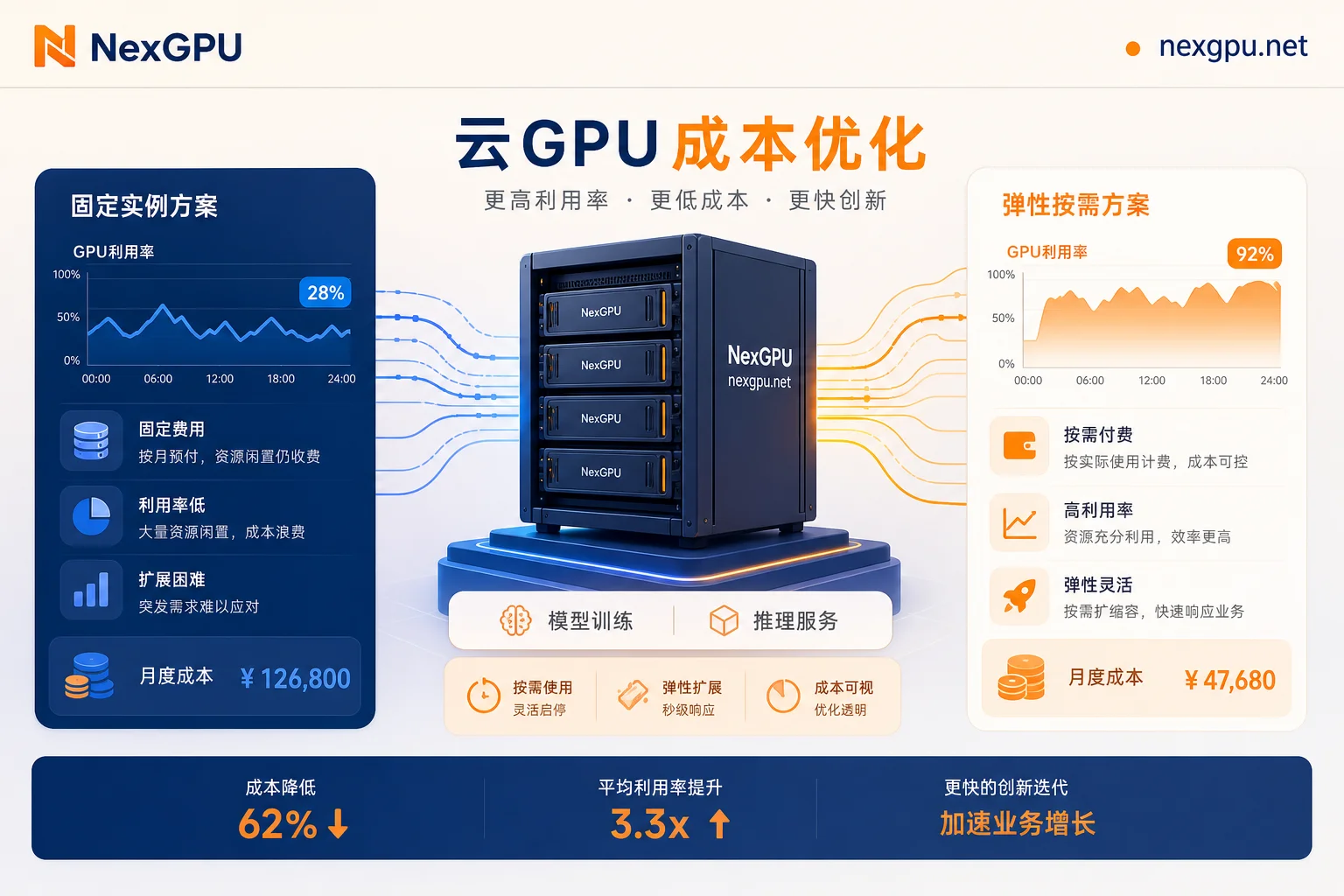
In 2026, with the explosive growth of generative AI and Agentic AI, compute budgets are undergoing profound structural shifts. According to SquareOps' July 2026 AI cloud cost management report, 98% of enterprises have made AI cost management a top priority, with average monthly AI cloud spending reaching $85,000, of which GPU compute accounts for 55% of total expenditures. However, global Kubernetes cluster monitoring telemetry published by Arc Compute in July 2026 reveals a harsh reality: clusters without fine-grained optimization have an average cloud GPU utilization of just 5%. That means up to 95% of compute budgets are spent on 'computational idle time'.
How to break this vicious cycle of 'renting cloud GPUs at high cost while leaving them largely idle'? The NexGPU team has compiled the latest GPU FinOps (compute financial operations) practices, from hardware selection and inference framework optimization to cloud resource billing strategies, providing you with an actionable guide to reduce costs and increase efficiency.
The Three Major 'Bleeding Points' of Cloud GPU Cost Waste
During NVIDIA SIGGRAPH 2026, the industry focused on the surge in compute density brought by Agentic AI and physical world models. As model inference gradually replaces training as the largest compute consumer, cloud GPU cost leakage is concentrated in the following three areas:
- Hardware Over-provisioning: Developers tend to lock in flagship H100 or B200 instances, but when handling small to medium models or lightweight agent tasks, high-bandwidth memory above 80GB and FP4/FP8 compute units remain underutilized for long periods.
- Static Batching and KV Cache Management Failure: If the inference service layer does not adopt Continuous Batching or PagedAttention, GPUs will have significant idle cycles while waiting for request queuing and context transfer.
- Rigid Long-Term Reserved Instances: Many teams, to avoid 'not being able to rent GPUs,' reserve idle nodes on a monthly or yearly basis in advance, but continue paying full bills during business traffic troughs.
Three-Step Optimization Path to Reduce Cloud GPU Costs
To address the above waste, engineering teams can restructure their compute architecture with the following strategies:
Step 1: Precise Selection Based on Context and Precision
Don't blindly pursue top-tier cards. For example, in FP8/INT4 quantization scenarios, inference memory usage for 14B or 32B parameter models drops significantly. Using high-performance RTX series or previous-generation enterprise GPUs can often reduce cost per token by over 40% while meeting P95 latency requirements.
Step 2: Optimize Serving Runtime and Memory Reuse
Introduce mainstream inference engines like vLLM or TensorRT-LLM, enabling PagedAttention and continuous batching. This can boost GPU throughput by 3-5x, significantly increasing GPU utilization without additional hardware investment.
Step 3: Flexibly Combine 'Pay-as-You-Go' and 'Prebuilt Templates'
Separate development testing, temporary stress testing, and long-running inference. Use elastic cloud GPU resources on a pay-as-you-go basis for burst traffic, avoiding high fixed costs around the clock.
NexGPU: Building an Elastic and Efficient Cloud GPU Deployment Ecosystem
As a professional GPU cloud compute and AI server rental platform, NexGPU is committed to helping AI developers and enterprise procurement decision-makers completely solve the problem of compute waste.
For different AI training and inference scenarios, NexGPU offers a wide range of GPU server models. Whether you need multi-card clusters with high throughput and large memory, or single-card inference nodes with high cost-effectiveness, developers can achieve instant availability and pay-as-you-go, avoiding fixed asset sinking and compute idle costs from the source.
At the same time, to reduce the time cost of environment setup, NexGPU provides rich prebuilt models and application templates, supporting one-click deployment of mainstream open-source large models and inference frameworks. This shortens the cycle from code debugging to production, and ensures teams can validate algorithm logic at the lowest cost during business experimentation.
Summary and Implementation Advice
Reducing compute costs does not mean sacrificing model performance, but rather using more scientific FinOps methodologies to make every second of every cloud GPU valuable. It is recommended that operations and MLOps teams first visualize monitoring of GPU busy % and token throughput, then experience pay-as-you-go billing and prebuilt deployment templates on the NexGPU platform, achieving slimmer compute bills while maintaining high business availability.




Comments(0)