 NexGPU-算力租赁,GPU服务器,GPU云算力,AI服务器租用-新闻博客
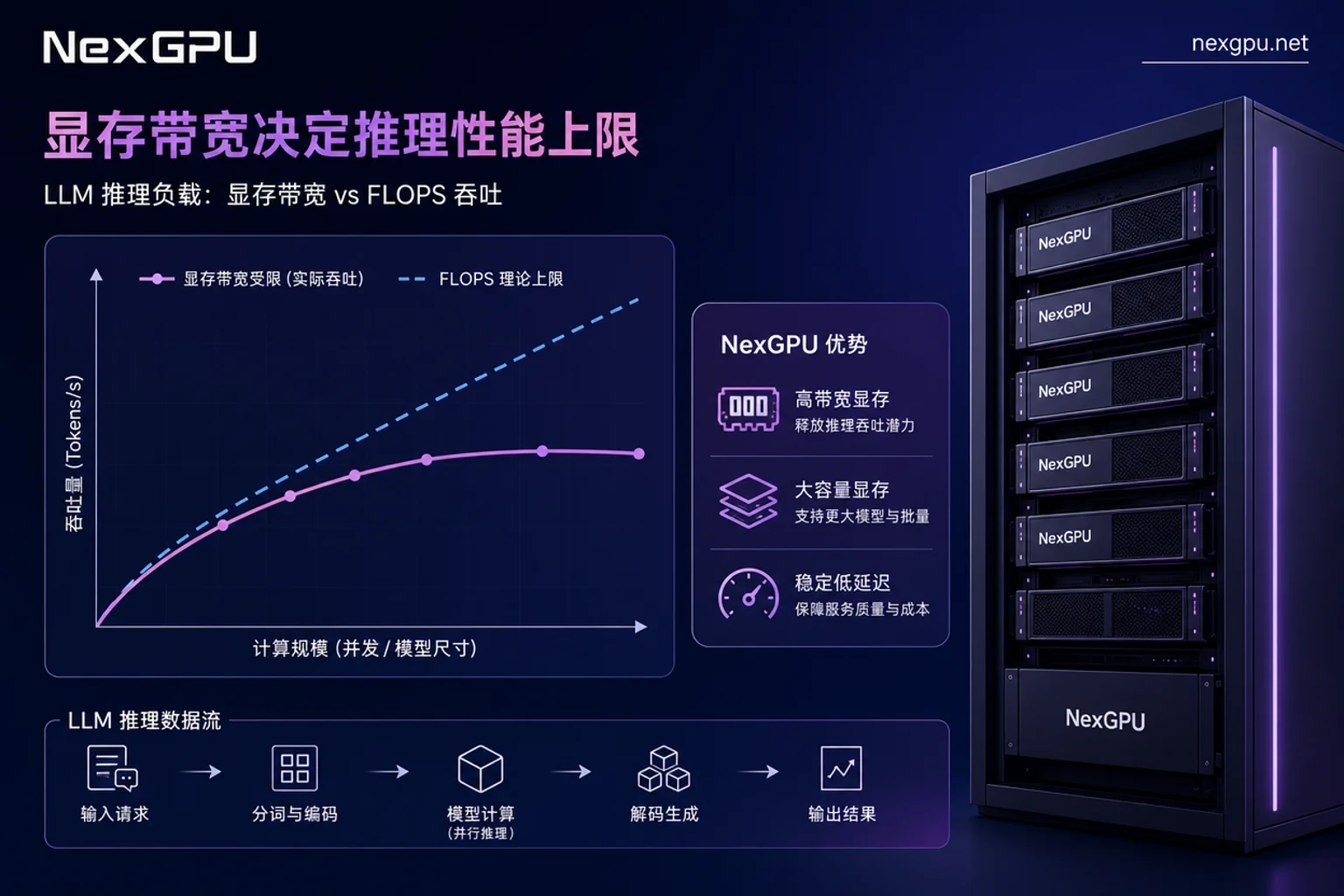
As AI large models transition from experimental R&D to full-scale production deployment, the demand for compute resources has undergone a fundamental shift. In the past, model training dominated GPU demand in data centers, with the core procurement metric being极致 floating-point performance (TFLOPS). Today, however, routine model inference and frequent fine-tuning constitute the primary compute expenditure, and VRAM capacity and memory bandwidth have become the critical bottlenecks determining service response latency and concurrent throughput.
Recent hardware and cloud service markets have seen several important updates. For instance, Supermicro has unveiled new AI server architectures featuring sixth-generation CPUs and AMD Instinct series GPUs, aimed at significantly boosting compute throughput and memory bandwidth rates. Meanwhile, research on cloud compute deployment for LLM inference points out that KV Cache management under high concurrency and multi-GPU interconnect topology are reshaping the economics of GPU cloud server rental. Developers choosing GPU cloud servers need to look beyond single-card benchmark scores and precisely match hardware to their specific business traffic patterns.
1. Decomposing the Core Bottlenecks of Inference and Training
To select the right GPU cloud server, it's essential to understand the performance bottlenecks in different scenarios:
- Low-concurrency/long-context inference (Memory-Bandwidth Bound): In low-concurrency (batch size 1-4) and long-context generation (128K+ tokens) scenarios, the GPU spends most of its time waiting for model weights to be loaded from VRAM to the compute units. Here, memory bandwidth directly determines the tokens generated per second.
- High-concurrency/large-batch inference (Compute Bound): When concurrent requests reach 32 or more, matrix multiplication operations increase, and the GPU becomes compute-bound. At this point, the FP8/FP4 compute density of Tensor Cores and the parallel optimization efficiency of inference engines (e.g., vLLM, SGLang, TensorRT-LLM) become key.
- KV Cache memory usage: In multi-turn conversations and long-text inference, KV Cache quickly consumes VRAM. Insufficient memory capacity can force the system to reduce maximum concurrency or perform frequent paging, causing severe response latency fluctuations.
2. Mainstream Cloud GPU Hardware Comparison
When evaluating GPU cloud server options, different hardware architectures vary in memory capacity, bandwidth, and cost focus:
| GPU Model | VRAM Capacity | Memory Bandwidth | Core Precision Support | Suitable Business Scenarios and Recommendations |
|---|---|---|---|---|
| NVIDIA B200 | 192GB HBM3e | 8.0 TB/s | FP4 / FP8 / FP16 | Inference for ultra-large parameter models and high-concurrency, ultra-dense generation; extremely high compute density at FP4 precision |
| NVIDIA H200 | 141GB HBM3e | 4.8 TB/s | FP8 / FP16 | Long-context large model inference and enterprise-grade efficient fine-tuning |
| AMD MI300X | 192GB HBM3 | 5.3 TB/s | FP8 / FP16 | Cost-effective large-memory deployment for open-source models (e.g., Llama 3/3.1 70B) |
| NVIDIA H100 | 80GB HBM3 | 3.35 TB/s | FP8 / FP16 | Production-grade standard LLM inference, complex Agentic AI, and medium-scale model training |
| NVIDIA A100 / L40S | 48GB-80GB | 864 GB/s - 2.0 TB/s | FP8 / FP16 / INT8 | Inference for small-to-medium models (8B-14B), quantization deployment, and edge/medium-concurrency API services |
For most small and medium-sized AI teams, outright purchase of top-tier hardware often involves significant capital pressure and depreciation risk. Renting GPU cloud servers on-demand has become the mainstream choice to balance deployment flexibility and compute costs.
3. Scenario Matching and NexGPU's Compute Support
In real-world deployment, NexGPU, as a professional GPU cloud compute and AI server rental platform, offers a variety of GPU server options to help developers quickly build a cost-effective runtime environment tailored to model size and concurrency needs.
- Prototype development and lightweight inference (7B-14B parameters): During initial validation, compute usage is uncertain. With NexGPU's pay-as-you-go and instant-start mechanisms, teams can flexibly use compute resources based on actual inference duration without the sunk cost of long-term fixed subscriptions.
- High-concurrency production deployment (70B+ parameters): For systems in production, high-tier nodes with high-bandwidth HBM memory can be selected. To help development teams quickly validate configurations, NexGPU also provides pre-built models and application templates, significantly shortening the preparation cycle from image construction to API service launch.
4. GPU Cloud Server Deployment and Cost Control Strategies
To avoid compute waste and improve cost-effectiveness per token, it is recommended to follow these best practices during deployment:
- Adopt quantization techniques wisely: Applying AWQ, GGUF, or FP8/FP4 quantization to FP16 models can halve memory usage with minimal precision loss, allowing larger models to run on smaller GPU nodes.
- Pair with high-quality inference engines: Using modern engines like vLLM or SGLang that support PagedAttention and Continuous Batching can significantly improve VRAM utilization and system throughput.
- Monitor KV Cache dynamics: During traffic peaks, monitor GPU memory utilization and request queue length in real time to prevent request timeouts caused by memory exhaustion.
Considering memory, bandwidth, and scalability flexibility comprehensively is key to building high-performance AI services. If you are planning your next AI inference or fine-tuning project, evaluate your compute requirements against the selection matrix in this article and conduct on-demand cloud validation to unlock model compute potential at minimal cost.



Comments(0)