 NexGPU-算力租赁,GPU服务器,GPU云算力,AI服务器租用-新闻博客
Why Serverless GPU Matters Now
AI inference and agent workloads suffer from fluctuating demand. Gpus sit idle and burn money during quiet periods, then queues explode during unexpected spikes. Traditional hourly instance rentals often see idle rates of over 50%. Serverless mode directly addresses this: GPUs are allocated only when requests arrive, automatically scale down to zero after use, and billing is per-second. Recent industry trends show this approach is moving from experiments to production, especially beneficial for small teams and early-stage products.
The core benefits are tangible. With no always-on instances, idle costs drop to zero. With proper cold start optimization, you can reduce time-to-ready from zero to a few seconds or tens of seconds. Streaming output, batch tasks, and fine-tuning jobs all run well. For agents with multi-turn conversations or tool calls, this intermittent pattern is a perfect fit—you don't keep models running continuously but spin them up as needed.
Of course, it's not a silver bullet. Steps like loading large model weights and CUDA initialization can stretch cold starts to 30-60 seconds. Users of real-time chatbots or voice assistants won't wait that long. So, you need to pick the right scenarios rather than applying it universally.
Where Cold Starts Really Get Stuck
Breaking it down, cold starts have several phases. First, container image pulling—LLM-related images often include CUDA libraries and dependencies, ranging from a few GB to over a dozen GB, which can take tens of seconds on slow networks. Then, model weights move from storage to GPU VRAM; a 7B model at FP16 is about 14GB of data, which takes seconds even on fast storage. Next, there's GPU driver and CUDA context initialization, plus framework startup, KV cache preallocation, and CUDA graph compilation. Adding these up, time-to-first-token easily exceeds 40 seconds, while warm instances generate tokens in tens of milliseconds. The gap is over a thousandfold, which destroys user experience.
Cross-referencing multiple sources confirms this. Platform-side tests and optimization case studies point to the same bottlenecks: image size, model loading path, and local caching. The issue is more pronounced for agents because request intervals in multi-turn loops are irregular, leading to repeated cold starts.
Practical Optimization: Cutting Cold Start Latency

Don't panic—there are proven strategies. Start with the image. Use multi-stage builds to strip out development tools and unnecessary dependencies, and choose a lightweight base image. Pre-download models into the image or mount network volumes rather than pulling them at runtime. Quantization is a game-changer: 4-bit or methods like AWQ/GPTQ can halve (or more) the weight size, reducing load time. Use formats like Safetensors or GGUF that support zero-copy, which are faster than pickle.
Layered caching is key. Prioritize local NVMe for model checkpoints, and use idle GPU VRAM for hot caches. Some research systems use multi-level loading to speed up cold starts by 6-8x, cutting large model load from tens of seconds to a few seconds. Predictive warm-up is also useful: based on historical traffic patterns, spin up instances before peak times. Set a minimum number of replicas for production critical paths to keep one or two warm instances, keeping idle costs manageable while stabilizing latency.
Your deployment flow can look like this: containerize your inference service (using engines like vLLM), attach quantized models. Configure auto-scaling with reasonable idle timeouts—not too short. During testing, simulate a burst from zero traffic to observe time-to-first-token and subsequent throughput. For agent scenarios, add a layer: tool execution and sandboxes can run on the CPU side, with GPUs only for model inference, reducing GPU residency.
Fine-tuning jobs are even better suited for serverless. Previously you'd have to start a cluster, worry about mid-run failures, and then handle deployment. Now you can directly submit jobs, which auto-terminate on completion, and self-deploy to the inference endpoint. For intermittent experiments or small dataset adaptation, costs are much lower.
Scenario Selection and Implementation
For batch processing, internal tools, and development/testing, prioritize serverless. Document processing, content generation, and weekly reports are latency-insensitive, making scale-to-zero most cost-effective. Agent background tasks or non-real-time multi-turn loops also work. For real-time user-facing chat, voice, or interactive coding assistants, use a hybrid approach: keep warm instances or an always-ready pool for the critical path, and use serverless as a safety net for spikes.
During implementation, pay attention to data privacy and networking. Cache model weights and user inputs locally or use encrypted volumes. Cross-region deployment can reduce latency, but factor in data transfer costs. Monitor key metrics like cold start ratio, P95 time-to-first-token, and GPU utilization. If utilization is low, adjust timeouts and warm-up strategies; if latency is high, add quantization or a warm pool.
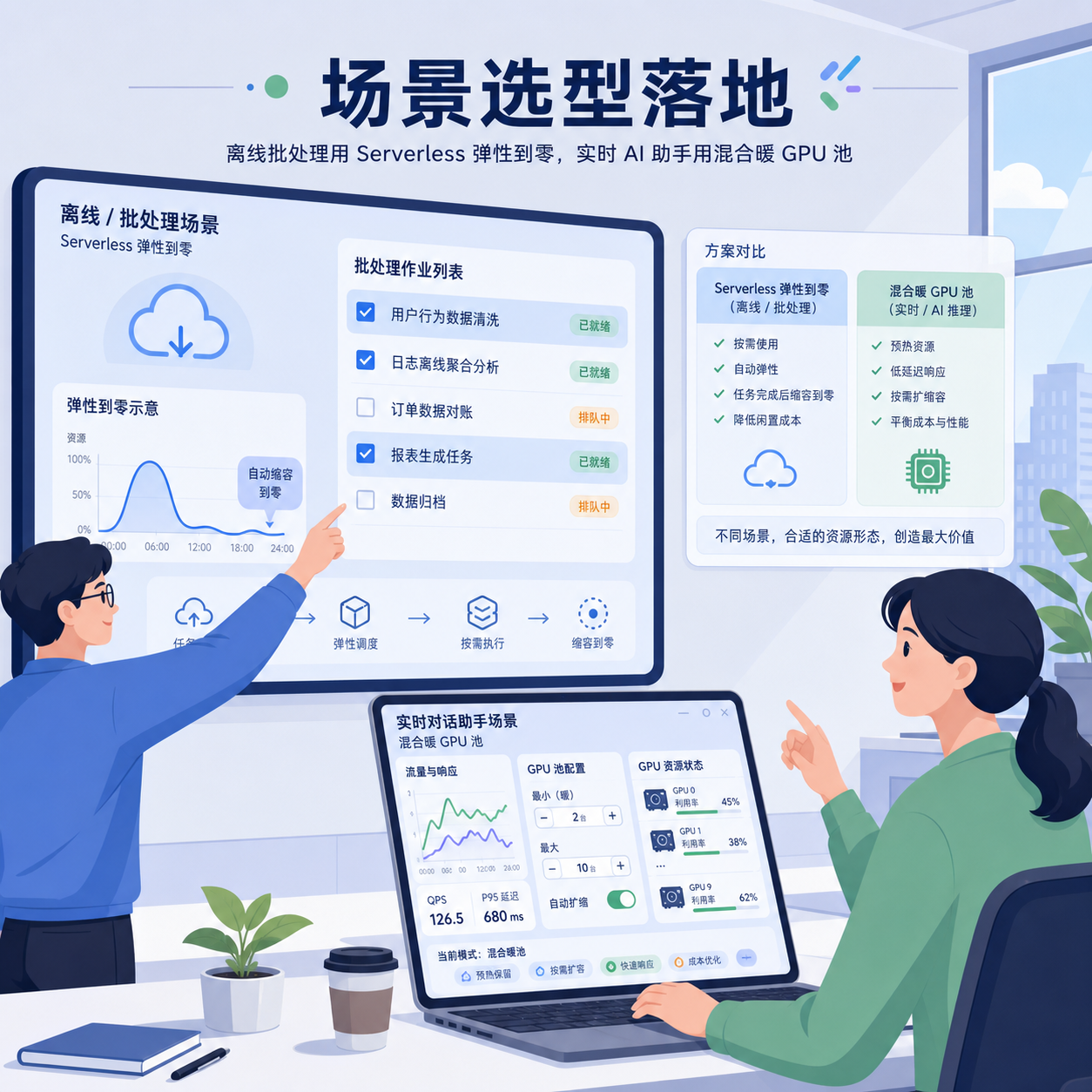
Platforms like NexGpu provide cloud computing power with flexible GPU rental, perfectly supporting such elastic scenarios. You can spin up instances for inference or fine-tuning on demand and release them when idle, without managing underlying drivers or clusters. Your team can focus on models and service logic rather than hardware ops. In practice, combining containers with auto-scaling, you can quickly get medium- to small-scale agent or inference services up and running.
Common pitfalls include assuming all workloads can scale to zero for free, ignoring the damage cold starts do to user experience. Not slimming down images, pulling from scratch every time. Deploying large models without quantization, causing load times to blow up. Running production with zero warm replicas, gambling on cold starts. And only looking at per-instance cost while ignoring retries from cold start failures and user churn in the total cost of ownership.
Elastic Play with Agents
Agents amplify demand fluctuations. Multi-turn loops, tool calls, and environment interactions have long request intervals but high peaks. Serverless fits well: inference requests occupy GPUs only when needed, and tool execution can be separated. Some practices decouple rollout from training, boosting GPU utilization from just over 40% to above 70%. With cloud elastic scheduling, the on-demand rental from NexGpu can quickly fill gaps—expand during spikes, shrink during lulls.
Practical advice: validate the chain with a small model first, then go live with quantization. Monitor traffic patterns and set predictive warm-up. Keep minimum warm instances for critical paths, and let the rest go serverless. Push batch fine-tuning or offline inference entirely to serverless. This way, you control costs while maintaining experience.
Overall, serverless GPU isn't a replacement for all traditional rentals but fills the gap for fluctuating and intermittent workloads. With proper optimization, idle crises are mitigated, and token costs are better controlled. Teams can start with platforms like NexGpu, first getting the elastic flow working, then adjusting the hot-to-cold ratio based on actual traffic, ensuring compute is used where it matters most. The start is simple, iteration is fast, and it's ideal for quickly validating AI applications.




Comments(0)