 NexGPU-算力租赁,GPU服务器,GPU云算力,AI服务器租用-新闻博客
The GPU rental market has been notably active over the past two weeks. Several providers have raised H100 term pricing, with the overall price curve shifting upward and flattening, moving from a steep backwardation to a tighter range. Data clearly shows that since early July, short, medium, and long-term rates have strengthened simultaneously. The market is no longer pricing in oversupply but persistent tightness. This isn't a random fluctuation—it's driven by real demand from the explosion of AI agent workloads.
Agents are no longer simple prompt-response models. They break down objectives into multiple steps, call tools, query databases, run policy checks, retrieve memories, and loop for verification. This pattern shifts heavy orchestration, execution, and security validation onto CPUs, with CPU-to-GPU ratios moving from 1:4-8 in early chatbots to 1:1 or even CPU-heavy. GPUs still handle core model computation, but overall system utilization is pushed higher, with inference and multi-turn loops consuming significant capacity. As a result, the rental market mirrors commodities like electricity or oil, with prices reflecting real-time supply and demand rather than one-sided supply shocks.
Compute is increasingly commoditized. Data platforms and exchanges are already collaborating on futures contracts based on GPU rental rates, enabling companies to lock in costs and hedge volatility. For large enterprises, this is an opportunity for arbitrage and rebalancing—capacity locked in at low prices earlier can now be flexibly released or shifted to newer hardware. For small teams and startups, long-term, large-scale commitments have become riskier: demand is hard to predict, and prices are moving. Fixed capacity often sits idle or falls short; on-demand elasticity is the solution.
This is where cloud GPU rentals shine. Platforms like NexGpu support rapid start/stop and flexible scaling, so you don't need to bet on peak usage six months out. You can rent instances suited to current workloads and release them immediately after tasks, tying costs to actual output. When the market tightens, elasticity helps you grab short-term available capacity, avoiding queues or high-premium long-term contracts.

But elasticity alone isn't enough; you need to squeeze out maximum per-hour utilization. Modern LLM inference is often limited by memory bandwidth and scheduling rather than pure compute. Standard attention generates massive intermediate matrices, slowing down HBM reads/writes; KV caches grow linearly with context and batch, quickly becoming the biggest VRAM hog. Focus on these key areas first:
Start with FlashAttention-style IO-aware kernels. They chunk QKV into fast SRAM, compute softmax incrementally, and avoid materializing the full attention matrix, drastically reducing memory traffic for long contexts and improving throughput. Next, manage KV cache efficiently—use PagedAttention to divide the cache into fixed pages, dynamically allocate like virtual memory in OS, supporting larger batches and longer sequences while facilitating cross-GPU sharding. Continuous batching is far superior to traditional request-level batching: new requests can be inserted mid-stream, keeping GPUs fully occupied and reducing idle periods.
Add speculative decoding in the generation phase. A small model drafts multiple tokens quickly, and the large model validates them in parallel, accepting multiple correct tokens in one forward pass, increasing token output speed and reducing latency. Quantization to FP8/INT8 or lower also reduces memory and improves bandwidth utilization, but don't rush to quantize—first optimize scheduling and caching, then adjust precision, to avoid pitfalls.
Common mistakes abound. Many focus on TFLOPS, ignoring GPU utilization dashboards, resulting in idle GPUs and wasted money. Others jump to aggressive quantization without solving KV explosion or naive batching, leading to unstable performance. In agent scenarios, system prompts and prefixes are highly repetitive, yet prefix caching or semantic caching isn't enabled, wasting computation on redundant work. For long contexts, some just add VRAM without optimizing scheduling, still suffering from poor TTFT (time-to-first-token).
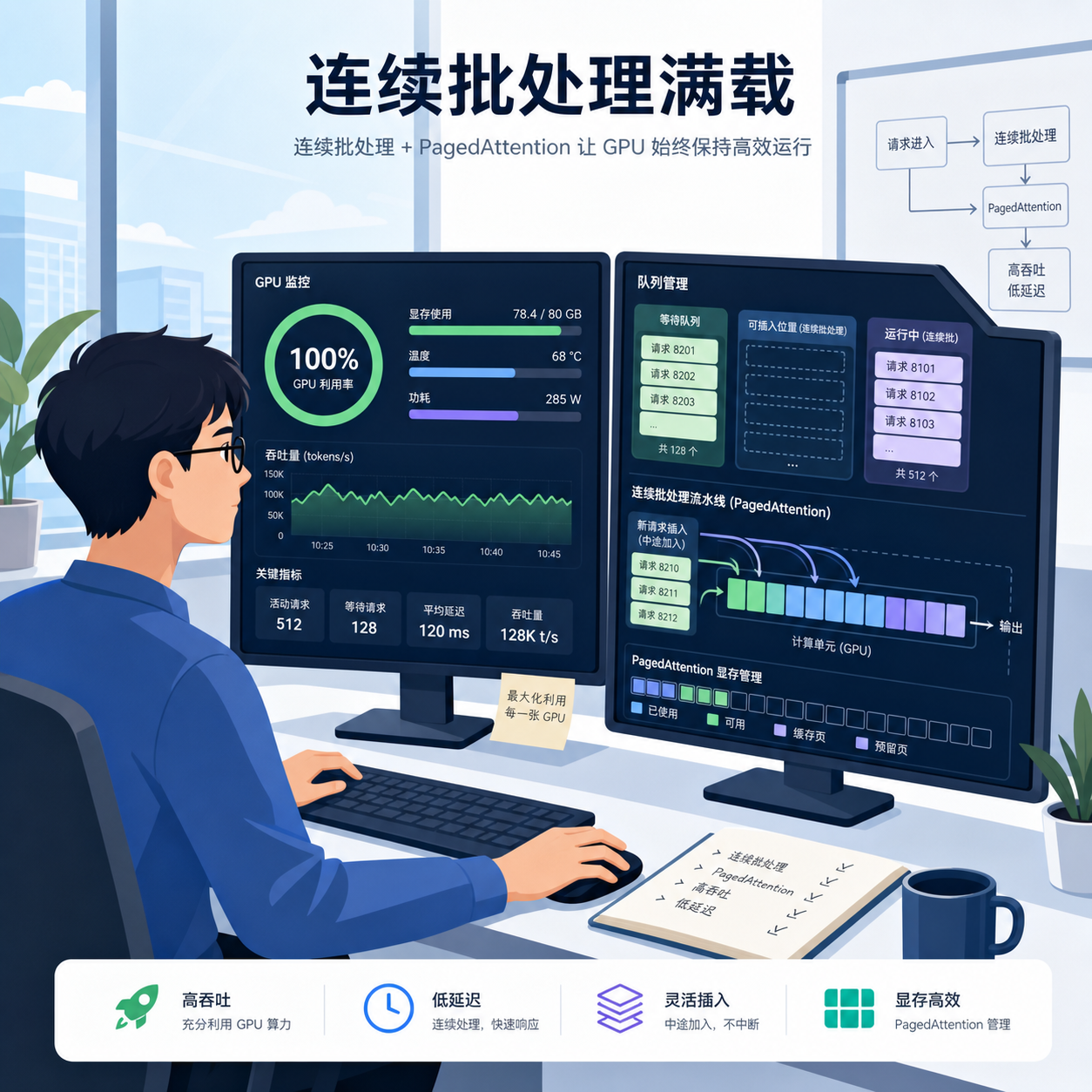
Here's a step-by-step approach. First, use Nsight or the framework's profiler to identify bottlenecks: memory stalls, bandwidth saturation, or scheduling idle. Second, choose a serving engine that supports PagedAttention, continuous batching, and speculative decoding (e.g., mainstream open-source inference frameworks), and configure sensible max model len and gpu memory utilization. Third, enable prefix caching to cache common system prompts; for multi-turn agents, consider offloading KV to high-speed storage to speed up first token. Fourth, implement dynamic batching with request priority queues, monitoring tokens/sec, P99 latency, and actual utilization. Fifth, combine with elastic rental: use multiple GPUs or high-performance instances during peaks, scale down to minimum during troughs, or even scale-to-zero, paying only when active.
Deploying such an optimization stack on NexGpu is straightforward—prepare the image and environment, launch with one click, and adjust instance count based on traffic. Teams don't need to build their own clusters or worry about cooling and networking, freeing them to focus on business logic and prompt engineering. In real cases, after continuous batching and caching optimization, throughput can double on the same hardware, significantly reducing cost per token, offsetting the pressure of rising rental rates.
The market will continue to fluctuate, and agent applications will only demand more compute. Instead of betting on price drops or hoarding your own hardware, use elastic cloud GPUs to shift risk, and optimize the software stack. Higher utilization means more experiments and more users served with the same budget. Start profiling your workloads now, try continuous batching and caching, and pair that with flexible rentals—you'll find that even a tightening market hides efficiency gains.




Comments(0)