 NexGPU-算力租赁,GPU服务器,GPU云算力,AI服务器租用-新闻博客
Compute Is Starting to Feel Like Oil
The most striking change in the GPU rental market over the past two weeks isn't a new card launch, but a sudden maturation of price discovery. Prediction market platforms have introduced GPU compute forward curves based on their own trading data, covering B200, H200, and A100, directly providing the market's implied expectations for hourly rental prices over the coming weeks to months. This kind of tool previously existed only in mature commodities like crude oil and natural gas. Now, compute is being treated similarly.
In simple terms, the forward curve isn't a directly tradable contract, but it consolidates fragmented bilateral quotes into a shared "view of future prices." Buyers can use it to judge whether locking in current prices is appropriate, and sellers can price their inventory accordingly. Some have compared this to an early-stage NYMEX for compute—moving from pure over-the-counter negotiation toward a benchmarked, hedgeable direction. Meanwhile, other exchanges are exploring compute futures, indicating this isn't an isolated phenomenon but part of a broader market shift toward commoditization.
On the spot market, B200 remains scarce. Latest monitoring shows its spot price ranges from roughly $5.98 to $6.34 per GPU hour, 130% to 140% higher than H100, with few cloud platforms offering it and supply highly concentrated. The curve itself also shows short-term dips—some data points mention implied prices dropping about 30% within a month—but overall it still reflects a "supply tightness" premium. For actual users, this means: don't just look at today's spot price; incorporate expectations for the coming months into your planning.
Utilization Is the Real Decisive Factor
With price transparency, decisions become more complex. Because many people's cards aren't running at full capacity. Industry audits repeatedly mention that enterprise GPU average utilization hovers around 5%. Gartner estimates AI infrastructure spending in the hundreds of billions of dollars, but the proportion of actual useful tokens produced is shockingly low. For every dollar spent on silicon, 95 cents might be idle. This isn't a tuning issue; it's a structural and procurement inertia problem—during the FOMO era, three-to-five-year capacity was locked in, now depreciation is running, and CFOs are starting to pay attention.
Buy or rent? The core depends on sustained utilization. Rough framework: if sustained utilization is below 50%, cloud is almost always more cost-effective; above 75-80%, with scale of 50+ cards and a three-year outlook, self-hosting or long-term ownership starts to win. Most institutional clusters actually run between 40% and 70%, so the case for "buying" often requires improving utilization first, rather than committing to hardware upfront.
Specific numbers vary with scale and whether idle capacity can be monetized. For a single card, around 70% is the critical point without monetization; for a hundred-card cluster, it's a bit higher, at 75-80%. If you can sell idle hours on an open market as inference capacity, the threshold drops by about 15 percentage points to around 60%. Reserved cloud (especially 1-3 year reservations from long-tail or specialist providers) is already priced close to the effective cost of self-hosting, minus the operational burden. For most teams, reserved cloud is the default option for 2026.
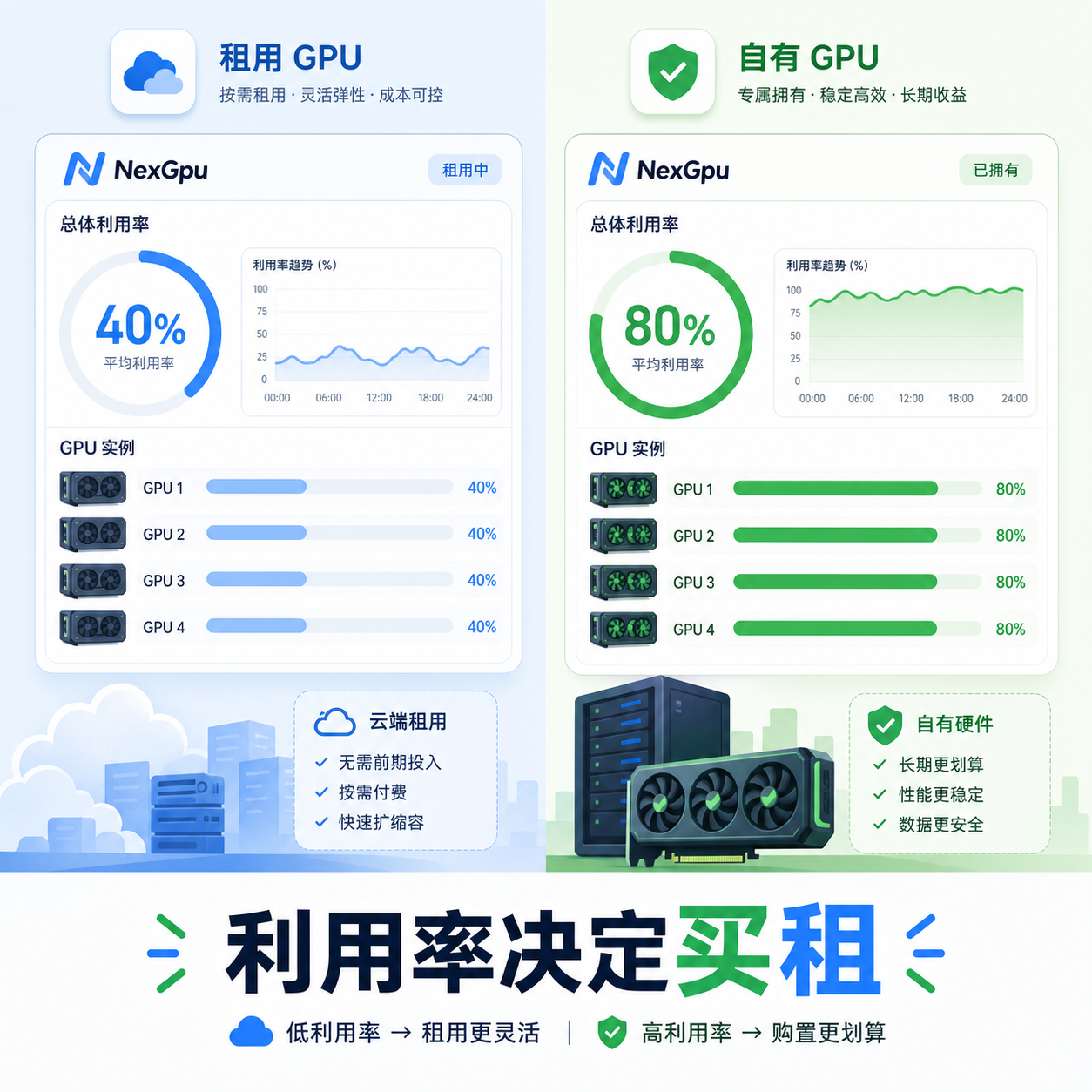
Don't forget real operational costs. A hundred-card cluster needs at least 1.5 full-time infrastructure people plus on-call, and vendor support contracts. Small teams (under 20 cards) should almost never buy; operational overhead can't be amortized, and capital is more precious. Workloads with strong cross-generation needs should also prefer renting to facilitate card upgrades.
How to Implement: From Curve to Hybrid Strategy
First, measure your utilization properly. Don't just look at "is the card on," but useful hours—time actually producing tokens or completing training steps. Many teams see decent activity rates but low production efficiency due to network, storage, KV cache, and scheduling bottlenecks. RDMA, shared KV caches, and better scheduling can squeeze out "waiting for data" time, directly raising effective utilization.
Second, compare the forward curve with spot prices. If the curve shows a clear upward trend over the coming months, and your load is relatively predictable, consider locking in some reserved capacity. Conversely, if the curve is declining or volatile, rely more on on-demand or spot, leaving flexibility for uncertain parts. For new cards like B200 with concentrated supply and high premiums, use the curve to decide whether to rush in or wait.
Third, break down by scenario. Early-stage startups with 4-10 cards and fluctuating loads: go straight to on-demand or short-term reservations, avoid self-hosting. Growth-stage teams with 20-50 cards and stable production loads: 1-year reserved cloud as the base, reassess annually. Those already at 100+ cards with stable utilization above 75%: self-host the main cluster plus cloud for peaks, and try to monetize idle capacity. Research or intermittent high-intensity loads: long-tail on-demand with spot, tolerate interruptions to save significantly. Compliance or data sovereignty requirements: may force self-hosting or choosing certified cloud providers. Cheap electricity resources: self-hosting advantages are immediately amplified.
Hybrid is the norm. Use reservations for baseline (can cut costs 30-50%), spot for batch processing, on-demand for bursts. Well-executed deployments can achieve 40-60% lower total costs than pure on-demand. The key is to avoid a one-size-fits-all approach, and don't over-provision for three years just because "cards are hard to get now."
Platforms like NexGpu are great for the elastic side—start/stop on demand, quickly switch between different specs, helping you minimize idle for the variable part. For your main stable load, lock in some reservations, and for peaks and experiments, use NexGpu's elastic pool, making your overall utilization look much better. Don't expect a single model to work for everything.

Common Pitfalls and How to Avoid Them
The biggest pitfall is FOMO over-provisioning. In the past, "lock in first, think later," now the reality of 5% utilization hits hard. The second is ignoring operational and electricity costs. Self-hosting may look good on paper, but insufficient staffing, high electricity bills, and slow fault handling can double effective costs. The third is looking only at spot prices and ignoring the curve. Short-term bargains can be traps; if the curve signals a rebound, later purchases will be more expensive. The fourth is confusing "activity" with "production." Cards are running, but token output is low, so unit costs remain high.
Practical advice: review real useful hours weekly/monthly; archive forward curve screenshots to compare against your decisions; start with a one-month hybrid run at small scale before scaling up; don't lock reservations too tightly—1 year is better than 3 years unless your load is super stable and generation-insensitive. Blackwell is still ramping up, so over-locking older-generation cards carries technical depreciation risk.
For small and medium teams, the friendly approach is: don't shoulder all operations yourself; use cloud elasticity to bring utilization into a reasonable range, while using the curve for mid-term price judgments. NexGpu fits naturally in this scenario—you focus on models and business, it turns compute into a pay-as-you-go resource, reducing the embarrassment of "buying but idle."
What to Watch Next
Commoditization is just beginning. The curve will become denser, and hedging tools will follow. Price volatility won't disappear, but transparency will make decisions more rational. First, get a clear picture of your utilization, then use the curve as a navigation aid, and hybrid leasing will suffice. Don't wait for perfect tools; you can start optimizing now. When your load changes, adjust your strategy—that's how cloud GPU should truly be used.



Comments(0)