 NexGPU-算力租赁,GPU服务器,GPU云算力,AI服务器租用-新闻博客
In mid-July, a new tool emerged in the GPU compute market: the market-implied forward price curve officially went live. At the same time, Japan launched the world's first national-level physical AI infrastructure, planning 27,500 Rubin GPUs in one go. For newcomers, these aren't distant news—they're signals that directly affect your compute rental decisions. Prices are no longer just about today's spot rates; you can now see market expectations ahead of time. Let's break it down in FAQ form.
What is a GPU compute forward curve, and why should beginners care?
Simply put, a forward curve is a collective expectation graph of future GPU compute prices. It's not a price list from a single cloud vendor, but an aggregation of data from prediction markets. Participants use real money to bet on "whether a specific GPU model will be above a certain price at the end of a given month," and then the data from multiple durations and price points is pieced together into a curve.
Around July 14, such markets covered mainstream models like B200, H200, and A100. Previously, compute rental only looked at spot prices—whatever you pay today is the price, with high volatility and poor planning. Now the curve tells you: does the market think H100 will loosen up next month? Will the price gap between B200 and H200 widen or narrow? This directly helps you decide whether to try short-term rentals or lock in medium-term capacity.
For beginners, the most useful aspect is transparency. Prices used to rely on asking around, comparing, and guessing; now there's a public signal. Combined with July industry data, H100 80GB spot prices are roughly in the $2–$11 per hour range, while A100 80GB is lower, around $1–$5. The curve adds a time dimension to these numbers.
How to use forward signals in compute rental to avoid blind decisions
Don't treat the curve as absolute truth—it's expectations and will change. But as a reference, it's sufficient.
First, look at the short-term end (a few weeks out). If the curve shows near-term prices are high and supply is tight, prioritize on-demand instances for small-scale experiments rather than jumping into long-term contracts. Conversely, if the curve hints prices will drop, you can use cheaper GPU models to run your pipeline first, then scale up once the signal confirms.
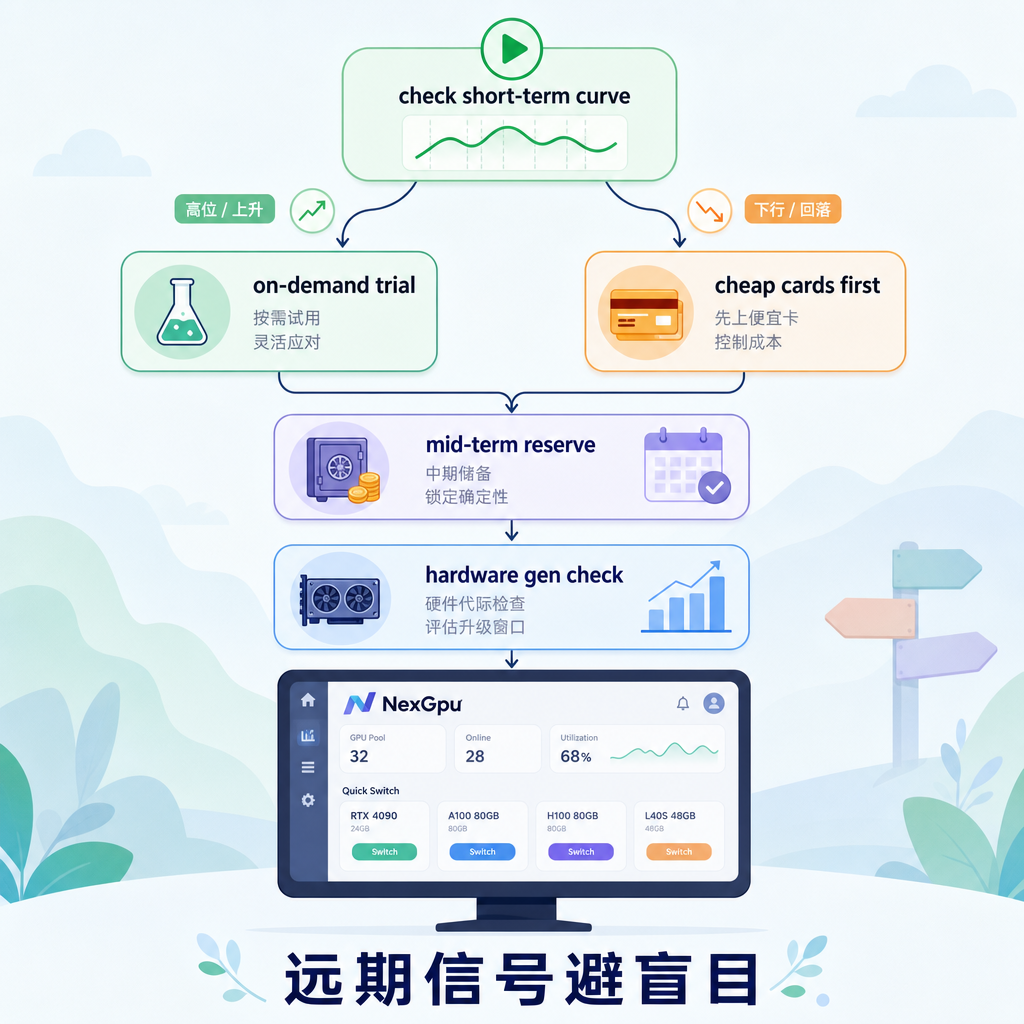
The medium-term end (one to two months) is better for planning training or inference peaks. For example, model fine-tuning requires several consecutive days of high intensity; if the curve shows supply will improve around that time, reserve capacity in advance instead of scrambling at the last minute.
Consider hardware generations. Vera Rubin has entered full production, but initial supply mostly goes to big players and specific projects. The curve reflects this stratification: new cards may be expensive and scarce in the forward market, while older cards (H100, A100) might loosen due to substitution effects. Beginners shouldn't fixate on the latest chips—first assess your actual needs for VRAM and compute power.
On platforms like NexGpu, you can spin up instances by the hour or by task, and quickly switch card types or scale based on curve signals, without being tied down by long-term contracts.
What practical impact does Japan's 27,500-GPU Rubin factory have on regular users?
Officially announced on July 16, this project is the core of the government-backed FRONTia plan. Led by Noetra, it features 27,500 Rubin GPUs plus 13,750 Vera CPUs, with a total power of 140 MW, based on NVL72 racks and accompanying networking. The goal isn't commercial cloud resale but training open multimodal foundation models for physical AI (robotics, digital twins, manufacturing, logistics). Pretrained weights will be open to Japanese developers.
The indirect impact on the global compute rental market is more noteworthy. Large-scale deployment of next-gen cards will accelerate production ramp-up, helping to ease overall supply pressure in the long run. In the short term, it might make existing Hopper and Blackwell cards more flexible in the secondary market or rental segment—big players free up some old resources. The demand split between physical AI and general inference/training also means inference-optimized cards will see concentration, while training still relies on high-bandwidth VRAM.
Beginners don't need to wait for this factory to come online (expected to ramp over the next few years); you can start with existing GPU models now. But remember: new capacity prioritizes national and large clients, so regular tenants still depend on cloud elastic pools. Market reports show the GPU rental market has reached a multi-billion-dollar scale in 2026, with competition widening price ranges and reliability becoming a new threshold.
Four practical checkpoints for compute rental newcomers
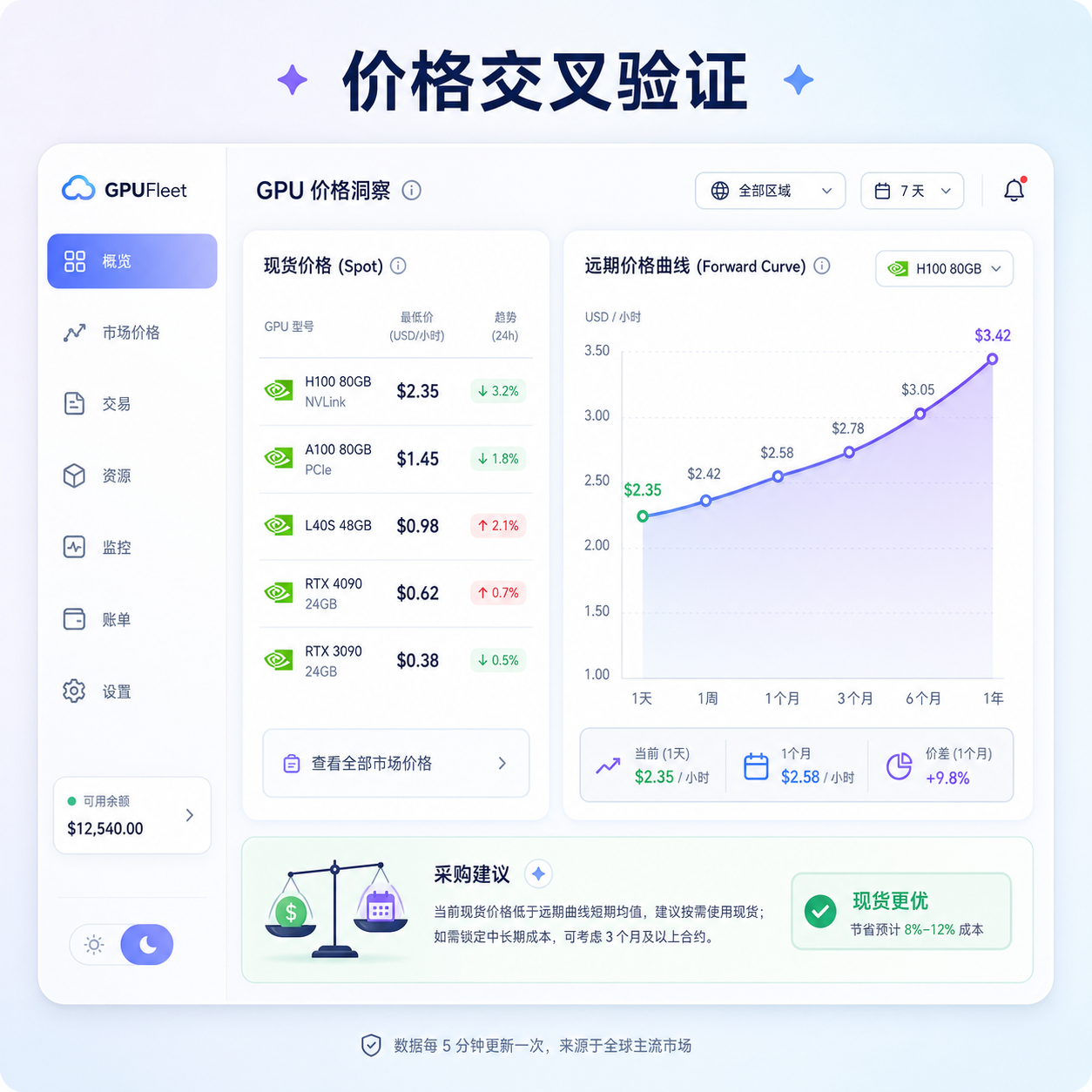
- Task decomposition: Start with smaller GPUs (like A100 or lower) to validate code and data pipelines, ensuring VRAM and throughput are sufficient before scaling up to larger cards. Don't jump straight into full-scale training.
- Price cross-validation: Look at today's spot rate, then compare with the slope of the forward curve. If the curve is steeply declining, lean toward short-term rentals + observation; if stable or rising, consider moderate reservation.
- Supply stratification awareness: The latest cards have long queues and high prices; mature models often offer better availability and cost-effectiveness. Switching on demand is more cost-effective than sticking to one generation.
- Elasticity first: Choose platforms that support second-level start/stop and pay-as-you-go. On NexGpu, you can scale up or down anytime, adjusting the moment curve signals change, avoiding idle waste.
These checkpoints sound basic, but many beginners get stuck in "impulsively renting new cards" or "panicking at price fluctuations." The forward curve plus major deployment news gives you a calm external reference.
How will the forward curve and factory news change daily usage?
In the short term, price discovery moves from "bilateral negotiation + opacity" toward "public expectations," maturing like energy or metal markets. When budgeting, you can include a "market expectation range" rather than just calculating based on the current highest price.
In the medium term, new architectures like Rubin will push token costs lower, but access barriers remain high. Regular teams can continue using current-generation GPUs for inference and fine-tuning, which is still cost-effective. Rental models will become more granular: products based on tokens, tasks, and elastic pools will multiply.
For newcomers, the most direct change is decision rhythm. Previously you relied on experience or friend recommendations; now you can glance at the curve and supply news weekly to decide what GPUs to use and for how long. NexGpu's on-demand model fits this rhythm perfectly—fast to spin up, fast to stop. When the curve tells you whether to charge ahead or wait, you execute immediately.
Treat these signals as tools, not noise. The price curve helps you see direction; the big factory news helps you see supply structure. The rest is just running your first small task. Compute rental is no longer a black box—beginners can learn by doing.


Comments(0)